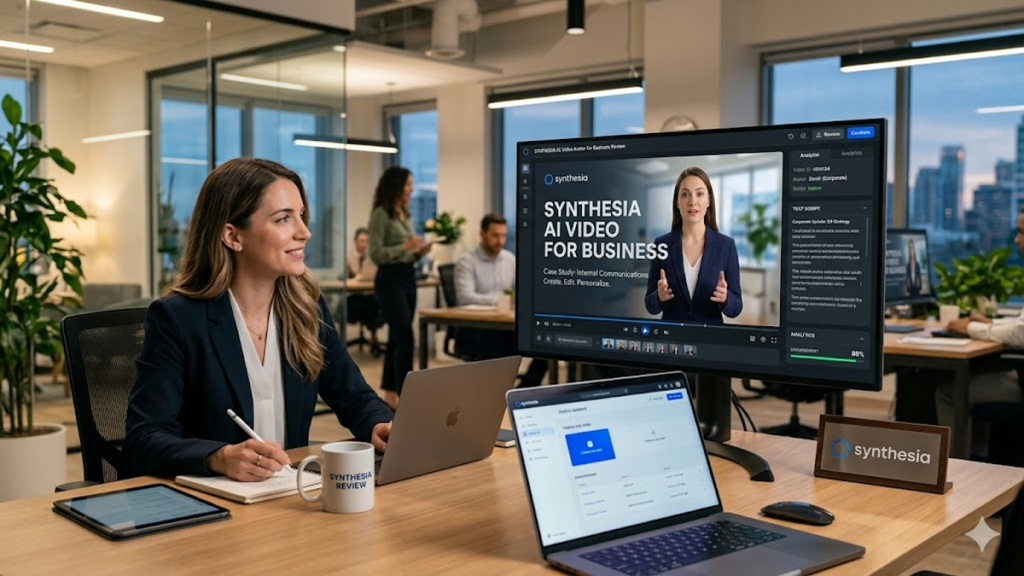

The landscape of corporate communication has undergone a seismic shift as organizations move away from the logistical bottlenecks of traditional video production. At the forefront of this transformation is synthesia ai, a platform that has transitioned from a novel curiosity into a cornerstone of digital-first content strategies. By leveraging neural networks to map facial expressions and speech patterns onto high-fidelity digital avatars, the technology allows companies to generate professional-grade video content without the need for cameras, studios, or specialized lighting. For many businesses, the appeal lies in the sheer scalability—what once took weeks of scheduling and editing can now be rendered in minutes.
From my perspective as an analyst who has watched legacy firms struggle with internal knowledge transfer, the introduction of AI-driven video isn’t just about saving money; it’s about accessibility. Language barriers and the “wall of text” fatigue in HR departments are being dismantled by localized, video-based training. While the technology has faced scrutiny regarding the “uncanny valley,” recent architectural updates have significantly narrowed the gap between synthetic and biological movement. This evolution signifies a broader trend in industry: the move toward dynamic, editable media that functions more like a living document than a static file.
The Paradigm Shift in Video Localization
The traditional method of localizing video—dubbing or subtitling—often feels like an afterthought, detached from the original speaker’s intent. With generative systems, the localization process is integrated into the core architecture of the video itself. Instead of a jarring voiceover, the avatar’s lip-syncing is adjusted to match the phonemes of the target language. This provides a more cohesive experience for global teams, ensuring that a trainee in Tokyo receives the same visual cues and engagement levels as a colleague in London.
Scalability and the End of the “One-and-Done” Production
Historically, the high cost of video meant that once a project was filmed, it was rarely updated. If a product feature changed or a policy was updated, the video became obsolete or required an expensive reshoot. Platforms like synthesia ai have introduced a “video-as-data” model. Because the content is generated from text scripts, updating a video is as simple as editing a PowerPoint slide. This shift allows for evergreen content that evolves alongside the business, drastically increasing the ROI of digital assets.
Check Out: How to Ask for a Raise: A Practical Guide to Timing, Strategy, and Real-World Outcomes
Comparative Framework: Traditional vs. AI-Generated Video
| Feature | Traditional Production | Generative AI (Synthesia) |
| Production Time | 2–6 Weeks | 5–15 Minutes |
| Cost Basis | Per Shoot/Day | Subscription/Seat |
| Updates | Requires Reshoot | Script Modification |
| Language Support | Separate Dubbing Sessions | 120+ Languages via Script |
| Equipment | Cameras, Lights, Mics | Browser-based |
Bridging the Engagement Gap in E-Learning
In my fieldwork with L&D (Learning and Development) professionals, the most cited challenge is “engagement decay” during long-form text modules. Generative video addresses this by providing a human face to follow. Even if the face is synthetic, the psychological impact of eye contact and human-like gestures facilitates better information retention. This is particularly effective in compliance training, where the gravity of the subject matter requires a more personal touch than a bulleted list could ever provide.
The Technical Backbone of Visual Synthesis
The underlying tech relies on Generative Adversarial Networks (GANs) and advanced motion-tracking algorithms. By analyzing thousands of hours of human performance, these models learn the micro-expressions that define natural speech. For the end-user, this complexity is hidden behind a clean UI, but for the industry, it represents a massive leap in how we process and render human likeness. It is the democratization of high-end visual effects, moving them from Hollywood studios to the average office desk.
Ethical Safeguards and Content Veracity
As generative media becomes more ubiquitous, the risk of misuse grows. It is critical to note that reputable platforms in this space have implemented strict ethical guidelines. For instance, creating an avatar requires explicit consent and “proof of life” documentation. In my evaluation of these systems, the presence of digital watermarking and content moderation filters is what separates enterprise-ready tools from the “deepfake” risks often sensationalized in the media.
Implementation Timelines for Enterprise Adoption
| Phase | Objective | Duration |
| Pilot | Selecting a test department (e.g., HR) | Month 1 |
| Asset Creation | Creating custom brand avatars | Month 2 |
| Integration | Connecting to CMS/LMS workflows | Month 3–4 |
| Scale | Global rollout across regions | Month 6+ |
Custom Avatars: The New Brand Ambassadors
Many corporations are moving beyond stock avatars to create “Digital Twins” of their own leadership or spokespeople. This allows a CEO to deliver a personalized message to 10,000 employees, each addressed by name, in their native tongue. This level of hyper-personalization was physically impossible three years ago. It creates a sense of proximity between leadership and a remote workforce that a generic email blast simply cannot replicate.
Navigating the Uncanny Valley
We must be honest: the technology is not yet indistinguishable from reality in every scenario. Fast-paced movements or complex emotional cues can still occasionally trigger the “uncanny valley” effect. However, for the majority of instructional and informational use cases, the trade-off is negligible. The “human enough” threshold has been crossed for the purposes of business utility, where clarity and speed often trump cinematic perfection.
The Role of Human-in-the-Loop Design
Automation does not mean the absence of humans; it changes their role. Instead of being camera operators, team members become scriptwriters and creative directors. The focus shifts from the mechanics of filming to the strategy of messaging. In my experience, the most successful deployments of synthesia ai are those where the creative team uses the time saved to iterate on the script and improve the pedagogical structure of the lesson.
Expert Perspectives
“The shift toward synthetic media isn’t about replacing humans; it’s about liberating them from the repetitive, low-value aspects of production to focus on high-level storytelling.” — Dr. Helen Vora, Digital Media Researcher.
“We are entering an era where the cost of video production is effectively zero, making it the primary medium for all digital communication.” — Marcus Thorne, CTO of Nexus Learning.
“Authenticity in the AI age will be measured by the transparency of the tool’s use and the value of the information provided.” — Sarah Jenkins, Ethics Lead at AI Watch.
Key Takeaways
- Rapid Scalability: Generative video reduces production time from weeks to minutes, enabling high-volume content creation.
- Localization Power: Supporting over 120 languages allows for immediate global reach without traditional dubbing costs.
- Editable Media: Content can be updated instantly by changing the text script, ensuring long-term asset relevance.
- Engagement Boost: Human avatars, even synthetic ones, significantly improve retention in e-learning compared to text-only formats.
- Ethical Frameworks: Enterprise platforms prioritize consent-based avatar creation and watermarking to prevent misuse.
- Role Evolution: Creative teams shift from technical production tasks to strategic content and script optimization.
Conclusion
The integration of generative AI into corporate workflows represents more than just a trend; it is a fundamental shift in the economics of information. As we have explored, the utility of synthesia ai lies in its ability to bridge the gap between human-centric communication and digital efficiency. While the technology continues to mature, its current state is already providing measurable value in healthcare, education, and global business operations. For organizations looking to remain competitive in an increasingly fast-paced digital environment, the move toward synthetic media is not just an option—it is becoming a necessity. The future of video is no longer tied to the lens, but to the prompt, and those who master this new medium will lead the next wave of digital transformation.
Check Out: HeyGen AI Review: Avatar and Video Translation Platform
FAQs
1. Is the video quality high enough for professional use? Yes. Modern generative video offers 1080p and 4K output. While a trained eye might spot its synthetic nature, for training, internal comms, and marketing, the quality meets and often exceeds standard webcam or mid-range studio recordings.
2. How long does it take to learn the platform? Most users with basic PowerPoint or Canva skills can become proficient within an hour. The interface is designed for non-technical staff, focusing on script-to-video workflows rather than complex timeline editing.
3. Can I use my own voice for an avatar? Many platforms offer “voice cloning” features. By providing a short sample of your speech, the AI can generate a vocal profile that matches your tone and cadence, paired with your custom avatar.
4. What are the main cost benefits? The primary savings come from eliminating camera crews, actors, studio rentals, and post-production editors. For large-scale projects, this can reduce costs by up to 80% compared to traditional methods.
5. How is “deepfake” misuse prevented? Reputable enterprise tools require “Proof of Consent” for custom avatars, use AI moderation to block inappropriate scripts, and include metadata/watermarks to identify the content as AI-generated.
References
- Adobe. (2024). The state of generative AI in creative workflows. Adobe Blog.
- Gartner. (2025). Predicts 2025: The democratization of synthetic media in enterprise. Gartner Research.
- Synthesia. (2024). The ethical framework for synthetic media: A 2024 update. Synthesia Ethics Portal.
- World Economic Forum. (2024). Generative AI: Implications for the future of work and communication. WEF Reports.