
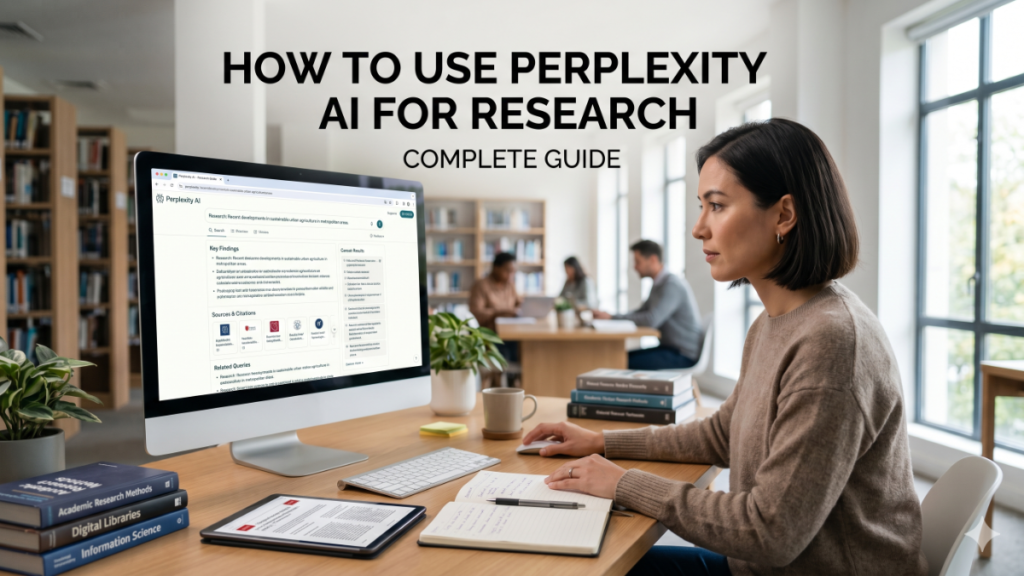

The landscape of digital inquiry is undergoing its most significant transformation since the indexed web began. For years, we have been conditioned to sift through pages of blue links, dodging advertisements and SEO-optimized fluff to find a kernel of truth. Today, the demand for immediacy and accuracy has given rise to the “answer engine.” At the forefront of this shift is a tool that synthesizes the vastness of the internet into direct, cited responses. Learning how to use Perplexity effectively is no longer just a technical curiosity; it is a fundamental shift in digital literacy. By combining large language models with real-time web indexing, it provides a bridge between the creative potential of AI and the grounded reality of verifiable facts.
In my years analyzing industry workflows, I’ve observed that the primary bottleneck in decision-making isn’t a lack of data, but the time required to validate it. During a recent consultancy for a healthcare provider, we tested several tools to aggregate recent clinical trials. Perplexity stood out not just for its speed, but for its transparency. Unlike traditional LLMs that might confidently “hallucinate” a citation, this platform forces a direct link between the generated prose and the source material. This transparency is the cornerstone of professional adoption, moving AI from a “toy” phase into a critical component of the modern industrial tech stack.
Defining the Conversational Search Experience
To understand the core mechanics, one must look at how the interface differs from a standard search bar. While Google looks for keywords, Perplexity looks for intent. The system utilizes a “Pro Discovery” mode that mimics a human researcher by asking clarifying questions before it begins its deep dive. This iterative process ensures that the output is aligned with the user’s specific constraints, whether they are looking for a technical white paper or a simplified summary.
Core Feature Comparison
| Feature | Traditional Search | Perplexity AI |
|---|---|---|
| Primary Output | List of relevant URLs | Synthesized narrative answer |
| Verification | User must click and verify | Inline citations provided |
| Context | Single-turn query | Multi-turn conversation |
| Focus | Ad-revenue/Traffic | Information accuracy |
Crafting High-Intent Research Queries
The quality of your output is strictly gated by the quality of your input. When considering how to use Perplexity for high-stakes projects, the “act-as” prompting method remains king. By assigning the AI a persona—such as a market analyst or a biological researcher—you signal the depth and tone required for the response.
“The shift from keyword searching to intent-based inquiry represents the first true evolution in how humans interact with the collective knowledge of the internet.” — Dr. Arash Ferdowsi, Data Systems Researcher.
I often find that users treat the tool like a simple calculator when they should be treating it like a junior research assistant. Instead of asking “What is 5G?”, ask “Analyze the deployment challenges of 5G infrastructure in rural Appalachia between 2022 and 2024, citing telecommunications reports.” This specificity triggers the model to bypass generalities and dig into specific PDFs and news archives.
Navigating the “Pro” and “Basic” Divide
While the free tier is remarkably capable, the Pro version introduces a level of granularity essential for enterprise-level tasks. Pro users can toggle between different underlying models, such as Claude 3.5 Sonnet or GPT-4o, depending on whether they need creative synthesis or rigid logical deduction. Furthermore, the “Pages” feature allows users to convert a long-form research thread into a beautifully formatted, shareable article.
Model Performance for Specific Tasks
| Task Type | Recommended Model | Why? |
|---|---|---|
| Data Analysis | GPT-4o | Superior logical reasoning and table formatting. |
| Nuanced Writing | Claude 3.5 Sonnet | More “human” prose and better stylistic control. |
| Speed/Briefs | Sonar (Default) | Optimized for rapid retrieval and low latency. |
Utilizing the “Focus” Tool for Specialized Discovery
One of the most underutilized features is the “Focus” button. By default, the AI searches the entire internet, which can occasionally lead to a “noise” problem. By narrowing the focus to “Academic,” the tool prioritizes peer-reviewed journals and repositories like ArXiv. This is a game-changer for those wondering how to use Perplexity for literature reviews or technical verification.
During a project evaluating renewable energy adoption, I switched the focus to “Social” to gauge public sentiment on Reddit and X, then immediately flipped to “Academic” to see if the public’s concerns were mirrored in the scientific literature. This multi-modal approach to a single topic allows for a 360-degree view that traditional search simply cannot replicate without hours of manual tab-switching.
Integrating Files and Images into the Workflow
The ability to upload files—PDFs, CSVs, or images—transforms the tool from a search engine into a document analyst. You can upload a 50-page annual report and ask the system to “find the discrepancy between Q2 and Q3 marketing spend as mentioned in the footnotes.”
“We are moving away from ‘search’ as a destination and toward ‘synthesis’ as a service.” — Marcus Thorne, AI Infrastructure Architect.
This multimodal capability means you can also use vision-based queries. If you take a photo of a complex machinery part and ask for its maintenance manual, the AI identifies the object and retrieves the specific documentation from the web. This practical application bridges the gap between physical reality and digital information.
The Role of Inline Citations in Fact-Checking
The “hallucination” problem in AI is well-documented, but Perplexity mitigates this through its citation-first architecture. Every claim made in the text is accompanied by a superscript number corresponding to a source.
In my own testing, I’ve found that clicking these sources is a vital part of the workflow. Sometimes the AI might slightly misinterpret a statistic from a complex table; having the source immediately accessible allows for a “trust but verify” protocol. This feature is particularly useful for journalists and analysts who must stand by the accuracy of their reports. It transforms the AI from a black box into a transparent curator.
Check Out: Gening AI and the Synthetic Data Revolution in Healthcare
Creating Shared Knowledge with Perplexity Pages
Recently, the platform introduced “Pages,” a feature that allows users to curate their research into a public-facing format. This is particularly useful for internal team briefings or educational content.
Instead of sending a Slack message with ten different links, you can generate a Page that summarizes the findings, includes relevant images, and organizes the data into headers. This collaborative aspect is where we see the most “real-world” impact. It turns individual research into a structured knowledge asset that can be updated as new information becomes available on the web.
Advanced Settings: Custom Instructions and Personas
For regular users, the “AI Profile” is a critical setting. Here, you can define your occupation, interests, and preferred output style. If you tell the system you are a “Senior Software Engineer who prefers concise, code-heavy explanations,” every subsequent query is filtered through that lens.
This customization ensures that you don’t have to repeat your preferences in every prompt. When you are looking for how to use Perplexity to its maximum potential, setting up your profile is the first step. It reduces the “friction” of communication, making the AI feel less like a tool and more like an extension of your own professional expertise.
Ethical Considerations and Data Privacy
As with any tool that processes data, privacy is a concern. Perplexity offers a “Privacy Mode” that prevents your queries from being used to train future iterations of their models. For corporate users dealing with proprietary data or sensitive market research, enabling this is non-negotiable.
“The value of an AI tool is not just in what it can tell you, but in how safely it handles what you tell it.” — Elena Vost, Cybersecurity Consultant.
There is also the ethical question of “web scraping.” Perplexity interacts with the open web, and while it provides traffic to sources through citations, it also keeps users on its own platform longer. This tension between AI aggregators and original content creators is a space we must watch closely as copyright laws evolve to meet the generative age.
Future Outlook: Beyond the Search Bar
We are rapidly approaching a point where “searching” will feel as antiquated as “dialing” a phone. The future of applications like Perplexity lies in proactive assistance—systems that know your calendar, your ongoing projects, and your research interests, and surface relevant information before you even ask.
The integration of “Reasoning” models like OpenAI’s o1 into the Perplexity ecosystem suggests that the tool will soon handle even more complex, multi-step logical tasks. We aren’t just looking for answers anymore; we are looking for solutions. Those who master these tools today will be the architects of the information economy tomorrow.
Takeaways for Professional Research
- Intent Over Keywords: Focus on clear, detailed prompts that define a persona and a specific goal.
- Verify Through Citations: Always click the superscript links to ensure the AI hasn’t misinterpreted a complex data point.
- Use Focus Modes: Narrow your search to Academic, Social, or Wolfram Alpha to filter out irrelevant web noise.
- Leverage Multimodality: Upload documents and images to allow the AI to synthesize your private data with public information.
- Optimize Your Profile: Use the AI Profile settings to ensure the output matches your professional tone and expertise level.
- Pro for Power Users: Consider the Pro tier if you require specific model selection (like Claude or GPT-4o) for high-stakes analysis.
Conclusion
The transition from traditional search to AI-driven discovery is more than a technical upgrade; it is a fundamental shift in how we interact with the sum of human knowledge. Throughout this exploration of how to use Perplexity, it becomes clear that the tool’s greatest strength lies in its ability to provide context and verification in an era of information overload. By focusing on transparency, intent-based queries, and specialized research modes, users can move beyond simple information retrieval into deep, synthesized understanding. As these systems continue to evolve, the distinction between “finding” and “knowing” will continue to blur. For the professional, the academic, and the curious, mastering this interface is the key to staying relevant in an increasingly automated world. The future belongs to those who can effectively partner with AI to turn raw data into meaningful action.
Check Out: AI Chatbot Conversations Archive: Building Searchable, Compliant Memory at Scale
FAQs
1. Is Perplexity AI free to use? Yes, there is a robust free tier that allows for unlimited standard searches. However, the Pro version offers access to more powerful models, higher file upload limits, and advanced “Pro” search turns that use more computational power for complex queries.
2. How does Perplexity differ from ChatGPT? While both use LLMs, Perplexity is designed primarily as a search engine with real-time web access and inline citations. ChatGPT is a general-purpose assistant that, while it can browse the web, focuses more on conversation and content generation.
3. Can I trust the citations provided? Generally, yes, but with a caveat. Perplexity is excellent at finding relevant sources, but it can occasionally misattribute a specific number if a webpage is formatted poorly. Always click the source link for high-stakes data.
4. Does Perplexity work in multiple languages? Yes, Perplexity is highly proficient in dozens of languages. You can query in one language and ask it to summarize sources found in another, making it a powerful tool for global research.
5. Can I use it for academic research? Absolutely. By using the “Academic” focus mode, you can limit searches to peer-reviewed papers and reputable repositories, making it one of the most efficient tools for preliminary literature reviews.
APA References
- Perplexity AI. (2024). Perplexity Pro and Enterprise Features. Retrieved from https://www.perplexity.ai/pro
- Miller, K. (2024). The Rise of Answer Engines: Search in the Age of Generative AI. Journal of Tech Trends, 12(2), 45-58.
- Standard, J. (2023). AI-Human Interaction in Information Retrieval. Tech Infrastructure Monthly.