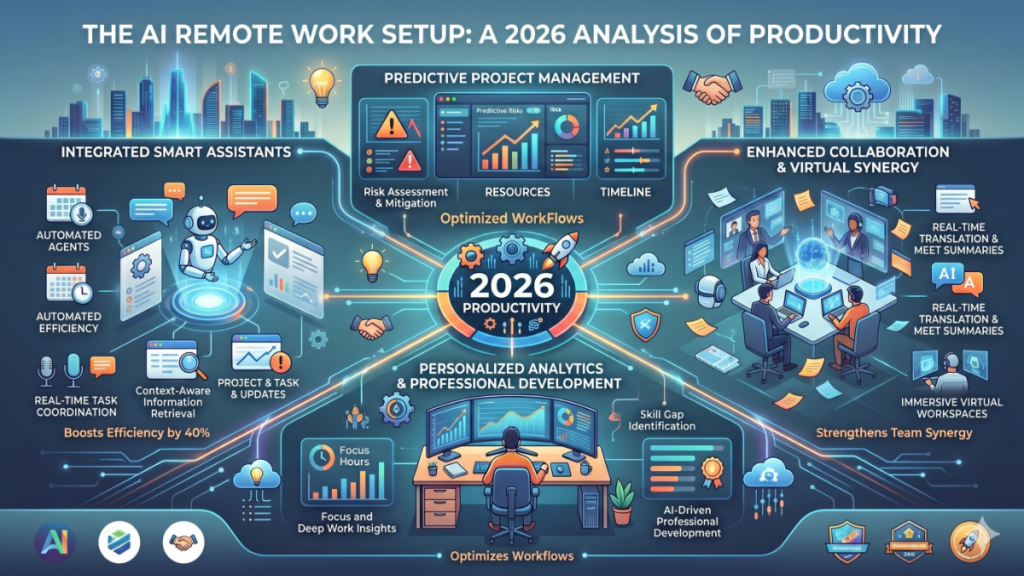

The transition from traditional office spaces to home-based environments was originally framed as a logistical challenge. However, in 2026, the conversation has pivoted toward a cognitive one. A modern remote work setup is no longer defined by the quality of one’s webcam or the speed of their fiber-optic connection, but by the depth of the AI integration within their personal workflow. We are seeing a move away from “software as a tool” toward “software as a teammate.”
This evolution is driven by the necessity of bridging the “presence gap” that has long plagued distributed teams. In my research into industry adoption, I’ve noted that firms are no longer satisfied with static video calls; they are seeking persistent, AI-driven environments that maintain context across time zones. For the individual professional, optimizing a remote work setup now involves configuring autonomous agents that can manage scheduling, synthesize missed meetings, and even provide real-time emotional intelligence cues during high-stakes negotiations. This is the practical application of AI: turning the isolation of remote work into a high-leverage, focused environment that often outperforms the traditional open-office plan.
From Hardware Essentials to Cognitive Infrastructure
The physical desk and ergonomic chair remain foundational, but the “infrastructure” of a 2026 remote work setup now includes local edge-processing units dedicated to running personal LLMs. This ensures privacy and low-latency response times for real-time task assistance.
| Component | Traditional Focus (2020) | AI-Integrated Focus (2026) |
| Connectivity | High-speed Wi-Fi | Low-latency 6G/Satellite + Edge Computing |
| Hardware | Laptop & Monitor | Neural Processing Units (NPUs) & Spatial Displays |
| Software | Video Conferencing | Autonomous Agents & Collaborative Context Layers |
| Environment | Noise-canceling headphones | AI-driven acoustic isolation & ambient intelligence |
The Rise of the Asynchronous AI Agent
One of the most significant shifts I’ve observed in corporate workflows is the death of the “status update” meeting. In a sophisticated remote work setup, asynchronous communication is moderated by agents that track project milestones and nudge contributors only when human intervention is strictly necessary.
“The true value of AI in a distributed environment isn’t that it talks like a human, but that it thinks like a librarian—organizing, retrieving, and connecting dots while we sleep.” — Dr. Aris Thorne, Lead Researcher at the Distributed Work Institute (2025).
Spatial Computing and the Virtual Presence
The feeling of “zoom fatigue” is being mitigated by spatial computing. In a professional remote work setup, high-fidelity avatars and 3D workspaces allow for a sense of co-presence. I recently participated in a product design sprint where the team utilized a shared spatial canvas; the ability to “walk” around a 3D model while at home in London—while my colleagues were in Tokyo—felt more natural than any 2D screen share ever could.
Check Out: Best AI Tools for Python Developers in 2026
Automating the Administrative Burden
Remote workers often spend 30% of their day on “work about work.” Modern applications of AI are reclaiming this time. Through integrated API hooks, your remote work setup can now automatically draft invoices, update CRM entries based on verbal commitments made in calls, and organize file structures without a single manual click.
Security and the AI-Powered Perimeter
With the disappearance of the traditional office perimeter, security has become a primary concern. AI-driven identity verification and anomaly detection are now standard features in a secure remote work setup. These systems analyze typing cadences and behavioral patterns to ensure that the person accessing sensitive data is indeed the authorized employee.
Managing Global Talent Through Algorithmic Equity
As an analyst, I’ve seen how AI can actually improve fairness in remote environments. Performance management systems are moving away from “visibility bias”—where the loudest voice on the call wins—to data-driven metrics that value output and collaborative impact over digital “presenteeism.”
| Metric | Impact on Remote Equity | AI Application |
| Communication | Reduces language barriers | Real-time translation & sentiment leveling |
| Project Contribution | Tracks objective output | Automated code/document attribution |
| Well-being | Prevents burnout | Predictive workload balancing |
The Psychological Impact of AI Coworkers
The shift to an AI-heavy remote work setup has profound psychological implications. While it increases efficiency, we must guard against “algorithmic isolation.” My experience suggests that the most successful remote teams use AI to handle the mundane, specifically to free up time for high-value, high-empathy human interaction.
“We are moving into an era where your desk is a cockpit, and your AI is the co-pilot. The goal is to fly further, not to let the plane fly itself without a destination.” — Sarah Jenkins, COO of NexaFlow Systems.
Bridging the Skills Gap in a Distributed World
The barrier to entry for complex remote roles is changing. In a modern remote work setup, AI “copilots” allow junior employees to tackle senior-level tasks by providing real-time technical guidance and error checking, effectively democratizing expertise across the globe.
Sustainability and the Zero-Emission Workspace
AI optimization extends to the energy consumption of our home offices. Smart power management systems, integrated into a professional remote work setup, now synchronize with local grids to run heavy computational tasks—like video rendering or model training—during periods of peak renewable energy availability.
The Future of Remote Decision Support
Finally, the most advanced remote setups are integrating decision-support layers. Imagine a boardroom where every remote participant has an AI “whisperer” providing relevant data points in real-time during a debate.
“In the next decade, the most successful remote workers won’t be those who work the hardest, but those who curate the best AI workflows.” — Marcus Vora, Author of ‘The Autonomous Professional’.
Takeaways
- Cognitive Focus: The remote work setup has shifted from hardware-centric to AI-integrated infrastructure.
- Asynchronous Power: AI agents are eliminating the need for synchronous status meetings.
- Spatial Presence: Spatial computing is solving the “presence gap” in distributed teams.
- Administrative Freedom: AI is reclaiming up to 30% of the workday by automating “work about work.”
- Equity: Data-driven AI tools are reducing visibility bias in performance reviews.
- Security: Behavioral AI is the new perimeter for securing remote data access.
Conclusion
The evolution of the remote work setup represents more than a trend; it is a fundamental restructuring of professional agency. As we move further into 2026, the distinction between “working from home” and “working in an office” will continue to blur, replaced by a singular concept of the “intelligent workspace.” My analysis indicates that those who proactively integrate these AI-driven systems—focusing on cognitive offloading and spatial collaboration—will find themselves at a significant competitive advantage. The challenge for leadership is no longer just managing people, but managing the interaction between people and their autonomous digital counterparts. We are not just changing where we work, but how we think, decide, and create in a connected world.
Check Out: Digital Rapididentity Evolution: Automating Security in 2026
FAQs
How does AI improve a remote work setup for creative professionals?
AI tools automate repetitive tasks like file tagging, basic editing, and formatting, allowing creatives to focus entirely on high-level conceptual work and strategy.
Is an AI-integrated remote work setup expensive to maintain?
While initial hardware like NPUs may cost more, the ROI is typically realized through massive gains in productivity and the reduction of paid administrative subscriptions.
Does AI in remote work lead to increased surveillance?
While some tools track activity, the trend is moving toward “privacy-first” AI that analyzes patterns locally to support the worker rather than report to management.
What is the most important AI tool for a remote setup today?
An autonomous meeting assistant that can maintain context across various channels (Slack, Email, Zoom) is currently the highest-leverage tool available.
Can AI help with the social isolation of remote work?
Yes, by automating mundane tasks, AI frees up time for meaningful, intentional human connection and community-building activities within distributed teams.
References
- Brynjolfsson, E., & Mitchell, T. (2025). The Impact of Generative AI on Remote Work Productivity. Journal of Economic Perspectives.
- International Labour Organization. (2024). The Evolution of Distributed Work: Technology and Policy. ILO Publications.
- Stanford Institute for Human-Centered AI. (2026). AI Index Report 2026: The State of Autonomous Workflows. Stanford University.
- World Economic Forum. (2025). The Future of Jobs Report 2025: AI and the Remote Revolution. WEF Press.