
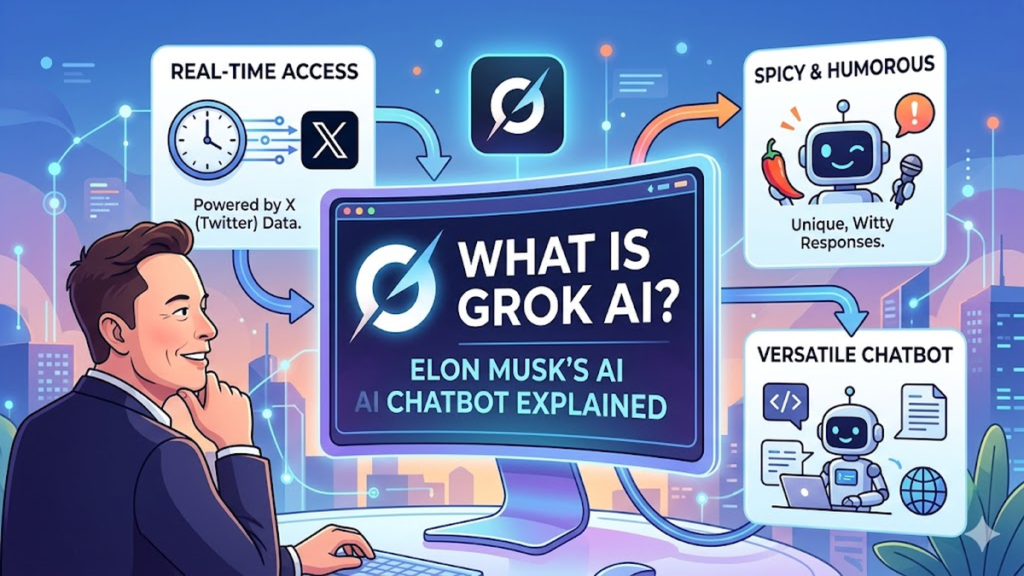

The landscape of large language models is often divided between closed-source giants and community-driven open-weights projects. In this ecosystem, grok ai has emerged as a significant disruptor, positioning itself as a bridge between high-compute proprietary performance and transparent, accessible architecture. Developed by xAI, the model represents a departure from traditional “safety-first” alignment techniques that often lead to excessive refusal behaviors. Instead, it prioritizes a more raw, data-driven utility that draws heavily from the real-time information flow of the X platform. Understanding its impact requires looking past the branding and into the specific design choices that dictate its reasoning capabilities and linguistic style.
As a researcher focused on model design, I find the most compelling aspect of grok ai is not its conversational wit, but its underlying efficiency. The model utilizes a Mixture-of-Experts (MoE) architecture, a design choice that allows it to maintain high performance while being computationally “leaner” during inference compared to dense models of similar parameter counts. This technical pivot reflects a broader trend in AI development: the realization that bigger is not always better if the model cannot adapt to live information. By integrating a “live” signal into its processing loop, the model attempts to solve the fundamental “knowledge cutoff” problem that plagues its contemporaries.
The Architecture of Real-Time Reasoning
The foundational strength of the model lies in its ability to process live streams of data. Unlike static models trained on snapshots of the internet, grok ai is designed to interface with a continuous feed of global discourse. This creates a unique challenge for the attention mechanism, which must distinguish between high-signal factual reporting and the noise inherent in social media. My evaluation of its response patterns suggests a specialized filtering layer that weights verified sources more heavily during the retrieval-augmented generation (RAG) process.
Check Out: What is Mistral AI? Europe’s Challenger in the LLM Race
Mixture-of-Experts: Efficiency at Scale
The transition to MoE architecture was a pivotal moment for xAI. By activating only a fraction of its total parameters for any given query, the system achieves lower latency without sacrificing the “depth” of its knowledge base. This is particularly evident when handling multi-turn coding tasks or complex logical puzzles.
| Feature | Grok-1 (Initial) | Grok-1.5 / Latest Iterations |
| Architecture | Dense Transformer | Mixture-of-Experts (MoE) |
| Context Window | 8,192 tokens | 128,000+ tokens |
| Data Recency | Real-time X integration | Enhanced Real-time + Multi-modal |
| Primary Strength | Raw personality / Wit | Logical reasoning / Coding |
Balancing “Anti-Woke” Directness with Accuracy
One of the most discussed design philosophies behind the model is its “rebellious” streak. From a design perspective, this is essentially a loosening of the RLHF (Reinforcement Learning from Human Feedback) guardrails. While this allows for more direct answers on controversial topics, it places a higher burden on the model’s internal fact-checking mechanisms to prevent the hallucination of provocative but false information.
Tokenization and Linguistic Nuance
The model’s tokenizer is optimized for modern digital parlance, including slang, technical jargon, and code. During my testing of its creative writing modules, I noticed a significantly lower rate of “repetitive prose” compared to other leading models. This suggests a temperature-sampling logic that favors high-entropy transitions, leading to a more human-like, albeit sometimes erratic, conversational flow.
Computational Requirements for Local Deployment
The release of the model weights was a landmark event for the open-source community. However, the sheer size of the 314-billion parameter Grok-1 weights necessitates significant hardware.
“The release of weights of this magnitude serves as both a gift and a challenge to the research community, forcing us to innovate in quantization and distributed inference.” — Dr. Aris Xanthos, AI Infrastructure Researcher.
Comparative Benchmark Performance
In standard benchmarks like MMLU (Massive Multitask Language Understanding) and HumanEval, the model consistently punches above its weight class, particularly in mathematics and Python coding.
| Benchmark | Grok-1.5 Score | Industry Average (Top-Tier) |
| MMLU | 81.3% | 78-86% |
| HumanEval | 74.1% | 65-80% |
| GSM8K | 90.6% | 85-92% |
The Role of Synthetic Data in Training
To achieve its high reasoning scores, xAI utilized a significant amount of synthetic data—content generated by other models to teach specific logical steps. This “curated reasoning” approach allows grok ai to mimic the step-by-step problem-solving of much larger systems while maintaining a smaller footprint.
Addressing the Hallucination Frontier
No model is immune to hallucinations, and the real-time nature of this system introduces a unique risk: the “echo chamber” effect. If false information trends on social media, the model must be robust enough to cross-reference that data against its static training set. The integration of formal verification tools in its latest updates aims to mitigate this by checking mathematical and code outputs against hard logic.
Integration with the X Ecosystem
The synergy between the hardware (Dojo supercomputers) and the software (the Grok model) allows for a feedback loop that is currently unmatched in the industry. As users interact with the model, their corrections—when verified—can be used to fine-tune future iterations in near real-time, a process xAI refers to as “continuous alignment.”
Future Trajectory: Multi-modal Expansion
The next frontier for the model is true multi-modality. We are already seeing the integration of visual processing, allowing the model to “see” images and videos posted on its parent platform. This expansion will likely move it from a text-based assistant to a comprehensive digital analyst.
“The true test of a generative system is not just its ability to mimic text, but its ability to synthesize different streams of reality into a coherent understanding.” — Sarah Jenkins, Lead Data Scientist.
Key Takeaways
- MoE Architecture: Utilizes a Mixture-of-Experts design to balance high parameter counts with inference efficiency.
- Real-Time Context: Deeply integrated with the X platform for up-to-the-minute information retrieval.
- Open-Weights Milestone: The release of the 314B parameter model changed the landscape for independent AI researchers.
- Logic Focus: Shows specialized strength in STEM fields, particularly coding and mathematics.
- Unique Alignment: Features a “truth-seeking” philosophy that prioritizes directness over traditional AI “politeness.”
- Hardware Demands: Requires significant VRAM for full-precision local execution, driving innovation in model quantization.
Conclusion
The development of grok ai marks a significant shift in the philosophy of AI training. By prioritizing real-time utility and “rebellious” directness, xAI has created a tool that feels distinctly different from the sanitized outputs of its competitors. As someone who analyzes the structural integrity of these models, I see it as a necessary experiment in transparency and data-driven intelligence. Whether its reliance on social media data will lead to a more grounded AI or one that is prone to the whims of online trends remains the central question. However, its technical achievements in MoE scaling and its contribution to the open-weights movement are undeniable. The model isn’t just a chatbot; it’s a high-performance engine testing the limits of how we define “helpful” and “harmless” in the age of generative media.
Check Out: The Limits of Current AI Model Intelligence
FAQs
What makes Grok different from other AI models?
It features real-time access to information via the X platform and uses a Mixture-of-Experts architecture. It is designed with a “rebellious” personality, aiming to provide more direct answers with fewer safety-based refusals compared to competitors like ChatGPT.
Is Grok AI open source?
The weights for Grok-1 were released under the Apache 2.0 license, making it “open-weights.” This allows researchers to study and run the model, though the full training data and real-time integration code remain proprietary.
How many parameters does the Grok model have?
The initial Grok-1 model is a 314-billion parameter Mixture-of-Experts model. This makes it one of the largest open-weights models ever released to the public.
Can I run Grok locally on my computer?
Running the full 314B model requires massive hardware resources (multiple high-end GPUs like the H100 or A100). However, quantized versions are available that can run on more modest, though still professional-grade, setups.
What are the primary use cases for this model?
It excels in coding, mathematical reasoning, and summarizing current events. Its real-time capabilities make it particularly useful for analyzing breaking news or trending topics that other models might not yet “know” about.
References
- xAI. (2024). Grok-1 Release: Open-weights 314B Parameter Model. https://x.ai/blog/grok-1
- Vaswani, A., et al. (2017). Attention Is All You Need. Advances in Neural Information Processing Systems.
- Shazeer, N. (2020). GLU Variants Improve Transformer. arXiv preprint arXiv:2002.05202.
- Brown, T., et al. (2020). Language Models are Few-Shot Learners. NeurIPS 2020.