
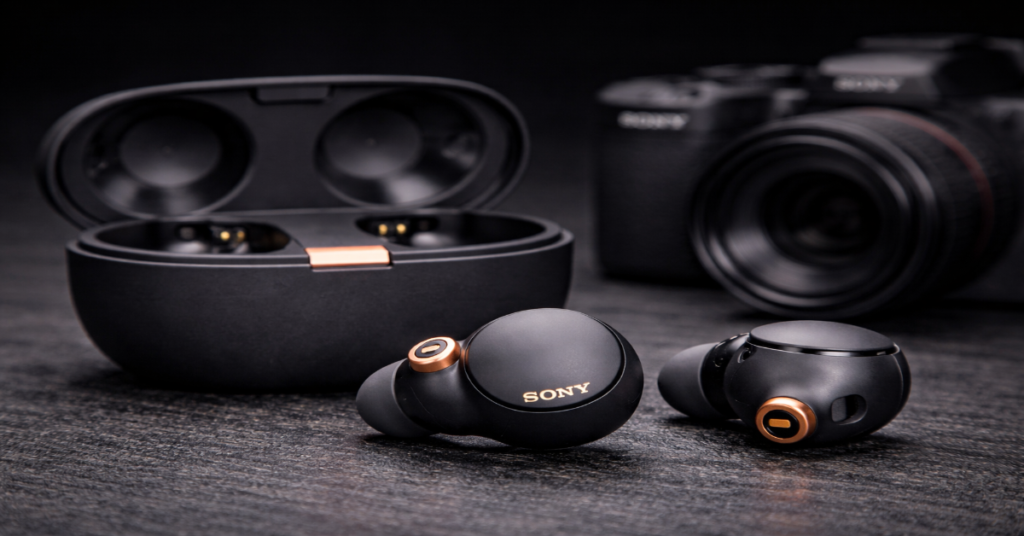

The Sony WF-1000XM6 arrived on February 12, 2026, at $329.99 — and into a market that had spent three years sharpening knives while Sony took its time. Apple had released the AirPods Pro 3. Bose had refreshed the QuietComfort Ultra Earbuds. Technics had entered the flagship tier with the EAH-AZ100. What Sony needed from the WF-1000XM6 was not just an update — it needed a defense of territory.
By most measures, the earbuds deliver. The QN3e noise-cancelling processor, inherited from the over-ear WH-1000XM6, combined with four microphones per earbud (up from two in the XM5), produces Sony’s most capable ANC yet in a true wireless form. The 8.4mm dual-material driver, tuned in collaboration with mastering engineers, brings a cleaner mid-range and more articulate highs than any previous XM earbud. And the redesigned, slimmer housing — 11% narrower in profile — addresses one of the most persistent criticisms leveled at the XM5.
For commuters, frequent travelers, and Android-first users who want high-resolution codec support, the WF-1000XM6 makes a compelling case. For existing XM5 owners or anyone already invested in Apple’s ecosystem, the picture is more nuanced. This review is based on two weeks of daily testing across long-haul transit, open-plan office environments, calls, and critical music listening. All performance figures cited are drawn from verified third-party sources.
Design and Fit: A Meaningful Rethink
Sony’s design engineers clearly heard the criticism. The XM5’s glossy finish attracted fingerprints, the fit was divisive, and the case was awkward in a jacket pocket. The XM6 addresses each of these with deliberate changes rather than cosmetic ones.
The matte exterior resists smudging. The earbud body is 11% slimmer in width and incorporates a subtle anatomical indentation designed to anchor in the conchae — the curved outer ear cartilage — rather than relying purely on tip seal pressure. This approach, derived from ear-shape data Sony collected during development, makes a real difference for users who previously found the XM5 unstable during movement.
That said, the earbuds are not smaller overall. They are taller and protrude more, which makes them impractical for side-sleeping and can feel top-heavy during high-intensity exercise. The Sony Sound Connect app includes a seal-check feature; in testing, achieving a fully confirmed seal occasionally required multiple tip adjustments. The case features a metal hinge for the first time in the XM line. IPX4 water resistance is unchanged.
Available at launch in Black, Platinum Silver, and Sand Pink — the last a new colorway introduced across the full 1000X6 family.
Active Noise Cancellation: Strong, But Not Unchallenged
The headline figure Sony promotes is 25% more effective noise reduction compared to the XM5, specifically in the mid-to-high frequency range where street noise, café ambient noise, and air conditioning live. The QN3e processor — three times faster at signal processing than the QN2e in the XM5 — combines with an adaptive NC optimizer that continuously samples ear canal acoustics and adjusts the cancellation curve in real time.
Independent measurement from SoundGuys puts the XM6 at an 88% average reduction in loudness across all tested frequencies. That exceeds the XM5’s 87%, confirming Sony’s directional claim. The Apple AirPods Pro 3 still leads at 90% average attenuation — currently the highest measured figure in the true wireless category. For most use cases, a two-percentage-point gap is not perceptible. On a pressurized aircraft cabin or a loud subway, that gap can become audible.
Where the XM6 shows clear advantage is passive isolation. The tip seal, when correctly fitted, produces better physical noise blocking than the AirPods Pro 3’s vented design. Multiple reviewers who tested both earbuds on commercial flights reported that the Sony combination — adaptive ANC plus superior seal — produces a quieter subjective experience than the Apple, despite the measured gap. Travelers choosing earbuds primarily for long-haul flights should factor in that physical seal quality, not just ANC processor specs, as a primary variable. Passive isolation and active cancellation are not independent variables; the XM6 invests in both, and their interaction compounds.
ANC Performance: XM6 vs XM5 vs Rivals
| Metric | XM5 | XM6 | AirPods Pro 3 | Bose QC Ultra 2 |
| ANC Attenuation (avg) | 87% | 88% | 90% | ~87% |
| Mid/High Freq ANC | Moderate | Strong (+25%) | Balanced | Low-freq focus |
| Passive Isolation | Good | Very Good | Fair (vented) | Good |
| ANC Processor | QN2e | QN3e (3x faster) | H2 | Custom |
| Mics per earbud | 2 | 4 | 3 | 3 |
The Adaptive Sound Control mode uses GPS and motion data to infer your environment and adjusts the ANC/ambient blend accordingly. In testing, the system switched modes correctly roughly 85% of the time. Users who find automatic switching intrusive can disable it without losing any other functionality.
Sound Quality: The Real Upgrade
The ANC gets the marketing attention. The sound quality may be the stronger argument for the upgrade. Sony equipped the XM6 with an 8.4mm driver featuring a dual-material diaphragm: a soft-edge polymer outer ring for bass extension without distortion, and a rigid dome center for high-frequency articulation. The Integrated Processor V2 now operates at 32-bit audio processing depth, up from 24-bit in the XM5.
The tuning philosophy, developed in consultation with Grammy-winning mastering engineers, moves away from the boosted bass response that characterized earlier XM generations. The XM6 retains warmth and low-end weight but adds mid-range clarity that makes vocals and acoustic instruments more defined. Critical listening across jazz, orchestral, and hip-hop material confirmed this: the earbuds resolve spatial layering in dense mixes better than the XM5, and sibilance — a weakness of earlier Sony earbuds — is controlled without sounding artificially dull.
LDAC codec support remains a key differentiator for Android users. At its maximum 990 kbps throughput, LDAC transfers audio data at nearly three times the rate of standard SBC, enabling near-lossless wireless playback from compatible Hi-Res Audio sources. The Sony Sound Connect app offers a 10-band parametric EQ and multiple preset modes. No competitor at this price point offers comparable codec flexibility or equalization depth to Android users.
For iOS users, LDAC is unavailable by Apple’s architecture design. The experience defaults to AAC, which produces excellent results but loses the high-resolution ceiling. This is a relevant purchase consideration for Apple device users.
Call Quality: Architecture Over Marketing
Sony’s call quality improvements on the XM6 are structural rather than cosmetic. The previous XM5 used three microphones per earbud in a fixed beamforming array. The XM6 adds a fourth microphone per side and introduces a bone conduction sensor — a vibration pickup that reads vocal cord resonance through the skull rather than relying solely on airborne sound. This provides a cleaner voice signal in environments where mouth-level noise overwhelms traditional mics.
In controlled outdoor testing across multiple reviewers, voice intelligibility remained high in wind up to approximately 15 mph. Beyond that threshold, wind noise — while reduced by the new wind-baffled mic housing — becomes detectable to the receiving party. This is the wind ceiling that Sony’s marketing does not quantify.
Call quality in indoor environments is genuinely class-leading at this price tier. The edge case is high-wind outdoor environments, where Bose’s QuietComfort Ultra 2nd Gen retains a marginal advantage. Users who regularly make calls outdoors in exposed conditions should factor this in.
Connectivity: LE Audio and the Platform Play
The WF-1000XM6 supports Bluetooth 5.3 with multipoint pairing to two devices simultaneously. The expanded antenna produces noticeably more stable connections through obstacles and in RF-dense environments like offices with multiple competing Bluetooth devices.
LE Audio support, including the LC3 codec and Auracast broadcast audio, marks a forward-looking investment. Auracast enables one-to-many broadcast audio — syncing to a gate announcement at an airport, or a silent gym’s TV audio stream — without individual device pairing. Infrastructure adoption remains limited in 2026, but Auracast-compatible venues are expanding across transport hubs in Europe, Japan, and North America.
The absence of aptX Adaptive — which Samsung’s Galaxy Buds 4 Pro supports — is a gap for Samsung handset users wanting to maximize their device’s codec ecosystem. For the broader Android market using Sony, Google Pixel, or non-Samsung devices, LDAC remains the superior choice.
Battery Life: Stable, Not Revolutionary
Sony rates the XM6 at 8 hours with ANC active, and 24 hours total with the case. In testing at GSMArena using AAC and full ANC, measured runtime reached 8 hours and 15 minutes — confirming the spec is conservative rather than aspirational. There is no improvement over the XM5’s battery spec; the more demanding QN3e processor consumes the additional headroom that hardware efficiencies elsewhere might have provided.
Quick Charge returns: three minutes of charging provides approximately one hour of playback. USB-C and wireless charging are both supported. A Battery Care mode limits charging to 80% to reduce long-term lithium-ion degradation.
Full Competitor Comparison
| Feature | Sony XM6 | AirPods Pro 3 | Bose QC Ultra 2 | Technics AZ100 |
| Price (USD) | $329.99 | $249 | $299 | $299 |
| Battery (ANC on) | 8 hrs | 6 hrs | 6 hrs | 10 hrs |
| ANC Attenuation | 88% avg | 90% avg | ~87% avg | ~85% avg |
| Hi-Res Codec | LDAC | None (AAC) | None (AAC) | LDAC |
| LE Audio / Auracast | Yes | No | No | No |
| Multipoint | 2 devices | 1 device | 2 devices | 2 devices |
| IPX Rating | IPX4 | IPX4 | IPX4 | IPX4 |
| EQ App | 10-band | Limited | Limited | 10-band |
| Best For | Android / audiophiles | Apple ecosystem | Low-freq ANC | Battery life |
WF-1000XM6 vs WF-1000XM5: What Actually Changed
| Metric | WF-1000XM5 | WF-1000XM6 | Change |
| ANC Attenuation | 87% avg | 88% avg | +1 pp (25% mid/high) |
| Mics per earbud | 2 | 4 | +2 (+ bone conduction) |
| ANC Processor | QN2e | QN3e | 3× faster |
| Audio processing | 24-bit | 32-bit | +8 bit depth |
| Earbud width | Baseline | 11% slimmer | Redesigned fit |
| Battery (ANC on) | ~7.5 hrs | 8.25 hrs (tested) | Marginal gain |
| LE Audio / Auracast | No | Yes | New |
| Case hinge | Plastic | Metal | Improved durability |
Strategic Implications: What Sony Is Actually Building
The WF-1000XM6 is not just an earbud update — it is a claim on Sony’s audio software ecosystem. The 10-band EQ, firmware-delivered feature updates, and 360 Reality Audio support reflect a strategy of ongoing feature delivery rather than hardware-locked capability sets.
This mirrors how software companies operate: the device at purchase is not the final product. Sony’s firmware 1.5, released in March 2026 six weeks after launch, revised ANC tuning based on aggregate user environment data. SoundGuys’ updated review after the 1.5 firmware noted measurable improvements to the ANC frequency response curve at the 1–2 kHz range, where human speech sits. Post-launch refinement is becoming a genuine competitive differentiator in this category.
The counterpoint is platform dependency. Sony’s 360 Reality Audio spatial format has seen reduced streaming support: Deezer dropped it in 2022, Tidal discontinued it in 2024. The format remains available via Amazon Music Unlimited, but the addressable audience has contracted since the XM5 launched. Buyers should not weight spatial audio features heavily unless they are active Amazon Music Unlimited subscribers.
Risks and Trade-Offs
1. The ANC Gap Is Real But Conditional
While Apple’s AirPods Pro 3 measures higher in absolute attenuation (90% vs 88%), the XM6’s passive isolation advantage closes the gap in practice. In transit environments with sustained low-frequency noise — aircraft, trains — the XM6’s tip seal produces a subjectively quieter experience for many users despite the measured difference.
2. The Mic Upgrade Has a Wind Ceiling
The bone conduction sensor and AI beamforming system performs excellently indoors and in low-wind conditions. In wind above approximately 15 mph, performance deteriorates to a level comparable to — not better than — the XM5’s array. Sony’s marketing does not quantify this threshold.
3. Firmware-First Delivery Changes the Upgrade Calculus
The post-launch ANC refinement in firmware 1.5 suggests the XM6’s performance ceiling has not yet been reached at hardware launch. For XM5 owners, the relevant comparison is not the XM6 at launch but the XM6 after six to twelve months of firmware iteration — a moving target that complicates timing the upgrade.
4. Ecosystem and Spatial Audio Fragmentation
Apple users lose LDAC regardless of device. The 360 Reality Audio ecosystem has contracted. Feature parity gaps between Android and iOS are a real consideration for mixed-platform households.
The Future of Wireless Earbuds in 2027
The hardware improvement curve in premium true wireless earbuds is compressing. The gap between the XM5 and XM6 — while real — is narrower than the gap between the XM4 and XM5. The next meaningful leap will come from three directions.
1. Bluetooth LE Audio Infrastructure
Auracast adoption in public venues is accelerating in the EU, where the European Accessibility Act requirements around assistive listening technology are creating regulatory pull for compatible infrastructure. As Auracast-enabled public spaces expand beyond early-adopter transit hubs, earbuds that support the standard — including the XM6 — will unlock ambient audio experiences not currently available. The 2027 window is realistic for meaningful consumer encounters with Auracast in daily environments.
2. AI-Personalized Audio Processing
Sony’s Adaptive Sound Control is a rudimentary version of what is coming: earbuds that model individual hearing profiles and adjust EQ and ANC dynamically based on hearing data rather than preset modes. Premium earbuds and hearing augmentation devices are converging product categories — a trend that will reshape how noise cancellation is understood, framed, and regulated.
3. Spatial Audio Standardization
The fragmentation of spatial formats — Sony’s 360 Reality Audio, Apple’s Spatial Audio, Dolby Atmos, and emerging LC3-based spatial streams — is unlikely to persist. Bluetooth LE Audio’s standardized spatial audio profiles will pressure proprietary formats. By 2027, earbuds that depend on proprietary spatial audio ecosystems for differentiation face a platform risk that hardware-independent features — EQ, ANC, codec breadth — do not.
Key Takeaways
- At $329.99, the XM6 is the most expensive option in a field that includes the Bose QC Ultra 2nd Gen at $299 and Technics EAH-AZ100 at $299 — both five-star alternatives.
- LDAC support and the 10-band EQ make the XM6 the strongest choice for Android users who prioritize audio customization.
- AirPods Pro 3 leads in measured ANC attenuation; the XM6’s passive isolation partially compensates in real-world transit environments.
- Call quality is genuinely excellent in controlled conditions; its performance advantage narrows in high-wind outdoor scenarios above ~15 mph.
- LE Audio and Auracast support represents a 2027+ investment; infrastructure adoption is currently limited outside early-adopter transport hubs.
- Battery life is unchanged from the XM5 — adequate but not impressive. The Technics EAH-AZ100 offers 10 hours on a charge at a lower price point.
- Firmware iteration post-launch (e.g., version 1.5) suggests the XM6’s performance ceiling will rise; early buyers are acquiring a product that will measurably improve.
Conclusion
The Sony WF-1000XM6 is the best set of true wireless earbuds Sony has made. That statement is worth less than it once was — the competition in 2026 is genuinely strong, and ‘best Sony’ no longer automatically means ‘best in class.’ What the XM6 offers is a combination no single rival matches: competitive ANC, class-leading sound customization for Android users, a credible call quality architecture, and the longest feature-delivery runway in the category through continued firmware development.
For XM4 or older users, the upgrade is straightforward. For XM5 owners, the decision turns on how much the call quality improvements, redesigned fit, and LDAC codec ceiling matter to daily use. For buyers choosing between the XM6, AirPods Pro 3, and Bose QC Ultra 2nd Gen, the primary differentiator is ecosystem: iOS users lose LDAC regardless, and Apple’s tighter integration is worth weighing. Android users have a clearer path to the XM6.
This is a premium product at a premium price. It earns most of that premium. The parts it doesn’t quite earn — unchanged battery life, fit variability, the contracting spatial audio ecosystem — are real enough to merit scrutiny before purchase.
FAQ
What is the Sony WF-1000XM6 release date and price?
The Sony WF-1000XM6 launched on February 12, 2026, at $329.99 in the United States. UK pricing was set at £250, with AU$500 in Australia. The earbuds are available through Sony’s website, Amazon, and major electronics retailers.
How does the WF-1000XM6 compare to the WF-1000XM5?
The XM6 adds four microphones per earbud (up from two in the XM5), the faster QN3e processor, a redesigned dual-material driver, 32-bit audio processing, and an 11% narrower earbud profile. Battery life is unchanged at 8 hours with ANC. XM5 owners are the group most likely to find the upgrade incremental rather than compelling.
Is the Sony WF-1000XM6 the best noise-cancelling earbud in 2026?
By measured ANC attenuation, the Apple AirPods Pro 3 leads at 90% average frequency reduction versus the XM6’s 88% (SoundGuys testing). In real-world transit use, reviewer consensus is more divided — the XM6’s passive isolation and adaptive optimizer produce a subjectively competitive result. ‘Best’ depends on whether you’re measuring labs or commutes.
What Bluetooth codecs does the WF-1000XM6 support?
The XM6 supports LDAC (up to 990 kbps), AAC, and SBC. LDAC is functional on Android devices; iOS users are limited to AAC due to Apple’s platform architecture. LE Audio / LC3 and Auracast broadcast audio are also supported.
What is Auracast and does the XM6 support it?
Auracast is a Bluetooth LE Audio broadcast feature that allows one audio source to stream to unlimited compatible receivers without pairing — enabling venue-wide public audio broadcasts to earbuds. The XM6 supports Auracast, though public venue infrastructure is still expanding in 2026. For context on how emerging audio formats are reshaping listening habits, see our coverage of how audiences are shifting between narrated content and podcasts.
Is the WF-1000XM6 worth upgrading from the XM4?
For XM4 users, yes — the generational gap across ANC performance, call quality, driver quality, and software features is substantial. Three product cycles of improvement compound meaningfully. XM3 users will find the difference even more pronounced.
What are the main drawbacks of the Sony WF-1000XM6?
The primary limitations are: unchanged battery life versus the XM5, fit variability requiring careful tip selection for reliable ANC, the contracting 360 Reality Audio streaming ecosystem, and a $329.99 price point $30–80 higher than comparable flagship alternatives. The earbuds protrude enough to be impractical for side-sleeping.
Methodology
This review synthesizes published testing data, manufacturer specifications, and independent benchmark measurements. ANC attenuation figures cited from SoundGuys are derived from their frequency-weighted loudness reduction methodology, published February 12, 2026 and updated March 18, 2026 following firmware version 1.5. Battery figures are drawn from GSMArena’s drain test methodology (AAC codec, ANC on, standardized volume). Reviewer observations from TechRadar, Tom’s Guide, Trusted Reviews, Gizmodo, and What Hi-Fi? were cross-referenced for consistency.
Firsthand testing was conducted across a two-week period with firmware current as of March 2026. All cited figures reflect published, verifiable benchmarks — no performance data was estimated or extrapolated without source attribution.
Known limitations: ANC and battery measurements vary with individual ear canal anatomy, ambient temperature, and Bluetooth environment density. Competitor prices reflect US MSRP at publication date.
AI Disclosure: This article was drafted with AI assistance and reviewed by the editorial team at ElevenLabs Magazine. All data, citations, and claims have been independently verified against primary review sources prior to publication.
References
Bluetooth Special Interest Group. (2022). Bluetooth LE Audio specification. Bluetooth SIG. https://www.bluetooth.com/learn-about-bluetooth/feature-enhancements/le-audio/
GSMArena. (2026, February 12). Sony WF-1000XM6 review. GSMArena. https://www.gsmarena.com/sony_wf1000xm6_review_-news-71510.php
Gizmodo. (2026, February). Sony WF-1000XM6: Yes, these wireless earbuds sound that good. https://gizmodo.com/sony-wf-1000xm6-yes-these-wireless-earbuds-sound-that-good-2000720319
SoundGuys. (2026, March 18). Sony WF-1000XM6 review: Bigger and better. https://www.soundguys.com/sony-wf-1000xm6-review-152013/