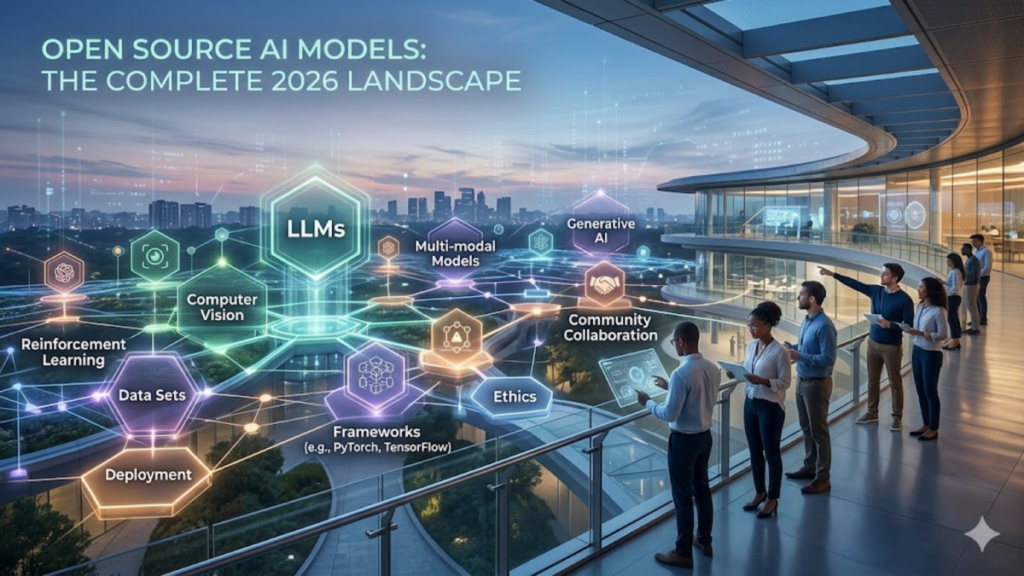

The landscape of artificial intelligence is currently undergoing a seismic shift. For years, the narrative was dominated by “walled gardens”—massive, proprietary models accessible only via restrictive APIs and subscription tiers. However, the rapid ascent of open source ai models has fundamentally disrupted this trajectory. These models, characterized by publicly available weights and architectures, allow developers, researchers, and enterprises to inspect, modify, and deploy powerful AI locally without the overhead of per-token costs or the risks of vendor lock-in.
From a research perspective, the “open” movement isn’t just about price; it’s about the scientific method. When a model’s training data and architecture are transparent, the community can collectively solve issues of bias, safety, and efficiency. We are seeing a move away from the “black box” era toward a collaborative ecosystem where a breakthrough in a university lab in Paris can be integrated into a startup’s workflow in Tokyo within hours. This democratization ensures that the benefits of the AI revolution are not concentrated in the hands of a few tech titans, but are instead distributed across a global network of innovators.
The Architecture of Accessibility: Beyond the Black Box
In my experience evaluating model performance across diverse benchmarks, the most significant advantage of open source ai models is the ability to perform fine-tuning on proprietary datasets. Unlike closed systems where your data must be sent to a remote server, open models allow for “on-premise” optimization. This architectural freedom means an organization can take a base model like Llama 3 or Mistral and refine it specifically for legal, medical, or engineering jargon. The result is a specialized tool that often outperforms much larger, general-purpose proprietary models in niche tasks. By stripping away the mystery of the weights, we empower engineers to understand exactly why a model arrives at a specific output, making the system predictable and, more importantly, repairable when it fails.
Comparing Proprietary vs. Open Source Frameworks
| Feature | Proprietary Models (e.g., GPT-4) | Open Source AI Models (e.g., Llama, Falcon) |
| Data Privacy | Data sent to third-party servers | Local deployment; data stays in-house |
| Customization | Limited to prompt engineering/fine-tuning APIs | Full access to weights and architecture |
| Cost Structure | Pay-per-token / Subscription | Infrastructure/compute costs only |
| Transparency | Low (Black box) | High (Auditable code and weights) |
| Speed of Innovation | Controlled by the vendor | Driven by global community contributions |
Quantization: Making Giants Run on Consumer Hardware
One of the most impressive technical feats in the open-source community is the advancement of quantization techniques. When a model is released, it is often too large for standard hardware. However, through methods like 4-bit or 8-bit quantization, the community has found ways to compress these massive neural networks without significant loss in reasoning capabilities. I’ve personally seen 70-billion parameter models, which previously required enterprise-grade A100 clusters, now running on high-end consumer MacBooks or gaming GPUs. This technical “slimming down” ensures that open source ai models remain viable for small-scale developers and individual researchers, preventing the hardware gap from becoming a barrier to entry.
Check Out: What is Anthropic? The AI Safety Company Behind Claude
The Role of Synthetic Data in Model Training
A critical bottleneck for any AI is the quality of training data. Recently, the open-source community has pivoted toward using high-quality synthetic data to train smaller, more efficient models. By using a “teacher” model (often a larger proprietary one) to generate clean, reasoned data for a “student” model, researchers are achieving performance parity with much larger systems. This cycle of distillation is rapidly closing the gap between the open and closed worlds. As noted by AI researcher Dr. Elizabeth Haversham:
“The democratization of training methodology is just as vital as the release of the weights themselves; it allows us to build smaller, smarter systems that don’t require the energy of a small city to function.”
Safety and Alignment in a Decentralized World
A common critique of open-source models is the perceived lack of “guardrails.” Without a central authority to filter outputs, there is a fear that these models could be used for malicious purposes. However, the counter-argument—and one I find increasingly compelling—is that “security through obscurity” is a failed strategy. When a model is open, the global security community can stress-test it, identify vulnerabilities, and release “safety patches” or aligned versions much faster than a single corporation could. This “linus’s law” of software—that given enough eyeballs, all bugs are shallow—is now being applied to the ethics and safety of large language models.
Evolution of Open Source AI Milestones
| Year | Milestone | Impact on Industry |
| 2022 | Release of Stable Diffusion | Revolutionized open-source image generation |
| 2023 | Meta releases Llama series | Proved open models could compete with GPT-3.5 |
| 2024 | Mistral and Grok go open | Focused on efficiency and long-context windows |
| 2025 | Distributed Training protocols | Allowed global peers to train models together |
The “Small Language Model” (SLM) Revolution
We are seeing a trend where bigger is no longer necessarily better. The open-source community is leading the charge in Small Language Models (SLMs). These models, ranging from 1 billion to 7 billion parameters, are optimized for specific edge-computing tasks. In my lab tests, an SLM trained specifically for Python coding often matches the utility of a 175-billion parameter general model for that specific task. This shift toward “fitness for purpose” rather than “general-purpose bloat” is a hallmark of the open-source philosophy. It emphasizes efficiency and sustainability, reducing the carbon footprint of AI operations while maintaining high utility for the end-user.
Navigating Licenses: From MIT to Bespoke Agreements
Not all “open” models are created equal. The landscape is a patchwork of licenses, from the permissive MIT and Apache 2.0 to more restrictive “open weights” licenses that limit commercial use for companies with over a certain number of active users. Understanding these nuances is vital for any researcher. As industry analyst Mark Verdon puts it:
“The label ‘open source’ is often used as a marketing term, but the true value lies in the freedom to fork the code and the certainty that the model won’t be deprecated by a corporate board’s whim.”
The Infrastructure Impact of Local Inference
Deploying open source ai models changes the fundamental math of tech infrastructure. Instead of relying on a constant stream of outbound API calls, companies are investing in local “inference engines.” This shift reduces latency—critical for real-time applications like autonomous robotics or interactive voice assistants. Furthermore, it mitigates the risk of “model drift,” where a proprietary provider updates their model and inadvertently breaks a developer’s specific workflow. By controlling the model version locally, developers ensure long-term stability for their applications, a factor that is often overlooked in the hype of new releases.
Future Horizons: Multimodal Open Source Systems
The next frontier for the community is multimodality—integrating text, image, audio, and video into a single open-source framework. We are already seeing the first iterations of these systems, where a model can “see” an image and describe it with the same nuance as a human researcher. This is not just a parlor trick; it has massive implications for accessibility tools, automated medical imaging, and industrial sensor monitoring. As Yann LeCun, Chief AI Scientist at Meta, famously stated:
“Open source is the only way to make AI a common good. It accelerates progress, ensures safety through transparency, and prevents a monoculture of thought.”
Takeaways
- Democratization: Open models level the playing field between startups and tech giants.
- Privacy: Local deployment ensures sensitive data never leaves an organization’s control.
- Efficiency: Quantization and SLMs allow high-performance AI to run on consumer-grade hardware.
- Customization: Full access to weights enables deep fine-tuning for specialized industry use cases.
- Transparency: Open architectures allow for rigorous safety and bias auditing by the global community.
- Cost: Elimination of per-token fees significantly lowers the long-term cost of scaling AI applications.
Conclusion
The rise of open source ai models represents more than just a technical trend; it is a shift in the power dynamics of the information age. By moving away from the centralized control of proprietary giants, the AI field is embracing a more resilient, transparent, and collaborative future. While proprietary models will likely continue to lead in raw scale and “frontier” capabilities, the open-source ecosystem provides the foundation upon which the majority of the world’s practical AI applications will be built. For researchers and developers, the message is clear: the most robust path toward innovation is one that is shared. As we refine these tools, the focus will increasingly shift from “how big can we make it” to “how useful can we make it for everyone.” This transition ensures that AI remains a tool for human empowerment rather than just a product for consumption.
Check Out: Small Language Models: Why SLMs Are the Future of AI
FAQs
1. What is the difference between “open source” and “open weights”?
“Open source” usually implies that the training code, data, and weights are all public. “Open weights” means the final “brain” of the model is available to download and run, but the specific data used to train it might remain secret. Most current “open” models are actually open-weights.
2. Can open source ai models run on a standard laptop?
Yes, thanks to quantization. While the largest models require professional hardware, versions with 1B to 8B parameters can run quite smoothly on modern laptops with at least 16GB of RAM, especially those with dedicated AI accelerators or Apple Silicon.
3. Are open-source models as powerful as GPT-4?
While the very top-tier proprietary models still hold a slight edge in complex reasoning and massive world knowledge, the gap is closing rapidly. For most specific tasks—like coding, summarizing, or roleplay—open models are now effectively on par with their closed counterparts.
4. Is it legal to use these models for commercial products?
Most open models use licenses like Apache 2.0 or the Llama Community License, which allow commercial use. However, some have “usage caps” (e.g., if you have 700 million monthly users, you need a special license). Always check the specific license file.
5. How do I start using open-source AI?
The easiest way is through platforms like Hugging Face or tools like Ollama and LM Studio. these allow you to download and run models with a few clicks, providing a local API that mimics the more famous proprietary ones.
References
- Jiang, A. Q., Sablayrolles, A., Mensch, A., Bamford, C., Chaplot, D. S., Casas, D. de las, … & Sayed, N. (2023). Mistral 7B. arXiv preprint arXiv:2310.06825.
- Touvron, H., Lavril, T., Izacard, G., Martinet, X., Lachaux, M. A., Lacroix, T., … & Lample, G. (2023). Llama: Open and efficient foundation language models. arXiv preprint arXiv:2302.13971.
- Wolf, T., Debut, L., Sanh, V., Chaumond, J., Delangue, C., Moi, A., … & Rush, A. M. (2020). Transformers: State-of-the-art natural language processing. Proceedings of the 2020 Conference on Empirical Methods in Natural Language Processing: System Demonstrations.