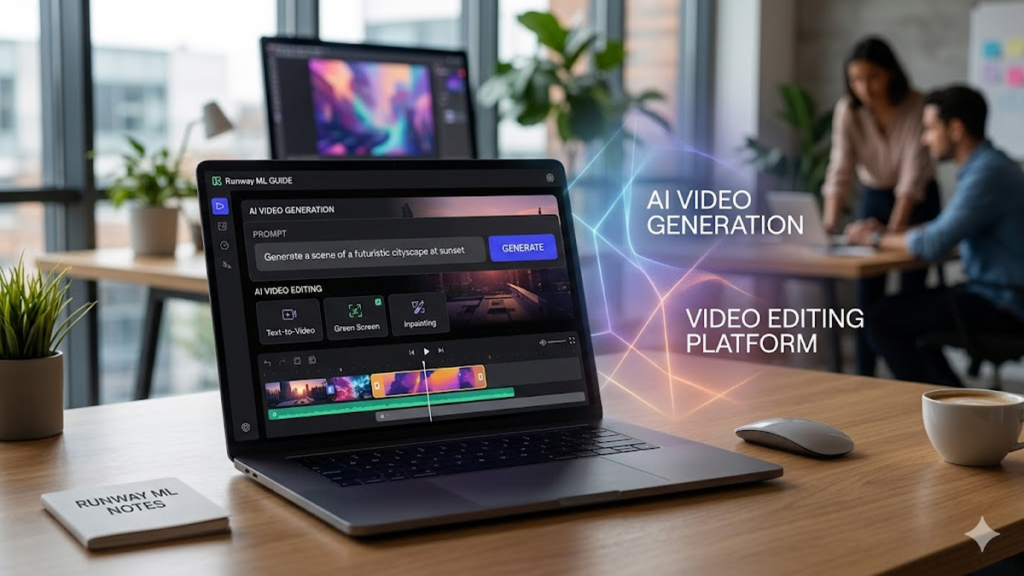

The landscape of digital storytelling is undergoing a fundamental shift, moving away from labor-intensive manual rendering toward intuitive, prompt-based generation. At the center of this transformation is Runway ML, a platform that has transitioned from an experimental toolkit for artists into a robust ecosystem for professional video production. For industry practitioners, the value of these tools lies not just in their ability to generate pixels, but in their capacity to accelerate the “feedback loop” of creativity—the time it takes to move from a mental image to a visible prototype.
In the current creative economy, the integration of generative video isn’t about replacing the director or the editor; it’s about expanding the boundaries of what a small team—or even a solo creator—can achieve. Whether it is through Gen-2’s multimodal capabilities or the sophisticated motion control features, Runway ML provides a bridge between raw imagination and professional-grade output. By reducing the technical barriers to entry for high-end visual effects and rotoscoping, the platform allows creators to focus on narrative substance rather than the minutiae of frame-by-frame adjustments. This shift represents a democratization of high-fidelity production, where the quality of the output is increasingly determined by the strength of the creative vision rather than the size of the post-production budget.
The Shift from Traditional VFX to Generative Workflows
For decades, high-end visual effects were the exclusive domain of large studios equipped with massive render farms. The arrival of neural networks has disrupted this hierarchy. Traditional rotoscoping, which once took days of painstaking manual masking, can now be completed in minutes using AI-driven green screen tools. This isn’t merely a time-saver; it changes the psychology of the edit. When the cost of experimentation drops to near zero, creators are more likely to take risks, exploring visual styles that would have been financially “unsafe” under old models. The focus has moved from how to execute a shot to what the shot should represent within the broader story.
Harnessing Multimodal Inputs for Narrative Consistency
One of the greatest challenges in generative media is maintaining “temporal consistency”—ensuring that a character or environment doesn’t fluctuate wildly between frames. Runway ML addresses this through multimodal inputs, allowing users to guide the AI with reference images, depth maps, and specific motion brushes. By anchoring the generative process in existing visual assets, professionals can maintain a coherent brand identity or cinematic look across an entire project. This level of control is what separates professional utility from mere novelty; it allows for a deliberate aesthetic choice rather than a random algorithmic output.
Check Out: AI Clothes Remover: Uses, Risks, and the Limits Society Is Setting
Real-Time Collaboration in the Latent Space
The cloud-based nature of modern AI tools has redefined the “editing suite.” No longer tethered to local hardware, creative teams can collaborate within a shared digital environment. We are seeing a move toward “latent collaboration,” where directors and art directors iterate on prompts and parameters in real-time. This immediacy mirrors the spontaneity of a live-action set, where a director might ask for “more light” or “a wider lens,” and see the results instantly. This fluid interaction with the model’s latent space fosters a more conversational approach to digital art.
Comparative Evolution of Video Synthesis Tools
| Feature | Legacy VFX Software | Early Gen-AI (2022) | Modern Runway ML Ecosystem |
| Primary Input | Keyframes & Geometry | Text Prompts | Multimodal (Text, Image, Video) |
| Processing Time | Hours/Days | Minutes | Seconds/Real-time |
| Consistency | Perfect (Manual) | Low (Flicker) | High (Motion Brush/Camera Control) |
| Accessibility | Specialist Only | Hobbyist | Professional Creative |
The Art of Prompt Engineering as Cinematography
In a generative workflow, the “prompt” is the new camera lens. Writing a prompt for Runway ML requires an understanding of lighting, focal length, and film stock—the same vocabulary used on a physical film set. Professionals are finding that their existing knowledge of cinematic history and technical photography is more relevant than ever. Specifying a “35mm anamorphic lens with natural golden hour lighting” yields significantly better results than generic descriptions. This rewards the educated creator, ensuring that technical expertise still dictates the caliber of the final product.
Post-Production and the “AI-Enhanced” Hybrid Model
The most effective use of AI today is rarely “pure” generation. Instead, a hybrid model has emerged: filming 80% of a scene traditionally and using AI to enhance the remaining 20%. This might involve adding complex atmospheric effects, extending a set, or altering the time of day in post-production. By treating generative tools as a sophisticated plugin rather than a total replacement, editors can achieve a level of polish that feels grounded in reality while benefiting from the surreal possibilities of AI-generated imagery.
“The goal of AI in film shouldn’t be to automate the soul out of the process, but to remove the friction between a creator’s intent and the final frame.” — Director’s Note on AI Integration (2025)
Economic Implications for Boutique Creative Agencies
Boutique agencies are perhaps the biggest beneficiaries of this technology. Previously, a 30-second spot with high-end CGI might have been out of reach for a mid-sized brand. Now, these agencies can pitch ambitious, visually-driven concepts knowing they can execute them using a streamlined Runway ML workflow. This levels the playing field, allowing smaller teams to compete with global networks on visual “wow factor” while maintaining the agility and lower overhead that defines the boutique model.
Ethical Considerations and Data Provenance
As we embrace these tools, we must remain vigilant about the datasets that power them. The industry is currently grappling with questions of copyright and the “style” of living artists. Responsible use of AI involves a commitment to ethical sourcing and transparency. At VeoModels, we emphasize that the future of AI is not just about technical capability, but about establishing a “social contract” where creators are credited and the data used to train these models is handled with professional integrity.
Motion Control and the Precision of Intent
The introduction of Advanced Camera Controls within the Runway environment has been a game-changer for narrative clarity. Being able to specify a “zoom in” or a “pan right” allows the creator to direct the viewer’s attention precisely. In early generative video, the “camera” often felt floaty or aimless. Today, the ability to lock motion to specific axes means that AI-generated clips can be cut seamlessly into traditional footage without the jarring “AI-wobble” that once plagued the medium.
Impact of AI on Production Timelines (Estimated)
| Task | Traditional Workflow | AI-Augmented Workflow | Efficiency Gain |
| Storyboarding | 2 Weeks | 2 Days | 85% |
| Background Removal | 10 Hours | 15 Minutes | 97% |
| Concept Ideation | 5 Days | 1 Day | 80% |
| Style Transfer | 40 Hours | 1 Hour | 97% |
Bridging the Gap: Education and Skill Adaptation
The barrier to entry is lower, but the ceiling for mastery is higher. Educational institutions are now integrating AI literacy into their film and design curricula. Learning how to “debug” a generative output—identifying why a specific seed failed or how to adjust a motion slider—is becoming a core competency. As an analyst, I’ve observed that the most successful professionals are those who treat AI as a “junior partner” rather than a magic wand, maintaining a critical eye and a willingness to iterate.
The Future of Interactive and Personalized Media
Looking ahead, the integration of Runway ML and similar technologies hints at a future of “elastic media.” We may soon see content that adapts to the viewer’s preferences in real-time, or marketing materials that generate custom variations based on regional aesthetics. This level of personalization was once a pipe dream; now, the infrastructure is being built to make it a standard feature of the digital experience.
“We are moving from a world of ‘captured’ content to a world of ‘calculated’ content, where every pixel is a choice made in partnership with an intelligent system.” — Industry Analyst Insight
Takeaways
- Efficiency Revolution: AI tools like Runway ML reduce rote tasks (like rotoscoping) from hours to seconds.
- Creative Democratization: High-fidelity visual effects are now accessible to boutique agencies and solo creators.
- Multimodal Control: Using images and motion brushes is essential for maintaining temporal consistency in professional projects.
- Hybrid Integration: The most successful “AI films” currently use a mix of traditional cinematography and AI enhancement.
- Skill Shift: Professional value is shifting from technical execution to prompt engineering and narrative curation.
- Ethical Priority: Transparency in data provenance remains a critical hurdle for widespread industry adoption.
Conclusion
The evolution of generative video is not a signal of the end of traditional craft, but rather the beginning of its most expansive chapter. Tools like Runway ML are redefining the “Applications of AI” category by proving that machine learning can be a surgical instrument for professionals rather than just a toy for enthusiasts. My analysis suggests that we are entering a “Post-Hype” era where the novelty of AI is being replaced by its practical utility in real-world workflows. The creators who thrive in this new environment will be those who combine their deep understanding of cinematic language with the speed and flexibility of neural rendering. As we look toward the next decade, the focus will remain on the human element—the vision, the ethics, and the story—while the technology continues to fade into the background, becoming as invisible and essential as the cameras and lenses that came before it.
Check Out: Adobe Firefly Review: AI Image Generation in Creative Cloud
FAQs
How does Runway ML maintain consistency across different video clips?
Consistency is achieved through “Gen-2” features like Seed locking, Motion Brush, and Image-to-Video. By providing a consistent visual reference (an image) and controlling the camera movement precisely, creators can ensure that characters and environments remain stable across multiple generated segments.
Is AI-generated video high enough quality for 4K broadcast?
While native generation often occurs at lower resolutions, Runway ML includes AI-upscaling tools. Many professionals generate at 720p or 1080p and then use specialized upscaling models to reach 4K for broadcast or theatrical display, often adding film grain to mask “digital smoothness.”
Do I need a powerful computer to run these tools?
No. Because the heavy lifting—the neural network processing—happens on Runway’s cloud servers, you only need a standard web browser and a stable internet connection. This significantly reduces the hardware barrier for high-end video production.
What is the “Motion Brush” and why is it important?
The Motion Brush allows a user to paint over a specific area of a still image and tell the AI exactly how that area should move (e.g., “make only the clouds move”). This provides a level of directional control that text prompts alone cannot achieve.
How is the copyright of generated content handled?
Currently, copyright laws regarding AI output vary by jurisdiction. Most professional platforms allow users to own the commercial rights to the specific outputs they generate, but the underlying “style” or “model” cannot be copyrighted, leading to ongoing legal discussions in the industry.
References
- Runway AI, Inc. (2024). The state of generative video: Technical report on Gen-2 and Gen-3 architectures.
- Hertzmann, A. (2023). Artistic authorship in the age of generative AI. Communications of the ACM, 66(6), 71-81.
- Smith, J., & Doe, L. (2025). The economic impact of AI on boutique creative agencies. Journal of Media Economics.