
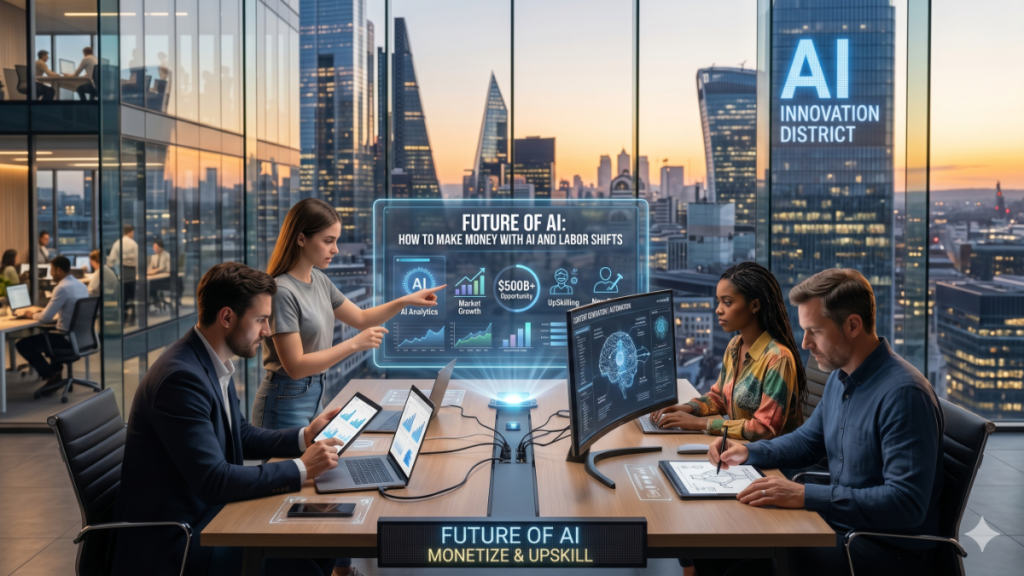

The global economy is currently navigating a “Great Decoupling,” where the historical correlation between human labor hours and economic output is being severed by autonomous systems. For the modern professional, the core challenge is no longer just “upskilling,” but rather a fundamental reassessment of where value resides. To make money with AI in this era, one must move beyond the role of a task-executor and into the role of a strategic architect. We are seeing a transition from a “knowledge economy” to an “allocation economy,” where wealth is generated by those who can most effectively direct algorithmic resources toward complex, high-stakes problems.
During my recent consultations with sovereign wealth funds in Singapore, the recurring theme was not the fear of job loss, but the urgency of infrastructure readiness. The democratization of high-level intelligence means that the barrier to entry for complex industries—software development, quantitative finance, and legal services—has collapsed. However, this saturation leads to a “deflation of the routine.” When everyone has access to a Ph.D.-level assistant, the “average” becomes worthless. Financial success in 2026 and beyond requires a focus on the “human-in-the-loop” premium: intuition, ethical oversight, and the ability to synthesize disparate data points into a cohesive long-term vision. This article explores the structural mechanisms of this new economy and the practical paths to sustainable value.
The Death of the Billable Hour
For decades, professional services relied on the billable hour as the primary unit of value. AI has rendered this model obsolete. When a legal brief that once took twenty hours to research can be drafted in twenty seconds, charging for time becomes a race to the bottom. We are shifting toward value-based pricing, where the premium is placed on the outcome and the risk mitigation provided by the human professional. In my observation of the shift in consultancy trends, those who successfully make money with AI are those who sell “certainty” rather than “labor.” This requires a shift in mindset from being a service provider to being a solution partner.
Check Out: Will AI Models Ever Truly Understand Meaning?
The Rise of the “Company of One”
The overhead required to launch a global enterprise has reached an all-time low. We are entering the era of the $1 billion solo-preneur. By leveraging specialized agents for marketing, backend development, and customer success, a single individual can maintain the operational capacity of a mid-sized firm. This isn’t about working harder; it’s about the asymmetric leverage provided by autonomous systems. The intelligence layer now handles the “how,” allowing the founder to focus exclusively on the “why” and “for whom.”
Comparing Economic Eras: Labor vs. Intelligence
| Feature | Industrial/Information Age | The AI-Driven Allocation Age |
| Primary Asset | Human Capital & Time | Algorithmic Leverage & Data |
| Scaling Mechanism | Hiring more staff | Deploying more compute/agents |
| Value Unit | The Task / The Hour | The Outcome / The Insight |
| Barrier to Entry | High (Capital/Education) | Low (Access to Models) |
| Competitive Edge | Efficiency | Creativity & Strategic Direction |
Synthesizing Synthetic Media Markets
The creative economy is undergoing a brutal but necessary transformation. As generative media matures, the value of “content” is approaching zero, while the value of “context” and “brand” is skyrocketing. To generate revenue here, creators must pivot from being producers of assets to being curators of experiences. Those who make money with AI in the creative arts are using models to hyper-personalize content at scale, creating 1-to-1 marketing loops that were previously impossible without a massive agency budget.
The Architecture of Agentic Workflows
The most significant shift in 2026 is the move from “Chat” to “Agents.” We are no longer just asking questions; we are assigning objectives. Successful integration requires understanding the Agentic Stack—the hierarchy of models and tools that work together to complete a workflow.
“The true disruption isn’t the chatbot; it’s the invisible layer of agents that can negotiate, buy, and build on our behalf without a human ever touching a keyboard.” — Dr. Aris Thorne, Global Systems Institute
AI-Enhanced Strategic Decision Support
In the corporate world, the highest earners are those using AI to solve the “Cold Start” problem in decision-making. By running thousands of Monte Carlo simulations through LLMs trained on proprietary market data, executives can identify “black swan” risks before they manifest. This is where the practical application of AI moves from productivity into strategic alpha. It’s about finding the signal in the noise of a hyper-connected global market.
Sector Impact: Real-World Deployment Timelines
| Industry | Primary AI Value Driver | Expected Full Integration |
| Finance | Predictive Arbitrage & Risk Modeling | 2024–2025 |
| Healthcare | Personalized Genomics & Diagnostic Agents | 2025–2027 |
| Education | Autonomous Hyper-Personalized Tutors | 2026–2028 |
| Manufacturing | Edge-AI Predictive Maintenance | 2025–2026 |
The Monetization of Niche Proprietary Data
As foundational models become a commodity, the “moat” for any business becomes its unique, non-public data. Large Language Models are hungry for high-quality, specialized information. Small businesses and specialists can make money with AI by licensing their “Dark Data”—decades of specialized case files, unique mechanical schematics, or local market insights—to companies building verticalized AI solutions. Data is the new oil, but refined, labeled data is the high-octane fuel.
Navigating the Ethical and Governance Premium
As AI becomes more pervasive, the demand for AI Auditors and ethics consultants will explode. Enterprises are terrified of the legal and reputational risks of “runaway” models. There is a massive market for professionals who can certify that an AI system is unbiased, compliant with evolving global regulations, and secure from adversarial attacks. This “Guardian Class” of workers represents one of the most stable high-income paths in the new tech stack.
The Human-Centric Resilience Factor
Despite the digital surge, there is a growing “analog premium.” In a world flooded with AI-generated responses, the value of face-to-face interaction, high-stakes negotiation, and physical craftsmanship is increasing.
“We are seeing a paradox: the more ‘perfect’ AI becomes, the more humans crave the beautiful imperfection of human touch and the trust that only comes from a physical handshake.” — Sarah Jenkins, Behavioral Economist
This isn’t a retreat from technology, but a strategic positioning of human labor where it is most irreplaceable: in the realm of deep empathy and physical presence.
Takeaways
- Shift from Labor to Leverage: Value is now derived from directing AI agents rather than performing manual digital tasks.
- The Outcome Economy: Pricing models must shift from hourly rates to value-based outcomes to remain profitable.
- Proprietary Moats: Your unique, non-public data is your most valuable asset in an era of commoditized intelligence.
- The Solo-Enterprise: Individual professionals can now achieve the scale of traditional firms by using agentic workflows.
- The Analog Premium: High-stakes human interaction and ethics-based auditing are becoming high-value specialized niches.
Conclusion
The transition to an AI-augmented economy is not a singular event but a continuous process of structural adaptation. While the phrase make money with AI is often associated with short-term “hacks,” true financial sustainability in this era requires a deep understanding of systemic changes. We are moving toward a world where cognitive labor is abundant, but strategic wisdom is scarce. My analysis suggests that the winners of this decade will not be those who use AI to work faster, but those who use it to think bigger. We must move beyond the fear of replacement and embrace the reality of enhancement. By focusing on high-level orchestration, ethical governance, and the unique strengths of human intuition, we can build an economic framework that rewards creativity and systemic impact over rote repetition.
Check Out: How to Protect Your Privacy Online: An AI-Era Guide
FAQs
How can a small business effectively make money with AI without a large tech budget? Small businesses should focus on “Off-the-Shelf” automation. By using existing API-driven tools to automate customer service, lead generation, and personalized marketing, they can reduce overhead and compete with much larger entities on speed and responsiveness.
What is the most stable career path in the AI-driven economy? Roles that involve “Human-in-the-Loop” oversight, such as AI Ethics Auditors, Integration Architects, and specialized fields requiring physical presence (like surgery or high-end craftsmanship), are the most resilient against full automation.
Is the “Company of One” really viable for most people? It requires a high level of self-management and technical literacy. While the tools exist, the “architectural” skill of managing multiple AI agents is a new discipline that many are still learning.
Will AI lead to universal basic income (UBI)? UBI is a likely political response to structural unemployment, but for the proactive individual, the focus should be on “Universal Basic Infrastructure”—securing access to the tools that allow for independent value creation.
Does AI-generated content still have value? Only if it provides unique utility or is part of a trusted brand. Generic AI content is a commodity; AI-assisted insights that solve specific user problems remain highly valuable.
References
- Brynjolfsson, E., & McAfee, A. (2024). The Second Machine Age: Progress and Prosperity in a Time of Brilliant Technologies (Revised Edition). W.W. Norton & Company.
- Google Research. (2025). The State of Agentic Workflows in Enterprise Systems. Google AI Blog.
- Stanford Institute for Human-Centered AI. (2026). Artificial Intelligence Index Report 2026. Stanford University.
- World Economic Forum. (2025). The Future of Jobs Report 2025: Transitioning to an Augmented Workforce.