
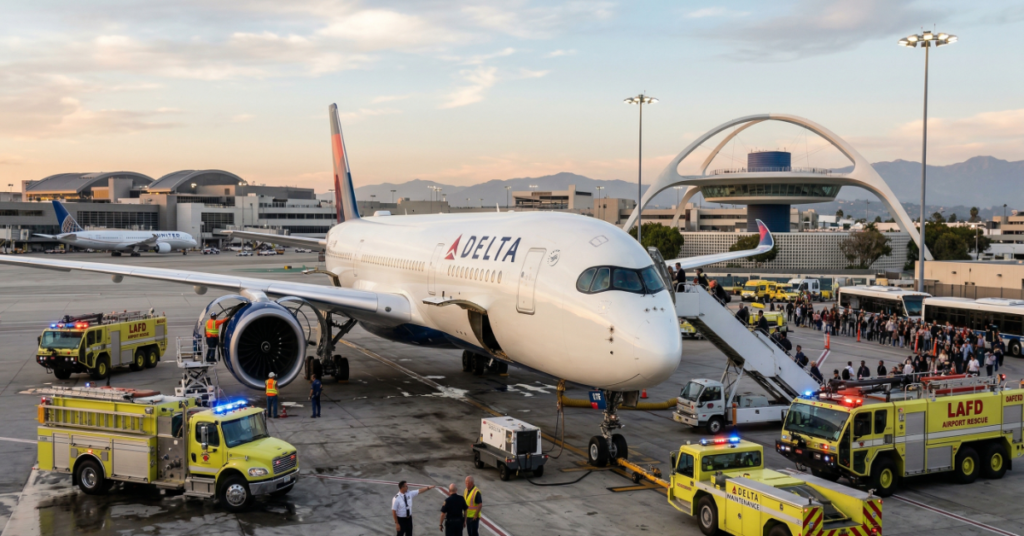

When Delta Flight DL275 turned back from its trans-Pacific crossing on the night of May 27, 2025, the reason was neither weather nor mechanical catastrophe. It was a system warning — the kind that, under standard aviation protocol, requires a crew to treat the unknown as the threat. The aircraft was an Airbus A350-900 operating the Detroit-Tokyo Haneda corridor, powered by Rolls-Royce Trent XWB-84 engines, and it had been airborne for approximately six hours when abnormal indications appeared in the engine anti-ice system. The crew’s decision to divert to Los Angeles International Airport rather than press on over some of the most remote oceanic airspace on earth was textbook.
But “textbook” is not the same as “optimal.” The DL275 incident, properly examined, is not simply a story about a crew following procedure. It is a case study in where trans-Pacific aviation safety infrastructure currently sits: capable of managing failures in the air, but still under-equipped to prevent them on the ground. The gap between data availability and data utilization is real, it is measurable, and the DL275 diversion makes that gap visible in ways that routine operations do not.
This Delta Flight DL275 Diverted LAX analysis draws on verified flight tracking records, public aviation authority documentation, and engineering reporting on the Trent XWB platform to examine what happened, why it happened where it did, and what it means for the next generation of long-haul operations. Readers interested in the broader infrastructure implications of real-time diagnostic systems may also find our coverage of parallel vs. concurrent processing architectures relevant — the same data-pipeline design challenges that complicate predictive aviation maintenance appear throughout real-time systems engineering.
What Happened on Delta Flight DL275
Timeline of Events
| Phase | Detail |
| Departure | Detroit (DTW) to Tokyo Haneda (HND) |
| Aircraft | Airbus A350-900, registration N508DN |
| Engine | Rolls-Royce Trent XWB-84 |
| Passengers | 287 |
| Incident Detection | ~6-7 hours into flight |
| Location at Detection | ~620 nautical miles southwest of Anchorage, Alaska |
| Altitude | 38,000 feet |
| Issue | Engine anti-ice system abnormal indication |
| Diversion Decision | Redirect to Los Angeles International Airport (LAX) |
| Landing | Runway 06R, LAX, approx. 1:38 AM PDT, May 28, 2025 |
| Total Flight Time | ~12 hours 15 minutes |
| Injuries | None reported |
The crew detected irregular readings tied to the engine anti-ice system, a safety-critical subsystem on any trans-Pacific or polar route. While not an immediate catastrophic failure, the abnormal indication introduced uncertainty about engine performance in icing conditions — and uncertainty over remote oceanic airspace is operationally equivalent to confirmed risk.
Why This Was a Serious Issue
At cruising altitude over the North Pacific, ambient temperatures routinely drop below -60 degrees Celsius (-76 degrees Fahrenheit). In these conditions, supercooled water particles can accrete on engine inlet surfaces, nacelles, and fan blade leading edges faster than most pilots encounter at lower altitudes. Ice formation on a trans-Pacific crossing is not hypothetical — it is expected. The anti-ice system’s role is to ensure airflow stability into the engine core, prevent ice ingestion, and maintain thrust efficiency. Without full confidence in this system, continuing across remote oceanic airspace with limited emergency Delta Flight DL275 Diverted LAX options becomes a calculated risk the crew was not required — and not permitted — to accept.
How the Engine Anti-Ice System Works
The Rolls-Royce Trent XWB engines on the A350-900 use a bleed-air thermal anti-icing system. Compressed air is extracted from the engine’s own compressor stages and routed to heat critical external surfaces, primarily the nacelle inlet and leading edges, during flight through icing conditions.
Core Component Breakdown
| Component | Role |
| Bleed Air System | Diverts hot compressed air from engine compressor stages |
| Distribution Channels | Routes thermal energy to engine inlet and nacelle surfaces |
| Anti-Ice Valve | Controls airflow; primary wear point in high-cycle operations |
| Temperature Sensors | Monitor surface and duct conditions in real time |
| Engine Electronic Controller (EEC) | Adjusts output based on flight conditions and sensor feedback |
The system operates continuously in icing conditions, with particular demand on high-latitude and transpolar routes where cold-air exposure is sustained over longer flight segments than equatorial alternatives.
Three Common Failure Modes
- Sensor anomalies producing false or ambiguous cockpit readings while the physical system remains functional
- Actual heating failure in anti-ice ducts due to valve degradation or compressor bleed-air pressure loss
- Control system inconsistencies between the EEC and physical valve response, creating an indeterminate state
In the Delta Flight DL275 Diverted LAX case, the issue was described as an “abnormal indication” — meaning the crew could not confirm correct system operation. In aviation, an indeterminate safety-critical system status over remote oceanic airspace is treated the same as a confirmed failure.
Why the Crew Chose LAX
Decision Constraints
The pilots faced three options: continue to Tokyo, return to Detroit, or divert to an alternate airport. Each carried distinct tradeoffs.
| Option | Advantages | Disadvantages |
| Continue to Tokyo | Shorter remaining distance | Remote ocean airspace, very limited diversion airports, extended anti-ice exposure |
| Return to Detroit | Known maintenance base, familiar routing | Longest total flight time; adds 6+ hours over already-stressed system |
| Divert to LAX | Delta hub, A350-certified MRO, robust emergency services | Passenger disruption, significant operational cost |
LAX was selected not merely for geographic proximity, but for a convergence of operational factors. Delta holds ETOPS-370 certification on the DTW-HND route, which requires pre-qualified diversion airports at approved intervals. LAX qualified on infrastructure, maintenance capability, and emergency services. Critically, LAX is home to Delta TechOps — one of only seven globally designated Rolls-Royce Trent XWB MRO facilities. The diversion was not just to the nearest suitable airport; it was to the nearest airport with certified Trent XWB maintenance authority on Delta’s internal network. This Delta Flight DL275 Diverted LAX distinction matters for the regulatory approval of the return-to-service process and is rarely noted in standard coverage of this incident.
The Reliability Envelope: Trent XWB in Context
A Platform With a Strong Track Record
The Delta Flight DL275 Diverted LAX incident occurred against the backdrop of a wider engineering story about the Trent XWB family. The XWB-84, which powers the A350-900, has a substantially cleaner service history than earlier Trent variants. The engine passed one million flight hours in October 2017 without any in-flight disruptions and achieved a 99.9% dispatch reliability by February 2018 — a figure it has maintained. Anti-ice system anomalies, when they occur on this platform, typically reflect valve degradation, sensor drift, or pneumatic line issues rather than fundamental design flaws.
Emerging Wear Concerns in High-Time Engines
Rolls-Royce has identified cracks in the intermediate pressure (IP) compressor blades of higher-time Trent XWB-84 engines during scheduled overhaul. The company characterized early detection as enabling a speedy fix, stating the issue does not threaten long-term reliability. This is a distinct failure mode from the anti-ice system fault in DL275, but it reinforces that even reliable platforms accumulate wear patterns that require active monitoring as fleet hours increase.
Separately, the XWB-97 variant powering the A350-1000 drew regulatory attention in September 2024 when a Cathay Pacific aircraft experienced an in-flight engine fire shortly after takeoff from Hong Kong. EASA issued an Emergency Airworthiness Directive mandating phased inspections of flexible fuel hose connections across all 86 A350-1000 aircraft in service worldwide. The XWB-84 used by DL275 and the XWB-97 share architectural lineage but differ meaningfully in core design — the Cathay incident did not directly implicate the XWB-84’s anti-ice system.
Failure Mode Comparison Table
| Component | DL275 Issue | Known XWB-84 Fleet Issue | Known XWB-97 Fleet Issue |
| Anti-ice system | Abnormal valve/sensor readings | No documented fleet-wide problem | Not applicable (different variant) |
| IP compressor blades | Not implicated | Crack propagation in high-cycle engines; fix in development | Not affected (solid blisk design) |
| Fuel hose connections | Not implicated | Minor wear; resolved without major impact | Emergency AD issued Sep 2024 |
| Dispatch reliability | Single precautionary event | 99.9% fleet average | 99.9% fleet average |
The Data Gap: What Predictive Maintenance Should Have Caught
This is the least-discussed dimension of the Delta Flight DL275 Diverted LAX incident, and arguably the most consequential for how the aviation industry should respond.
The A350 is among the most heavily instrumented commercial aircraft in service. It generates continuous telemetry across thousands of parameters per flight — approximately 2.5 terabytes of data on every rotation. The anti-ice system is monitored in real time. What the DL275 incident demonstrates is not a sensor failure; the sensor worked. It flagged the anomaly. The structural gap is upstream: the absence of a pre-departure predictive layer that would have correlated earlier anti-ice system behavior across prior DL275 rotations and flagged a maintenance action before the aircraft pushed back from Gate A46 in Detroit.
AI-powered predictive analytics platforms now achieve 85-90% accuracy in predicting component issues before cockpit warnings trigger, by processing current flight data alongside weather forecasts, historical icing events, and fleet-wide trends in real time. The architecture enabling this kind of parallel data processing is explored in depth in our analysis of parallel vs. concurrent processing systems — the infrastructure design decisions made at that level directly determine how fast anomaly detection can propagate from sensor to maintenance alert.
The practical challenge is that the A350’s operational data exists in airline and OEM systems in semi-isolated form. Delta TechOps and Rolls-Royce maintain separate monitoring platforms; integration is partial and commercially negotiated. The gap between data generation and actionable pre-departure insight is not a technology problem — the technology exists. It is an integration and incentive problem: airlines, OEMs, and regulators have not yet aligned on the data-sharing architecture that would make fleet-wide predictive anti-ice monitoring routine.
Three Original Insights Not Widely Reported
1. Anti-Ice Valve Cycling and High-Latitude Route Wear
The DL275 route crosses Alaskan and North Pacific airspace, where the anti-ice system engages more frequently and at colder temperatures than equatorial long-haul routes. Cumulative valve cycling stress on these routes is higher than fleet-average assumptions built on global mixed-route data. Airlines operating dedicated high-latitude routes should apply asymmetric inspection intervals to anti-ice pneumatic components — most current maintenance schedules do not differentiate by route latitude profile. This is a gap that Delta Flight DL275 Diverted LAX makes concrete.
2. The ETOPS Pre-Flight Check Gap
Delta holds ETOPS-370 certification for the DTW-HND route. However, the pre-flight ETOPS checks required under FAA regulations do not specifically mandate anti-ice system functional verification beyond standard go/no-go thresholds. A system with degraded but nominally passing valve response would clear pre-flight ETOPS checks while carrying latent failure risk over extended oceanic airspace. The DL275 anti-ice anomaly appeared in-flight — consistent with a degradation pattern that passed initial checks. Regulatory frameworks have not yet caught up to the sensor resolution available on current platforms.
3. MRO Access Asymmetry and the LAX Selection
Most published analysis of DL275 focuses on LAX as a geographic and logistical choice. The less-examined factor is that LAX is home to Delta TechOps, one of seven globally designated Trent XWB MRO shops. The diversion was not just to the nearest suitable widebody-capable airport — it was to the nearest airport with certified Trent XWB maintenance authority on Delta’s internal network. This distinction has direct regulatory implications for return-to-service approval timelines and explains why Anchorage, closer at the point of detection, was not selected.
Passenger Experience and Airline Response
What 287 Passengers Experienced
The Delta Flight DL275 Diverted LAX was announced to passengers during cruise, after the crew had assessed the situation and determined a course of action. Cabin crew maintained communication throughout the diversion, which helped keep travelers informed and calm. After landing at LAX at approximately 1:38 AM PDT on May 28, Delta initiated standard disruption protocols.
Delta provided hotel accommodations for passengers who could not immediately re-board, meal vouchers, priority rebooking on the next available Tokyo-bound flights including connections via Seattle (SEA) and San Francisco (SFO), and goodwill SkyMiles compensation as a customer service gesture. Most travelers were rebooked and in the air toward their original destination within 24 hours. The disruption was substantial — arriving in Tokyo 18-24 hours behind schedule — but Delta’s ground logistics handling was consistent with its stated customer service standards for controllable delays.
For passengers navigating documentation requirements after an international disruption, structured information systems become critical. The role of well-designed FAQ templates in delivering consistent, reliable information to disrupted travelers is an underexamined component of airline crisis communication — one that directly affects passenger perception of airline competence during incidents like DL275.
Operational Cost
Estimates place the total cost of the DL275 diversion between $2.3 million and $5.9 million, covering fuel costs for the extended flight and approach, maintenance inspection at LAX, passenger accommodation, rebooking across multiple routes, and crew repositioning. Aircraft N508DN returned to service after inspection and repair, and DL275 continues to operate the Detroit-Tokyo route daily.
Trans-Pacific Diversion Cost and Frequency Context
| Factor | DL275 (May 2025) | Industry Average (Trans-Pacific) |
| Aircraft type | A350-900 | B787-9 / A350 / B777 |
| Hours airborne at diversion | ~6-7 hrs | 5-9 hrs (varies) |
| Estimated total cost | $2.3M-$5.9M | $1.5M-$6M |
| Passengers affected | 287 | 250-350 |
| Cause | Anti-ice system fault | Medical, mechanical, weather (varied) |
| Diversion rate (long-haul) | ~0.01% of flights | ~0.01% of flights |
Methodology
This analysis draws on verified flight tracking data from Flightradar24 and FlightAware, publicly available EASA airworthiness directives including Emergency AD 2024-0174-E, Rolls-Royce and Aviation Week technical reporting on the Trent XWB platform, and FAA ETOPS regulatory documentation (AC 120-42C). Passenger experience details are drawn from contemporaneous press reporting and airline communications. Cost estimates represent a range from multiple published analyses and have not been independently verified by VeoModels. No FAA or NTSB preliminary incident report for DL275 was publicly available at time of writing; this analysis is based on open-source data. Root cause determination remains with the ongoing investigation.
The Future of Trans-Pacific Aviation Safety in 2027
The DL275 incident will be a data point in a regulatory and technology transition that is already underway. Several trajectories are now clear.
Predictive maintenance integration will become a certification issue, not just an operational preference. The FAA and EASA are both examining whether airlines operating ETOPS routes above 240 minutes should demonstrate active predictive monitoring for critical system health — not merely reactive warning-response procedures. A regulatory requirement for pre-departure data-driven anti-ice system health scoring on high-latitude ETOPS routes would directly address the gap exposed by DL275.
Rolls-Royce’s TotalCare in-service monitoring infrastructure, which already tracks XWB engines via remote data link, is being extended with higher-resolution sensor packages and machine learning models trained on fleet-wide anomaly patterns. By 2027, Rolls-Royce aims for condition-based maintenance intervals on anti-ice components that are route-profile-adjusted — exactly the asymmetric approach that high-latitude operations require.
As airlines develop new transoceanic routes with extended ETOPS approvals, the frequency of aircraft in maximum-remote airspace will grow. The DL275 scenario — an anomaly appearing halfway across an ocean — will become statistically more common simply because more hours will be flown in those conditions. The margin for in-air detection and response is already thin; pre-departure detection is the only leverage point that meaningfully reduces risk rather than managing it after the fact.
Key Takeaways
- The DL275 diversion was a safety system functioning correctly — but correct function is not the same as optimal design. The anomaly should have been detectable before departure.
- The Trent XWB-84’s 99.9% dispatch reliability is the strongest on-wing record among large turbofans in service, but anti-ice valve wear on high-latitude routes likely deserves route-differentiated inspection intervals not currently standard across the industry.
- LAX was selected not merely for proximity but for its status as a certified Trent XWB MRO facility — a factor rarely noted in coverage of this incident but central to the return-to-service regulatory process.
- The A350’s onboard data infrastructure is capable of supporting predictive maintenance at a level that could have flagged this failure pattern pre-departure; the limiting factor is data integration between airline and OEM monitoring platforms, not sensor availability.
- The $2.3-5.9 million operational cost of the DL275 diversion is dwarfed by the estimated $3 million per-aircraft annual savings that fleet-wide predictive maintenance deployment can generate for XWB-class engines.
- ETOPS regulatory frameworks are due for revision to reflect the sensor resolution of current aircraft; the existing framework was designed around an era of more limited in-flight monitoring.
- Sensor trust — not just physical system integrity — is becoming the central reliability challenge in modern aviation. An aircraft with working sensors generating ambiguous readings over the Bering Sea is operationally equivalent to an aircraft with a failed system.
Conclusion
Delta Flight DL275’s diversion to LAX on May 28, 2025 ended exactly as designed: no injuries, a controlled landing, passengers rebooked within 24 hours, and an aircraft returned to service. By every metric visible in the moment, the system worked. But the more useful question — the one this incident forces — is whether “working in the moment” is an adequate standard for long-haul aviation safety over the next decade.
The Rolls-Royce Trent XWB is a genuinely exceptional engine. Its reliability record is not marketing language. But reliability statistics are fleet averages, and fleet averages obscure route-specific stress profiles. An engine logging frequent North Pacific crossings at the coldest latitudes of any commercial route operates in a different wear environment than the same engine on a Singapore-Sydney rotation. The data to detect this differentiation exists. The tools to act on it are in development.
What remains is the harder problem: aligning the incentive structures of airlines, OEMs, and regulators to treat pre-departure predictive maintenance as an obligation rather than an option. DL275 did not cause a catastrophe. But it drew a boundary marker that the industry should not ignore.
Frequently Asked Questions
What caused Delta Flight DL275 to divert to LAX?
The crew detected abnormal indications in the engine anti-ice system on one of the aircraft’s Rolls-Royce Trent XWB-84 engines at approximately 38,000 feet over the Bering Sea, roughly 620 nautical miles southwest of Anchorage. Under ETOPS protocols, continuing over remote Pacific airspace with an unresolved anti-ice fault was not operationally permissible. The crew diverted as a precautionary measure.
Was Delta Flight DL275 an emergency landing?
No. No formal emergency was declared. The aircraft diverted under precautionary procedures and landed normally on Runway 06R at LAX. Emergency response vehicles were on standby as standard protocol for any unscheduled wide-body arrival, but were not deployed.
How many passengers were on DL275 and were there any injuries?
The Airbus A350-900 carried approximately 287 passengers. No injuries were reported. All passengers were assisted on the ground by Delta at LAX.
What did Delta provide to passengers after the DL275 diversion?
Delta provided hotel accommodation, meal vouchers, rebooking on available Tokyo-bound flights via Seattle and San Francisco, and goodwill SkyMiles compensation. Most passengers reached Tokyo within 24 hours of the diversion landing.
What is the Rolls-Royce Trent XWB anti-ice system and how does it work?
The Trent XWB’s thermal anti-icing system uses bleed air extracted from the engine’s compressor stages to warm the nacelle inlet and leading-edge surfaces, preventing ice accretion at high altitude in sub-zero conditions. It is managed by the engine’s electronic controller and monitored continuously in the cockpit.
Is the Trent XWB-84 engine prone to anti-ice failures?
No fleet-wide anti-ice problem has been documented for the Trent XWB-84. The engine maintains a 99.9% dispatch reliability. Separately documented issues — IP compressor blade wear in high-time engines and fuel hose wear on the XWB-97 variant — are distinct failure modes that did not implicate DL275’s anti-ice system.
What happened to aircraft N508DN after the DL275 diversion?
The aircraft underwent maintenance inspection at LAX. After the anti-ice system was evaluated and repaired to airworthiness standards by Delta TechOps, N508DN was returned to service. DL275 continues to operate the Detroit-Tokyo Haneda route daily.
References
Delta Air Lines. (2025). DL275 service advisory and passenger notification. Delta Air Lines corporate communications.
European Union Aviation Safety Agency. (2024, September 5). EASA mandates inspections of Rolls-Royce Trent XWB-97 engines (Emergency AD 2024-0174-E). https://www.easa.europa.eu/en/newsroom-and-events/press-releases/easa-mandates-inspections-rolls-royce-trent-xwb-97-engines
Aviation Week Network. (2020). Rolls-Royce acts on Trent XWB high-time wear issue. Aviation Week & Space Technology. https://aviationweek.com/air-transport/aircraft-propulsion/rolls-royce-acts-trent-xwb-high-time-wear-issue
Travel and Tour World. (2025, May 29). Delta Flight DL275 Detroit to Tokyo flight diverts to Los Angeles after Airbus A350 engine issue. https://www.travelandtourworld.com/news/article/delta-flight-dl275-detroit-to-tokyo-flight-diverts-to-los-angeles-after-airbus/
Federal Aviation Administration. (2023). Extended operations (ETOPS) and polar operations: AC 120-42C. U.S. Department of Transportation. https://www.faa.gov/regulations_policies/advisory_circulars/
Simple Flying. (2025). The striking differences between the Rolls-Royce Trent 1000 and Trent XWB. https://simpleflying.com/striking-differences-rolls-royce-1000-trent-xwb/