

Over the past several years, I have watched a quiet but powerful architectural shift unfold in the way AI systems are deployed. Developers are no longer thinking only about models or algorithms. Increasingly, the conversation centers on infrastructure design, especially how applications communicate with distributed services. One design pattern that has gained traction in this space is the application client container model.
In simple terms, the application client container refers to packaging the client logic of an application inside a containerized environment that manages service discovery, runtime dependencies, and communication with backend systems. This approach separates client orchestration from underlying infrastructure while maintaining consistency across environments. Within the first hundred lines of nearly every modern AI deployment architecture I examine, some form of this pattern now appears.
For teams building machine learning products, containerized client structures reduce operational complexity and allow applications to interact with models, APIs, and data pipelines in predictable ways. Instead of configuring dependencies individually across servers or devices, the entire execution environment travels with the client.
From my experience evaluating infrastructure deployments across startups and research labs, the appeal is not just technical elegance. The real advantage lies in stability and reproducibility. AI systems are notoriously fragile when environments change. Encapsulating application logic within containers helps preserve behavior across development, testing, and production.
In the sections that follow, I will examine how this architectural approach works, why it has become so influential in AI infrastructure, and what practical implications it carries for organizations deploying intelligent systems at scale.
The Rise of Containerized Application Architectures

Containerization fundamentally changed how software systems are distributed. Before containers became common, developers relied heavily on virtual machines. While effective, virtual machines required large resource overhead and complicated environment management.
Containers introduced a lighter abstraction layer. Technologies such as Docker, first released in 2013, allowed developers to package applications together with their runtime dependencies in isolated environments (Merkel, 2014). For AI systems that rely on specialized libraries, this shift proved transformative.
Within this ecosystem, the application client container pattern emerged as teams began containerizing not just backend services but also client components responsible for orchestrating requests and coordinating workflows.
The result is a system where client behavior becomes reproducible across machines. A developer’s laptop, a testing server, and a production cluster can all run the same container image.
As cloud infrastructure matured, orchestration tools like Kubernetes enabled automated scaling and deployment of thousands of containers simultaneously.
According to the Cloud Native Computing Foundation (2024), more than 96 percent of organizations now use containers in production environments. AI infrastructure is among the fastest growing segments of that adoption.
Understanding the Application Client Container Pattern
The application client container approach packages the client layer of an application into a portable container environment. Instead of relying on external runtime configurations, the container contains everything necessary to communicate with backend services.
In AI systems, the client layer often performs tasks such as:
- Sending inference requests to models
- Aggregating responses from multiple APIs
- Handling authentication and session logic
- Managing workflow pipelines
Encapsulating these responsibilities inside a container ensures consistency across deployments.
When I evaluate infrastructure designs, one of the recurring issues I see involves mismatched client dependencies. Slight differences in runtime libraries can cause failures that are difficult to diagnose. Containerized client logic eliminates much of this variability.
The architecture typically includes three core components:
| Component | Role | Typical Technology |
|---|---|---|
| Client Container | Handles application requests and workflows | Docker |
| Orchestration Layer | Manages scaling and deployment | Kubernetes |
| Backend Services | Models, APIs, databases | Microservices |
This separation of responsibilities allows organizations to upgrade models or services independently without rewriting client logic.
Read: MagFuseHub and the Rise of Distributed AI Tool Ecosystems
Why AI Systems Benefit from Containerized Clients
AI applications differ from traditional software in several ways. They depend heavily on specialized libraries, GPU drivers, and large model dependencies.
When these dependencies change across environments, reproducibility suffers. I have personally seen research prototypes fail during deployment simply because runtime libraries differed slightly between machines.
The application client container model helps stabilize these environments by locking dependencies into a consistent package.
AI infrastructure also tends to evolve rapidly. Models are retrained frequently and services are updated regularly. Containers allow these updates to occur without breaking client applications.
Andrew Ng once noted:
“AI systems fail more often from infrastructure friction than from algorithmic limitations.”
Containerized clients reduce that friction by ensuring predictable communication with backend systems.
Another advantage involves experimentation. Developers can spin up multiple client containers to test different workflows or model combinations without affecting production systems.
This flexibility has become especially valuable in organizations running large scale machine learning operations.
Deployment Workflow in Modern AI Infrastructure
Deploying an AI application using containerized clients typically follows a structured workflow.
The process begins with packaging the client logic into a container image. This image includes all runtime libraries, dependencies, and configuration files.
Once built, the container image is stored in a registry such as Docker Hub or a private repository.
Deployment orchestration tools then distribute the container across compute nodes.
A simplified workflow looks like this:
| Step | Process | Outcome |
|---|---|---|
| Build | Package client logic and dependencies | Container image created |
| Store | Upload to container registry | Image becomes reusable |
| Deploy | Orchestrator launches containers | Application runs across nodes |
| Scale | Containers replicate automatically | System handles demand spikes |
This workflow enables automated scaling when AI workloads increase.
In one deployment I reviewed at an autonomous systems startup, client containers scaled from 20 to over 600 instances within minutes during peak processing loads.
Infrastructure Scalability and Reliability
Scalability is one of the primary reasons organizations adopt containerized architectures.
AI workloads can fluctuate dramatically depending on user demand or batch processing jobs. Traditional monolithic systems struggle to adapt quickly to these changes.
The application client container structure allows client instances to scale independently from backend services.
If demand for inference increases, orchestration tools simply launch additional containers to handle new requests.
This design also improves fault tolerance. If a container fails, the orchestrator automatically replaces it without interrupting the system.
According to Google’s Site Reliability Engineering guidelines (Beyer et al., 2016), automated failure recovery is one of the most effective ways to improve system stability.
Containers make this process easier by allowing rapid redeployment of identical environments.
In large AI deployments, these mechanisms reduce downtime and improve operational resilience.
Managing Dependencies in Complex AI Systems
One challenge in AI infrastructure involves managing numerous software dependencies.
Machine learning pipelines frequently rely on frameworks such as TensorFlow, PyTorch, CUDA libraries, and specialized preprocessing tools.
Small differences in versions can lead to unexpected behavior.
The application client container model addresses this by packaging all required dependencies inside a controlled environment.
This ensures the client behaves consistently regardless of where it runs.
In practice, teams often maintain multiple container images for different experimental configurations.
Fei Fei Li once emphasized the importance of reproducibility in machine learning:
“Reproducibility is the foundation of trustworthy AI.”
Containerization helps achieve that reproducibility at the infrastructure level.
For organizations deploying AI systems across global cloud regions, maintaining consistent runtime environments becomes essential for reliable operation.
Integration with Microservices and AI APIs
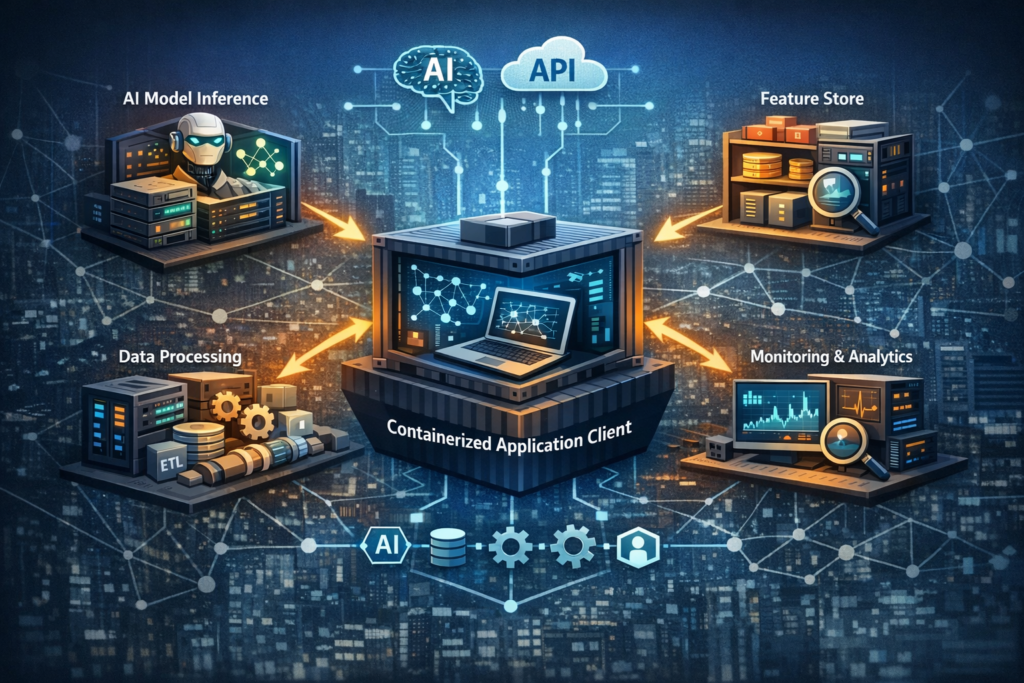
Modern AI systems rarely operate as single monolithic programs. Instead, they rely on networks of microservices that handle specific tasks.
Examples include:
- Model inference services
- Data preprocessing pipelines
- Feature stores
- Monitoring systems
The application client container often serves as the coordinator connecting these services together.
Rather than embedding communication logic inside each backend service, the client container manages orchestration.
This architecture simplifies backend services and allows them to evolve independently.
Sam Newman, a leading microservices expert, explains:
“Microservices succeed when responsibilities are clearly separated.”
Containerized client logic helps maintain that separation.
For AI systems that combine multiple models and services, this approach simplifies integration while preserving flexibility.
Security and Isolation Benefits
Security considerations also play a role in container adoption.
Containers isolate application processes from the host system, limiting the impact of vulnerabilities.
When client applications run inside containers, access permissions can be tightly controlled.
Security teams often use policies that restrict containers from accessing sensitive resources unless explicitly authorized.
This containment reduces the risk of system wide breaches.
The National Institute of Standards and Technology (2020) highlights container isolation as a key security benefit for modern cloud applications.
Another advantage involves environment verification. Because container images are immutable, security teams can audit them before deployment.
Once approved, the same image runs across environments without modification.
This predictability improves both security monitoring and compliance.
Operational Monitoring and Observability
Operating containerized infrastructure requires robust monitoring tools.
AI deployments often involve thousands of container instances interacting with multiple services. Without visibility into system behavior, diagnosing issues becomes difficult.
Observability platforms such as Prometheus and Grafana track container metrics in real time.
Typical metrics include:
- CPU utilization
- Memory usage
- Request latency
- Error rates
The application client container can also include built in telemetry tools that report performance data.
This instrumentation helps engineers detect bottlenecks or failures quickly.
From my own experience reviewing infrastructure dashboards, effective monitoring often reveals subtle performance issues before they escalate into system outages.
Organizations that combine containerization with strong observability practices gain significant operational advantages.
The Future of Container Based AI Infrastructure
Looking ahead, containerization will likely remain central to AI infrastructure design.
However, new trends are emerging that extend the concept further.
One development involves serverless containers, which allow applications to run on demand without managing persistent infrastructure.
Another involves edge AI deployments, where containerized clients operate directly on devices such as autonomous vehicles or industrial sensors.
These environments require lightweight orchestration systems capable of running on constrained hardware.
Researchers are also exploring ways to integrate containerized clients with distributed AI training systems.
Michael Jordan, a pioneer in machine learning systems, once observed:
“The future of AI depends as much on systems engineering as on algorithms.”
Container architectures represent a key piece of that systems engineering evolution.
As AI applications become more distributed, flexible infrastructure will become increasingly essential.
Key Takeaways
- Containerization has become a foundational technology for modern AI infrastructure.
- The application client container pattern packages client logic into portable runtime environments.
- This architecture improves reproducibility across development, testing, and production systems.
- AI deployments benefit from scalable orchestration tools such as Kubernetes.
- Containerized clients simplify communication between microservices and AI models.
- Security and operational monitoring improve when applications run in isolated container environments.
Conclusion
Over the past decade, the infrastructure supporting AI systems has matured rapidly. Early machine learning deployments often struggled with fragile environments and inconsistent dependencies. Containerization helped address many of these problems, but the architecture continues to evolve.
The application client container pattern represents an important step in that evolution. By packaging client logic into portable, reproducible environments, organizations gain greater control over how applications interact with complex AI services.
In my work reviewing emerging technology deployments, I increasingly see this design pattern used to coordinate model pipelines, API communication, and large scale inference systems. Its appeal lies in both technical simplicity and operational reliability.
As AI systems grow more distributed across cloud platforms and edge environments, container based architectures will likely become even more important.
The future of AI infrastructure will not depend solely on better models. It will also rely on robust systems that allow those models to operate reliably in the real world.
Read: Multitenant Database Container in Modern SaaS Infrastructure
FAQs
What is an application client container?
It is a containerized environment that packages client side application logic and dependencies. This allows consistent communication with backend services across different deployment environments.
Why are containers useful for AI infrastructure?
Containers ensure consistent runtime environments, which helps prevent compatibility issues between development, testing, and production systems.
How does Kubernetes interact with client containers?
Kubernetes manages deployment, scaling, and orchestration of containers, automatically launching new instances when system demand increases.
Are containerized clients secure?
Yes. Containers isolate applications from host systems and allow strict control over permissions and resource access.
Do containerized clients improve scalability?
Yes. Containers can be replicated rapidly across infrastructure nodes, allowing systems to handle increased workloads efficiently.