


When founders or AI developers ask me how to structure a compelling presentation, they are rarely asking about slides. They are asking how to build a persuasive Pitch that turns technical capability into clear value. Whether the audience is an investor evaluating scalability, a client assessing ROI, or a product team reviewing a chatbot demo, the goal is the same: clarity, credibility, and conviction within limited time.
In practice, a strong pitch combines problem framing, solution clarity, market logic, and evidence of traction. For AI startups especially, it must translate complex systems into business relevance. Over the past several years, I have worked with teams deploying language models in healthcare workflows and enterprise automation projects. The pattern is consistent. Technical depth alone does not win adoption. Structured communication does.
Today, collaborative presentation platforms and AI assisted slide tools have reshaped how teams prepare. Real time editing, AI driven formatting, and analytics have changed the workflow behind modern decks. But software does not replace strategy. It supports it.
This article examines how to design persuasive presentations in AI driven industries, how collaborative platforms such as Pitch.com fit into modern workflows, and what practical frameworks consistently improve results across investor, sales, and product contexts.
Understanding What a Pitch Really Does
A presentation is not information delivery. It is decision architecture. At its core, a pitch organizes evidence to guide a specific choice.
For investors, that choice is capital allocation. For enterprise buyers, it is procurement risk. For internal teams, it is resource prioritization.
In AI contexts, the stakes are often higher. Buyers must assess not only performance but also explainability, compliance, data governance, and integration costs. According to McKinsey’s 2023 State of AI report, 55 percent of organizations now report adopting AI in at least one business unit. Yet many pilots fail to scale due to unclear value communication (McKinsey, 2023).
A persuasive structure therefore moves through five elements:
- Clear problem definition
- Evidence backed solution
- Market or workflow impact
- Traction and validation
- Specific next step
Without this progression, audiences struggle to map innovation to outcomes.
As communications scholar Nancy Duarte has argued, “The audience does not need more information. They need clarity about why it matters” (Duarte, 2010). That insight remains central in AI environments.
Types of Pitch Formats in Tech and AI
Different contexts demand different structures. Treating all presentations the same is a common mistake I see in product teams.
Elevator, Sales, and Investor Formats
| Type | Duration | Primary Goal | Emphasis |
|---|---|---|---|
| Elevator | 30 to 60 seconds | Spark interest | Hook and problem |
| Sales | 10 to 30 minutes | Secure contract | Implementation and ROI |
| Investor | 10 to 20 minutes | Raise capital | Scalability and business model |
The elevator version distills positioning. It is used at conferences, networking events, and executive briefings.
The sales format focuses on integration details, pricing logic, deployment timeline, and risk mitigation. In AI implementations, this often includes model performance benchmarks, data requirements, and governance assurances.
The investor format expands on market size, competitive advantage, defensibility, and revenue structure. Venture capital firm Sequoia Capital’s publicly shared pitch guidelines emphasize storytelling clarity and traction metrics (Sequoia Capital, 2020).
Choosing the wrong emphasis for the audience weakens persuasion before the first slide is finished.
Structuring the Core Narrative
Across industries, strong decks follow a predictable cognitive path. I often advise teams to think of their presentation as a short documentary.
The narrative arc typically includes:
- Current state tension
- Consequence of inaction
- Introduction of solution
- Evidence of effectiveness
- Future scale
In AI sectors, the “current state tension” may involve inefficiencies in manual workflows, data silos, or regulatory bottlenecks. The “solution” must connect clearly to model architecture or system capability without overwhelming non technical audiences.
As Harvard Business School professor Carmine Gallo notes, “Ideas are not adopted because they are rational. They are adopted because they are memorable” (Gallo, 2014).
Story does not replace data. It organizes it.
Collaborative Presentation Platforms in Modern Teams
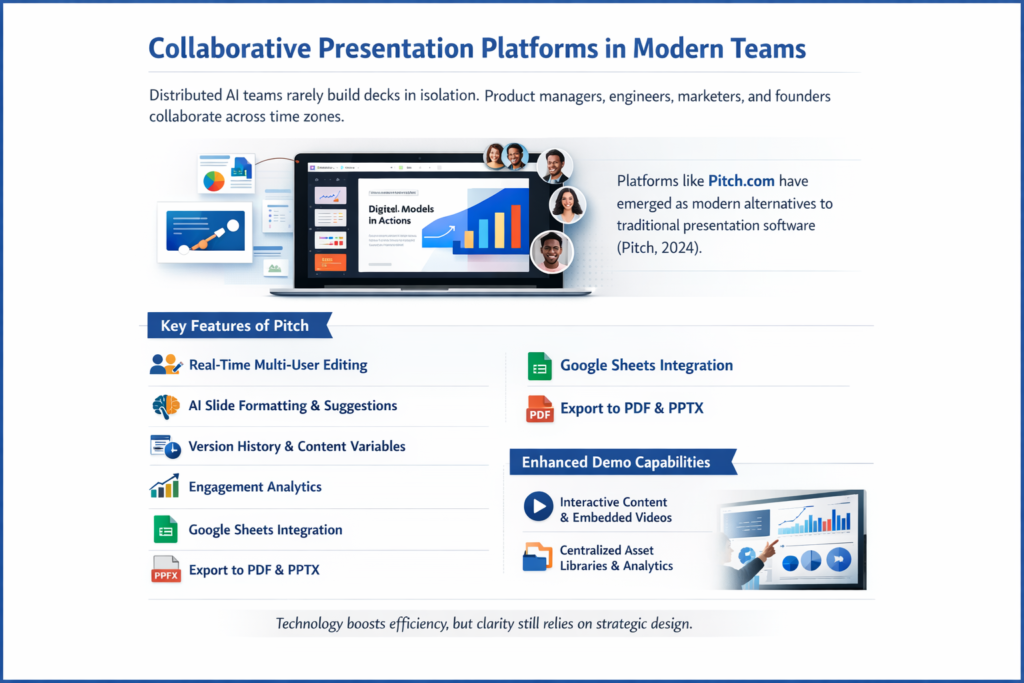
Distributed AI teams rarely build decks in isolation. Product managers, engineers, marketers, and founders collaborate across time zones.
Collaborative presentation platforms such as Pitch.com have gained traction in startup ecosystems because they combine slide creation with real time editing, analytics, and template control. Since its launch in 2020, Pitch has positioned itself as a modern alternative to traditional presentation software (Pitch, 2024).
Core features include:
- Real time multi user editing
- AI assisted slide formatting and tone suggestions
- Version history and content variables
- Engagement analytics
- Integrations with Google Sheets
- Export to PDF and PPTX
For AI developers preparing demos, embedding interactive content and videos can reduce friction. In my own consulting work with applied AI teams, centralized asset libraries and analytics have helped track which slides audiences revisit most during follow up sharing.
Technology enhances efficiency, but clarity still depends on strategic design.
Pricing and Scalability Considerations
Teams evaluating collaborative tools often compare cost to workflow efficiency.
| Plan | Monthly Price per Seat | Notable Features |
|---|---|---|
| Free | $0 | 100 AI credits, unlimited presentations, branded exports |
| Pro or Plus | $15 to $20 | 3,000 AI credits annually, custom fonts, video support |
| Business or Team | $23 to $80 | Unlimited links, guests, asset libraries, priority support |
| Enterprise | Custom | SSO, invoicing, expanded controls |
Annual billing typically reduces cost by roughly 17 percent. Additional AI credits may cost around $0.004 each beyond quotas.
From a practical standpoint, small AI startups often begin with Pro tiers, while larger product teams benefit from Business plans due to version control and asset libraries.
The investment should match collaboration complexity rather than slide volume.
Integrating Technical Depth Without Overload
AI founders frequently struggle with calibration. Too much technical detail alienates investors. Too little erodes credibility.
A balanced approach introduces architecture selectively. For example:
- Mention transformer based models if relevant
- Highlight fine tuning strategy
- Clarify data sources and evaluation benchmarks
- Summarize performance metrics
According to the Stanford AI Index Report 2024, model size and training costs have grown significantly since 2018, making efficiency and optimization increasingly important (Stanford HAI, 2024). Including such context signals awareness of broader industry dynamics.
When presenting language model solutions, I often encourage teams to show one clear workflow diagram rather than multiple architecture slides. Visual simplification builds trust more effectively than excessive jargon.
Demonstrating ROI and Market Viability
Enterprise clients prioritize outcomes over novelty. A well structured presentation quantifies impact.
Common ROI indicators include:
- Reduction in manual processing time
- Error rate improvement
- Revenue lift
- Customer retention increase
For example, Deloitte’s 2023 AI survey reported that organizations achieving scaled AI adoption often see measurable productivity gains within 12 to 18 months (Deloitte, 2023).
Rather than vague efficiency claims, include before and after comparisons. If using synthetic data demos, clarify assumptions.
In healthcare AI projects I have evaluated, the most persuasive decks connected diagnostic accuracy metrics directly to operational cost reduction. Decision makers respond to measurable transformation.
The Role of Analytics in Refining a Pitch
Modern collaborative platforms provide slide level engagement analytics. Teams can see which sections are viewed longest and which are skipped.
This feedback loop is underused. Reviewing analytics after sharing a deck with investors can reveal whether financial slides or product demos draw the most attention.
In fast paced AI environments, iteration cycles matter. A presentation should evolve based on data, not intuition alone.
As management thinker Peter Drucker famously stated, “What gets measured gets managed.” While originally referring to operations, the principle applies equally to communication strategy.
Treat the presentation itself as a product. Test, refine, repeat.
Common Mistakes in AI Startup Presentations
Even strong technical teams repeat predictable errors:
- Leading with features instead of problems
- Overloading slides with text
- Ignoring competitive landscape
- Failing to clarify revenue model
- Avoiding risk discussion
Investors expect acknowledgment of constraints. Transparency builds credibility.
In my experience advising early stage founders, the strongest decks address regulatory challenges, data privacy risks, and scalability limits directly. Avoiding these topics signals immaturity.
Balanced realism distinguishes sustainable ventures from speculative enthusiasm.
Designing for Decision Makers
Senior executives scan for clarity. They evaluate alignment with strategic priorities, not just technical elegance.
A practical framework for executive audiences includes:
- One sentence value proposition
- Three proof points
- One quantified outcome
- One clear call to action
Cognitive load research consistently shows that limited working memory constrains information processing (Sweller, 1988). Simplified structure respects that constraint.
When teams design with the audience’s mental bandwidth in mind, persuasion improves.
Takeaways
- A strong presentation guides decisions rather than delivering raw information.
- Tailor structure to investor, sales, or internal audiences.
- Collaborative platforms streamline workflow but do not replace strategy.
- Balance technical credibility with accessibility.
- Quantified ROI strengthens enterprise persuasion.
- Analytics enable iterative refinement.
- Transparency about risks builds trust.
Conclusion
Clear communication remains a competitive advantage in AI driven industries. Tools may evolve, slide templates may improve, and collaboration platforms may integrate advanced AI assistance, but the fundamentals endure. A compelling narrative, structured evidence, and audience awareness determine whether innovation translates into adoption.
From early stage founders seeking capital to enterprise teams presenting internal automation proposals, disciplined presentation design reduces friction in decision making. In complex technical environments, persuasion depends on clarity more than complexity.
Teams that treat their communication process with the same rigor they apply to model training or deployment tend to outperform peers. The most effective presentations are not flashy. They are structured, evidence based, and grounded in real world impact.
Read: Gamma in Context: From Greek Symbol to AI Presentation Engine
FAQs
1. What makes an AI startup presentation different from traditional business decks?
AI presentations must explain technical capability while emphasizing scalability, governance, and ROI without overwhelming non technical stakeholders.
2. How long should an investor presentation be?
Typically 10 to 20 minutes, with additional time reserved for discussion and due diligence questions.
3. Should technical architecture be included?
Yes, but selectively. Focus on relevance and differentiation rather than exhaustive diagrams.
4. Are collaborative presentation tools necessary?
Not mandatory, but they improve version control, remote teamwork, and analytics tracking in distributed teams.
5. How can teams improve presentation performance?
Review engagement analytics, gather audience feedback, and iterate structure based on observed decision patterns.
References
Deloitte. (2023). State of AI in the enterprise, 6th edition. Deloitte Insights.
Duarte, N. (2010). Resonate: Present Visual Stories that Transform Audiences. Wiley.
Gallo, C. (2014). Talk Like TED. St. Martin’s Press.
McKinsey & Company. (2023). The State of AI in 2023.
Pitch. (2024). Product overview and pricing. Retrieved from https://pitch.com
Sequoia Capital. (2020). Pitch deck guide.
Stanford Human Centered AI. (2024). AI Index Report 2024.
Sweller, J. (1988). Cognitive load during problem solving: Effects on learning. Cognitive Science, 12(2), 257–285.