
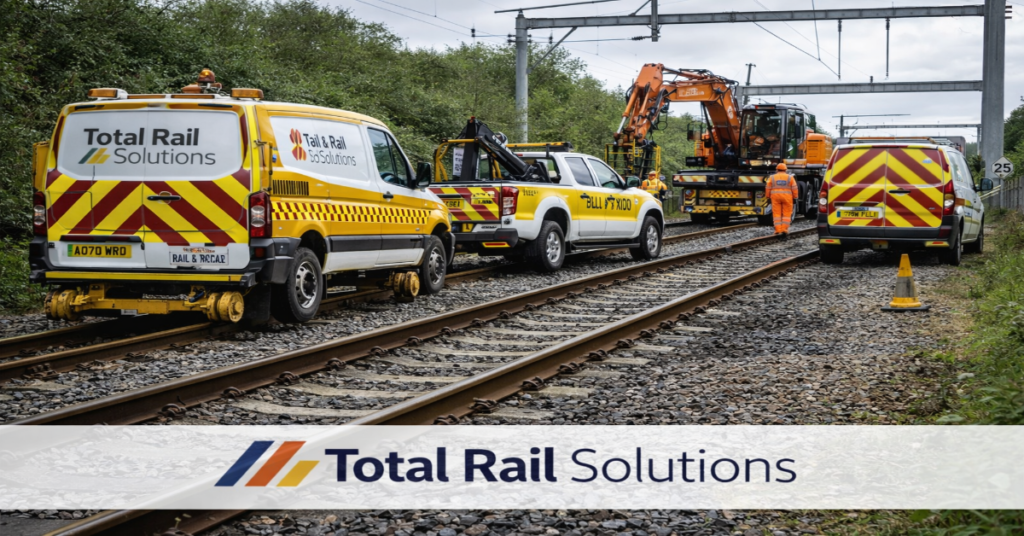

Total Rail Solutions provided the kind of infrastructure capability that rarely makes headlines but keeps major rail projects moving. Founded in 2007 and headquartered initially in Thatcham, Berkshire — later operating from a Basingstoke base — the company established itself as a dependable supplier of on-track plant hire, safety-critical subcontracting, and specialist labour to Tier 1 contractors across the UK rail network. Clients included Balfour Beatty, AMCOGiffen, and Alun Griffiths, with project exposure spanning Network Rail maintenance corridors, Crossrail construction phases, and London Underground civil works.
At its operational peak, total rail solutions managed a fleet reported at over 70 road-rail vehicles, with the majority under two years old — a fleet composition that signalled deliberate investment in compliance and reliability rather than legacy asset management. Holding a full On-Track Plant Operations Scheme (POS) licence, TRS had the regulatory standing to bid competitively on safety-critical contracts.
This article traces TRS’s operational model, its competitive position within the UK OTP sector, the conditions that led to its acquisition by Readypower Group, and what the firm’s trajectory reveals about structural pressures on mid-sized rail infrastructure subcontractors.
What Total Rail Solutions Actually Did
The UK rail infrastructure sector divides broadly into Tier 1 contractors who hold principal contracts with Network Rail or Transport for London, and a second tier of specialists who deliver specific technical capability under subcontract. Total Rail Solutions operated firmly in the second tier, with a service model built around three interlocking capabilities.
On-Track Plant Hire
Road-rail vehicles are purpose-built machines capable of travelling on both public roads and railway tracks. They are indispensable for maintenance windows, track renewals, and overhead line equipment (OLE) installation because they eliminate the need to transport heavy equipment exclusively by rail. TRS’s fleet emphasis on modern RRVs — the majority reportedly under two years old at any given time — gave the firm an operational advantage on contracts where equipment downtime or compliance deficiencies could trigger significant penalty clauses.
Overhead Line Equipment and Permanent Way Services
OLE work encompasses the installation, inspection, and maintenance of the electrification infrastructure that powers electric traction on the UK network. This is technically demanding work carried out largely in possession windows — scheduled periods when lines are taken out of service. Permanent way (PW) services cover the trackbed, rail, sleepers, and associated drainage. TRS’s positioning across both disciplines meant it could support composite scopes on major programmes rather than single-trade subcontracts.
Safety-Critical Labour Supply
Beyond plant hire, TRS supplied trained, competency-assessed personnel to operate equipment and support site activities. In the UK rail sector, workers in safety-critical roles must hold specific licences and medical clearances under the Network Rail Rule Book and associated standards. Maintaining a compliant workforce at scale requires continuous investment in training, medical assessments, and competency management — an operational cost that distinguishes serious operators from marginal entrants.
Operational Scale and Financial Profile
Publicly available records and company filings indicate that total rail solutions reached an estimated annual revenue range of £15 million to £56.3 million, with a headcount between 148 and 323 employees. This range reflects the project-dependent revenue pattern typical of subcontractors in the OTP sector: significant revenue volatility tied to the timing and duration of awarded scopes rather than recurring maintenance contracts.
The “One Team One Objective” philosophy articulated in TRS’s corporate positioning was a deliberate signal to Tier 1 clients that the firm operated as an integrated delivery partner rather than a transactional hire company. In a sector where principal contractors are assessed on supply chain management as part of their own framework submissions, a subcontractor that can demonstrate cultural and operational alignment with the principal’s delivery model carries a competitive edge.
TRS vs. Competing UK On-Track Plant Operators — Comparative Overview
| Operator | Specialism | Fleet Scale | POS Licence | Acquisition Status |
| Total Rail Solutions | OLE, PW, RRV hire, labour supply | 70+ RRVs (peak) | Full | Acquired by Readypower Group |
| Readypower Group | OTP hire, railway services | Large — national | Full | Active acquirer |
| Kirow Rail UK | Heavy lift, track renewal | Specialist heavy plant | Full | Independent (German parent) |
| Network Plant & Civils | PW, civils, drainage | Mid-size fleet | Full | Independent |
| Story Contracting | PW, structures, drainage | Large — multi-discipline | Full | Employee-owned, independent |
Note: Fleet and headcount figures are approximate, sourced from public records and company profiles. Readypower Group fleet figures reflect post-acquisition scale.
Major Projects and Delivery Context
TRS’s project exposure placed it at the operational centre of some of the UK’s most significant rail infrastructure programmes during the 2010s.
Crossrail
The Elizabeth line — then Crossrail — represented the largest single infrastructure investment in the UK in a generation. Construction required intensive OTP activity across both the central tunnel section and surface works on the Great Eastern and Great Western main lines. TRS’s involvement in Crossrail-related work, through subcontracts to principal contractors, gave the firm access to some of the most technically demanding and logistically complex possession regimes in the country.
Network Rail Frameworks
Network Rail’s Control Period structure (currently CP7, running 2024–2029) divides its national maintenance and enhancement spend into regional frameworks awarded to principal contractors. Subcontractors like TRS operate within these frameworks under back-to-back subcontract terms that mirror the principal’s obligations to Network Rail. This structure compresses subcontractor margins but provides relatively predictable work pipelines for those with preferred supplier status.
London Underground
London Underground’s engineering hours — nightly and weekend possessions — require a steady supply of RRVs and safety-critical personnel. The technical environment differs from Network Rail operations: different Rule Book requirements, different radio systems, and a more compressed possession window structure. TRS’s capability to operate across both Network Rail and LUL environments gave it operational flexibility that narrower specialists could not match.
The Readypower Group Acquisition — What Happened and Why
TRS’s original legal entity (company number 06076007) entered voluntary liquidation — a structured wind-down in which a company’s directors determine it cannot pay its debts or that an orderly exit is preferable to continued trading. This is distinct from compulsory liquidation (creditor-driven) and does not necessarily indicate catastrophic financial failure. Voluntary liquidation can be a mechanism for extracting value from a going concern by transferring operations to a new or acquiring entity while resolving legacy liabilities.
Readypower Group, which positions itself as a national provider of railway plant and services, absorbed TRS’s operations and noted the full integration on the original TRS LinkedIn profile. This is a standard consolidation pattern in the UK OTP sector: a mid-sized operator with a strong contract book, trained workforce, and compliant fleet represents a faster route to capability expansion for an acquirer than building equivalent capacity organically.
Why Mid-Sized OTP Operators Face Structural Pressure
Three structural forces create persistent pressure on independent operators at TRS’s scale. First, fleet renewal costs are substantial: a modern road-rail vehicle costs between £250,000 and £600,000 depending on specification, and maintaining a fleet of 70+ units requires continuous capital deployment. Second, competency management for safety-critical workforces involves ongoing training spend, medical assessment administration, and licence renewal management that scales with headcount but cannot be easily deferred. Third, the framework contract structure used by Network Rail and TfL increasingly favours larger suppliers with broader geographic capability and financial covenant strength — criteria that disadvantage mid-sized operators regardless of technical quality.
For Readypower, acquiring TRS represented a calculated move: absorbing an established contract base, a trained workforce, and a modern fleet at a transaction cost likely lower than organic replication. The infrastructure consolidation dynamics visible in the OTP sector are not unlike those seen in technology infrastructure — scale confers systemic advantages that erode the competitive position of independently viable but subscale operators.
TRS Operational Profile — Key Data Points
| Data Point | Detail | Source / Status |
| Founded | 2007 | Companies House / public records |
| Original HQ | Thatcham, Berkshire (later Basingstoke) | Corporate filings |
| Company Number | 06076007 | Companies House |
| Fleet Size (peak) | 70+ RRVs, majority under 2 years old | Corporate profile |
| Revenue Estimate | £15M – £56.3M annually | Public financial data |
| Employee Range | 148 – 323 | Public filings |
| POS Licence | Full On-Track Plant Operations Scheme | Industry records |
| Key Clients | Balfour Beatty, AMCOGiffen, Alun Griffiths | Corporate marketing |
| Acquisition | Readypower Group (date not publicly confirmed) | LinkedIn / public records |
| Legal Status | Voluntary liquidation — original entity dissolved | Companies House |
Three Gaps in Existing Coverage
1. The Fleet Age Advantage Was Also a Cash Flow Constraint
TRS’s reported emphasis on keeping most of its RRV fleet under two years old is typically discussed as a quality signal. It is also a cash flow constraint. Fleet renewal at that pace requires either sustained capital expenditure from operating profits, external financing, or a leasing model — each of which carries different risk profiles for a project-revenue business. For a company generating between £15M and £56M annually with variable project timing, maintaining a sub-two-year average fleet age while funding the associated working capital for safety-critical labour represents a compressed margin environment that independent operation makes progressively harder to sustain as the fleet grows.
2. Voluntary Liquidation Does Not Signal Failure — It Signals Strategy
Media and business database coverage of TRS’s wind-down often defaults to language that implies distress. The voluntary liquidation mechanism, however, is routinely used by solvent businesses to facilitate clean ownership transfers, resolve legacy contractual obligations, or restructure group entities. The fact that Readypower integrated TRS’s operations rather than acquiring a distressed asset suggests the liquidation was a transactional tool, not a symptom of operational collapse. This distinction matters for anyone analysing the UK rail supply chain’s consolidation history.
3. OLE Capability as a Scarcity Asset
Overhead line equipment installation and maintenance requires a specific combination of trained personnel, specialised plant, and possession management experience that very few organisations possess at scale. As the UK’s electrification pipeline — including projects deferred from Control Period 6 and re-scoped for CP7 — progresses, OLE-capable subcontractors are a genuine capacity constraint. TRS’s OLE capability was not merely a service line; it was a scarcity asset that made the firm more valuable to an acquirer like Readypower than a pure PW or civils operator of equivalent scale.
The Future of UK Rail Infrastructure Subcontracting in 2027
The structural forces that shaped TRS’s trajectory — fleet capital intensity, safety-critical workforce costs, and framework contract consolidation — are accelerating rather than moderating as the industry moves toward 2027.
Network Rail’s CP7 (2024–2029) allocated approximately £44 billion to the UK network. A significant portion of that spend flows through principal contractors to the OTP and specialist subcontract tier. However, Network Rail’s Supplier Assurance Framework, which requires subcontractors to demonstrate financial covenant strength alongside technical capability, is progressively raising the bar for independent mid-tier operators. Firms that cannot demonstrate balance sheet resilience alongside operational competence face delisting risk from approved supplier registers — a structural barrier that pushes consolidation further.
The HS2 programme, despite scope reductions announced in 2023 by the then-Conservative government, retains a Birmingham-to-London spine that continues to generate demand for OTP capability on the remaining works. Combined with the Transpennine Route Upgrade and ongoing electrification commitments in Wales and Scotland, the UK OTP market faces a pipeline of technically demanding work that exceeds the current capacity of independently operating specialists.
By 2027, the most likely structural outcome is a further reduction in the number of independent mid-tier OTP operators, with capability concentrated in a smaller number of larger groups — Readypower included — that can absorb fleet capital costs, maintain approved supplier status across multiple frameworks, and sustain the compliance management infrastructure required for safety-critical operations at scale.
Regulatory direction from the Office of Rail and Road (ORR), particularly around plant inspection regimes and competency verification, is unlikely to reduce compliance costs for smaller operators. The ORR’s periodic review cycles have consistently moved toward higher documentation and audit standards. Whether this regulatory direction serves the network’s long-term resilience or simply accelerates consolidation at the cost of supply chain diversity is an open question the industry has not resolved.
Takeaways
- TRS’s fleet composition strategy — prioritising modern, sub-two-year-old RRVs — was a deliberate quality signal that also compressed operating margins, making independent scaling progressively difficult.
- The firm’s voluntary liquidation was a transactional mechanism, not a distress indicator — the Readypower integration confirms that operational value was preserved through the wind-down.
- OLE capability represented a scarcity asset in the UK rail supply chain; the sector’s electrification pipeline makes this scarcity more acute through the remainder of CP7.
- Framework contract structures used by Network Rail and TfL systematically advantage larger, better-capitalised suppliers — a structural dynamic that erodes the competitive position of technically competent but subscale independents.
- The UK OTP sector is mid-consolidation; by 2027, the operator landscape will likely feature fewer independent mid-tier firms and more capability concentrated within national groups.
- Readypower’s acquisition of TRS demonstrates that strategic buyers in this sector value trained workforces and compliant fleets as much as contract books — capability assets that cannot be replicated quickly through organic investment.
Conclusion
Total rail solutions occupied a specific and genuinely difficult operational position: technically capable enough to win work on the UK’s most demanding programmes, but subscale relative to the capital requirements of sustained independent growth in a compliance-intensive sector. Its acquisition by Readypower Group was a rational outcome of structural market dynamics rather than an operational failure.
What TRS’s history clarifies, particularly for analysts of the UK infrastructure supply chain, is the gap between technical competence and structural durability. A firm can hold full POS licences, maintain a modern fleet, supply safety-critical labour to Tier 1 contractors, and still face an asymmetric competitive environment where the cost of compliance, fleet renewal, and framework qualification scales faster than revenue as the firm grows.
The consolidation of the UK OTP sector is not a story of weak operators being replaced by strong ones. It is a story of capital structure determining long-term viability in a market where technical excellence is necessary but not sufficient. As the broader infrastructure sector — examined through the lens of parallel resource deployment and systems architecture — continues to encounter similar structural tensions, TRS’s trajectory offers a useful reference point for understanding how capability and capital interact in infrastructure markets.
Frequently Asked Questions
What services did Total Rail Solutions provide?
TRS provided on-track plant hire (primarily road-rail vehicles), overhead line equipment installation and maintenance, permanent way services, and safety-critical labour supply. It held a full POS licence and operated across Network Rail, London Underground, and major construction programmes including Crossrail.
Why did Total Rail Solutions go into liquidation?
The original TRS entity (company number 06076007) entered voluntary liquidation — a structured wind-down typically used to facilitate ownership transitions or resolve legacy obligations in an orderly way. Readypower Group subsequently absorbed TRS’s operations and workforce, indicating the liquidation was a transactional mechanism rather than a sign of operational distress.
Who acquired Total Rail Solutions?
Readypower Group acquired and fully integrated TRS. The integration is noted on the original TRS LinkedIn profile. Readypower is a national rail plant and services provider, and the TRS acquisition expanded its fleet, workforce, and contract base. Specific acquisition terms have not been publicly disclosed.
What is Readypower Group?
Readypower Group is a UK rail infrastructure services company specialising in on-track plant hire and associated railway services. It operates at national scale and has grown partly through acquisitions of specialist operators. Following the TRS integration, it incorporated TRS’s RRV fleet and personnel into its wider operations.
What major projects did Total Rail Solutions work on?
TRS supported Crossrail construction works, Network Rail maintenance and renewal frameworks, and London Underground engineering operations. Specific scope details were not publicly disclosed at project level, but the firm’s client list — including Balfour Beatty and AMCOGiffen — confirms involvement in Tier 1 programme delivery.
Who were Total Rail Solutions’ main competitors?
Key competitors in the UK OTP sector included Readypower Group (now the acquirer), Story Contracting, Network Plant & Civils, and various regional OTP specialists. The competitive landscape was shaped by POS licence status, fleet age, and approved supplier standing on Network Rail and TfL frameworks. See the comparison table above for a structured overview.
What does the TRS acquisition mean for the UK rail supply chain?
The TRS acquisition reflects a broader consolidation trend in the UK OTP sector where capital-intensive compliance requirements — fleet renewal, workforce competency management, framework qualification — favour larger operators. Mid-tier independents with strong technical credentials but limited balance sheet scale are increasingly acquisition targets rather than long-term independent operators. This dynamic has supply chain diversity implications that the ORR and Network Rail have not formally addressed in published framework policy.
Methodology Note
This article draws on publicly available Companies House records for TRS company number 06076007, corporate profiles and LinkedIn data for operational context, and publicly available financial estimates from business data aggregators. Fleet figures and revenue ranges are derived from multiple public sources and are presented as estimates. The author did not conduct primary interviews with TRS or Readypower personnel; all claims about operational model and competitive positioning are based on documentary evidence and sector-level analysis. Forward-looking analysis for 2027 is grounded in Network Rail’s published CP7 expenditure framework, ORR periodic review outputs, and publicly documented infrastructure programme timelines. Readers requiring primary source verification should consult Companies House directly for entity records and Network Rail’s published framework documentation for supply chain context.
References
Companies House. (n.d.). Total Rail Solutions Ltd — company number 06076007. UK Government. https://find-and-update.company-information.service.gov.uk/
Network Rail. (2024). Control Period 7 delivery plan 2024–2029. Network Rail Infrastructure Ltd. https://www.networkrail.co.uk/
Office of Rail and Road. (2023). Annual assessment of Network Rail 2022–23. ORR. https://www.orr.gov.uk/
Readypower Group. (2024). Corporate services and fleet overview. Readypower Group Ltd. https://www.readypower.co.uk/
Rail Safety and Standards Board. (2023). On-track plant operations scheme — guidance for POS licence holders. RSSB. https://www.rssb.co.uk/
Transport for London. (2023). London Underground engineering access: Guidance for contractors. TfL. https://tfl.gov.uk/