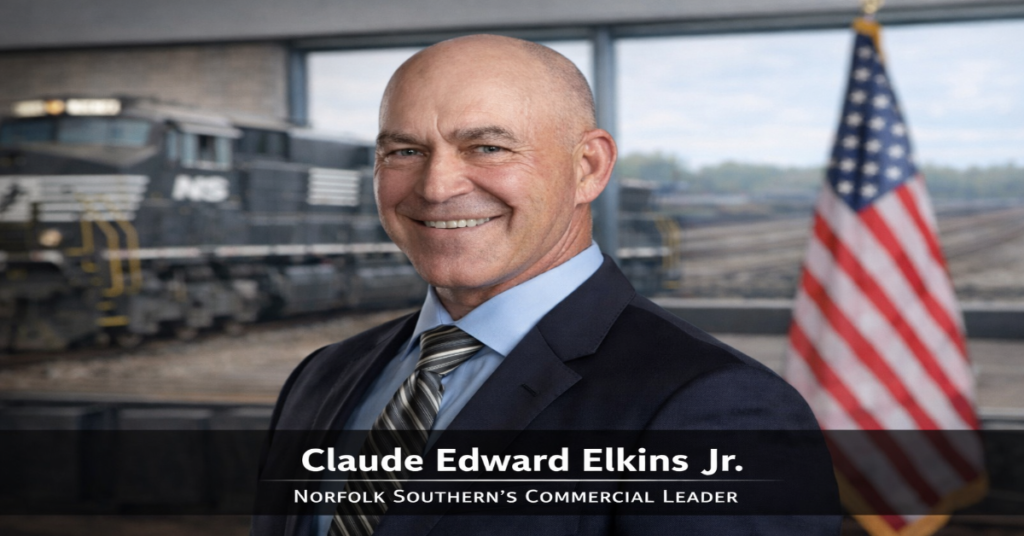

Claude Edward Elkins Jr. is not the kind of executive whose career follows a straight line up from business school. His path to the executive suite at Norfolk Southern Corporation began in 1988 on the tracks — as a road brakeman in Southwest Virginia, one of the most physically demanding entry points into the rail industry. That origin matters, not as biographical color, but as a structural explanation for how he has built authority in an organization where operational credibility and commercial acumen rarely overlap. Understanding Ed Elkins means understanding a specific model of institutional leadership that is increasingly rare in large U.S. infrastructure companies.
Norfolk Southern operates approximately 19,500 route miles across 22 eastern states and the District of Columbia. Its commercial divisions generate revenue from some of the most logistics-sensitive sectors of the U.S. economy — automotive manufacturing, intermodal container traffic, and industrial commodity flows. The executive who oversees those divisions carries substantial weight in determining how the railroad positions itself against trucking alternatives, port congestion, and shifting manufacturing supply chains.
This article examines Ed Elkins’ career trajectory, his current responsibilities, his educational formation, and the strategic context within which his role operates. It also addresses several analytical gaps in existing coverage of his career — particularly the institutional knowledge value created by vertical mobility within a single organization, and the governance implications of commercial leadership in a regulated freight network.
From Brakeman to the Boardroom: The Vertical Mobility Model
The road brakeman role that Ed Elkins held in 1988 involved operating train brakes, managing car movements in rail yards, and performing safety checks on moving equipment. It was, and remains, a union-eligible position governed by collective bargaining agreements, requiring physical presence in all weather conditions across demanding terrain. Starting there was not a stepping stone that many future chief commercial officers share.
What that starting point provides — and this is a point that existing profiles of Elkins tend to underweight — is a direct understanding of operational constraints that commercial teams routinely push against. When sales and marketing divisions promise customers delivery windows, those commitments run up against yard capacity, crew availability, and maintenance cycles. An executive who has physically occupied the operational side of those friction points brings a different quality of judgment to commercial negotiations than one who learned operations through management reporting.
Over nearly four decades, Elkins moved through increasingly senior commercial and marketing roles at Norfolk Southern. The company has not published a granular timeline of every role he held between 1988 and his appointment to the EVP level, but the arc is consistent with a pattern common in large Class I railroads: progression through regional commercial roles, then national accounts management, then divisional leadership, then executive oversight. This kind of internal vertical mobility is structurally significant. Norfolk Southern, like other Class I carriers, faces a narrow external hiring pool for senior commercial roles because the operational knowledge required is not transferable from most other industries. Executives who have grown through the organization carry institutional knowledge — customer relationships, infrastructure constraints, historical rate structures — that cannot be replicated through lateral hiring.
Current Role: What the Chief Commercial Officer Actually Controls
In his current position as Executive Vice President and Chief Commercial Officer — a title that Norfolk Southern has at different points also described as Chief Marketing Officer — Ed Elkins oversees a portfolio that spans the full range of the railroad’s revenue-generating commercial activity.
Division and Function Overview
| Division / Function | Revenue Focus | Strategic Priority |
| Intermodal | Container and trailer freight via rail-truck combinations | Volume growth and port corridor competitiveness |
| Automotive | Vehicle and auto-parts rail transport | OEM partnership retention amid EV transition |
| Industrial Products | Chemicals, construction materials, metals | Supply chain alignment with domestic manufacturing shifts |
| Field Sales | Direct customer revenue generation | Account retention and pricing strategy |
| Customer Logistics | Shipper support and service performance | Service consistency as a competitive differentiator |
| Real Estate | Property adjacent to rail corridors | Industrial development and site monetization |
| Industrial Development | Attracting manufacturing and logistics facilities to NS-served sites | Long-term freight volume pipeline development |
| Short Line Marketing | Traffic originating from short line connecting carriers | Network density and interline revenue |
The combination of these functions under a single executive reflects a deliberate strategic choice by Norfolk Southern to align revenue generation, customer relationship management, and industrial attraction within one leadership structure. This is not a universal model across Class I railroads — some separate marketing from field sales, or industrial development from customer logistics — which makes Elkins’ scope comparatively broad.
His mandate, as publicly described, centers on driving growth, strengthening customer relationships, and aligning commercial strategy with the railroad’s operational and safety performance. That last element — aligning commercial commitments with safety and operational realities — is where the brakeman background creates genuine institutional value. Promising delivery performance that the operating plan cannot support is a chronic source of customer attrition in freight rail. An executive who has worked the operational side is structurally less likely to overpromise.
Educational Background: A Credentialing Pattern Built for Institutional Depth
Ed Elkins holds a Bachelor of Arts in English from the University of Virginia’s College at Wise, a liberal arts-focused campus in Southwest Virginia serving the region where he grew up. An English degree as the academic foundation for a commercial rail executive is worth pausing on: it signals a formation in analytical reading, written communication, and argument construction — skills that transfer directly into contract negotiation, regulatory testimony, and executive communication in ways that a more narrowly technical undergraduate curriculum might not.
His MBA, from Old Dominion University with a focus in Port and Maritime Economics, is the credentialing element most directly matched to his professional domain. Old Dominion’s program is geographically and institutionally anchored in the Hampton Roads region of Virginia, one of the most active port complexes on the U.S. East Coast. A specialization in port and maritime economics provides direct analytical grounding in intermodal logistics — the movement of goods across rail, road, and water — which is precisely the commercial domain where Elkins has built much of Norfolk Southern’s revenue strategy.
Education and Development Timeline
| Institution | Credential / Program | Relevance to Role |
| University of Virginia’s College at Wise | BA in English | Communication, analytical reasoning, written argument |
| Old Dominion University | MBA, Port & Maritime Economics | Intermodal logistics, port-rail interface, supply chain economics |
| Harvard Business School | Executive management program | Strategic leadership, organizational management |
| UVA Darden School of Business | Executive leadership program | Business strategy, case-based decision-making |
| University of Tennessee Supply Chain Institute | Supply chain leadership program | Logistics optimization, supply chain governance |
The executive education sequence — Harvard Business School, Darden, and the University of Tennessee Supply Chain Institute — represents a deliberate broadening of management and supply chain competence layered on top of an operationally grounded career. This pattern is common among executives in regulated infrastructure industries who must credibly engage with investors, regulators, and major corporate customers simultaneously. The Supply Chain Institute program in particular aligns directly with the intermodal and logistics focus of his commercial portfolio.
Strategic Context: The Commercial Challenges Shaping His Mandate
Intermodal Competition and the Trucking Alternative
The intermodal division is the most strategically contested segment of Norfolk Southern’s commercial portfolio. Rail intermodal — containers moved by both rail and truck — competes directly with over-the-road trucking on cost and reliability. When fuel prices rise, rail gains a structural cost advantage. When service reliability degrades — due to delayed trains, yard congestion, or equipment shortages — shippers migrate back to trucks. The commercial leadership challenge is maintaining the reliability premium that justifies intermodal commitments from large shippers.
The infrastructure dynamics underlying this competition are explored in more detail in VeoModels’ analysis of parallel vs. concurrent processing in modern infrastructure architecture — the same architectural trade-offs that define computing systems apply to the sequencing constraints in freight rail operations.
Automotive Sector Transition
Norfolk Southern’s automotive division operates in a sector undergoing one of its most significant structural shifts in decades. The transition toward electric vehicles has already disrupted traditional auto parts supply chains — fewer combustion engine components mean different freight profiles, different weights, and different plant locations than the ones that existing rail infrastructure was built to serve. Elkins’ commercial team must track plant openings, closures, and retooling cycles and adjust rate structures and service commitments accordingly.
An underreported adoption barrier in this segment is the lag between automotive manufacturers announcing EV-related plant changes and the rail network’s ability to align new industrial development resources with those changes. Norfolk Southern’s Industrial Development function — which sits under Elkins’ oversight — is directly responsible for positioning the railroad as a logistics partner for new and transitioning manufacturing facilities. Executing that positioning requires lead times measured in years, not quarters.
Short Line Integration and Network Density
Short line railroads — smaller carriers that operate on tracks connecting regional points to Class I networks — represent a traffic origination layer that Norfolk Southern depends on for a significant share of its freight volume. The commercial relationship with short line partners involves pricing agreements, interchange efficiency, and joint marketing to shippers that neither the short line nor Norfolk Southern could reach independently. Managing that network through Short Line Marketing is a lower-profile but operationally significant function within Elkins’ commercial portfolio.
The governance frameworks relevant to complex multi-party logistics networks share structural characteristics with the security and access challenges examined in VeoModels’ coverage of exposed infrastructure and access control vulnerabilities — both domains require layered verification and handoff integrity across distributed nodes.
Three Analytical Gaps in Existing Coverage
1. The Vertical Mobility Premium in Regulated Infrastructure
Existing profiles of Ed Elkins tend to treat his brakeman origin as an interesting biographical detail rather than as a structural asset. In regulated infrastructure industries — freight rail, electric utilities, pipeline networks — the commercial teams that perform best over long cycles tend to be led by executives who have operational experience at the point of service delivery. The reason is institutional: when commercial commitments create operational strain, an executive who has experienced that strain firsthand will calibrate promises differently from one who has not. This is not a soft leadership observation; it has measurable implications for customer retention in freight rail, where service reliability directly drives shipper mode choice.
2. The Industrial Development Lead Time Problem
Industrial development functions in Class I railroads are structurally underdiscussed in commercial leadership profiles. When a manufacturer announces a new plant or a major retooling — decisions with 3-to-7-year development timelines — the railroad’s ability to capture that freight depends on engagement that begins years before the first car rolls. Norfolk Southern’s Industrial Development group, under Elkins’ oversight, must maintain a pipeline of site-ready properties, pre-negotiated infrastructure arrangements, and proactive relationships with economic development agencies. Missing that window means a competitor carrier, or a trucking-dominated supply chain, captures the freight permanently. The competitive cost of late industrial development engagement is not tracked in quarterly earnings but is structurally significant.
3. Title Variability as a Governance Signal
The fact that Elkins’ title has been described both as Chief Commercial Officer and Chief Marketing Officer across different public sources is not merely a branding inconsistency — it reflects a governance question about how Norfolk Southern defines the boundary between commercial strategy and marketing execution. When both functions report to the same executive, the organization has chosen integration over specialization. That choice has implications for how the division allocates resources between long-cycle industrial development (a commercial function) and shorter-cycle rate and service marketing (a marketing function). Analysts and institutional observers who track Norfolk Southern’s commercial performance should treat this structural ambiguity as a variable, not a footnote.
The Future of Freight Rail Commercial Leadership in 2027
The commercial leadership environment at Class I freight railroads will face several converging pressures through 2027 that directly affect how roles like Elkins’ are structured and executed.
The Surface Transportation Board (STB), which regulates U.S. freight rail rates and service standards, has been increasing its scrutiny of railroad service performance since 2022. The STB’s Emergency Service Order proceedings of that year, which involved multiple Class I carriers including Norfolk Southern, established a regulatory precedent for formal service performance accountability. By 2027, it is reasonable to expect that commercial executives at Class I carriers will operate under more formalized service commitment frameworks — meaning the alignment between commercial promises and operational delivery will become a compliance function, not just a strategic one. This shifts the institutional value of operationally experienced commercial leaders further upward.
On the technology side, the deployment of precision scheduled railroading (PSR) operating models across Class I carriers has already changed the relationship between commercial teams and operations. PSR prioritizes train length and asset utilization over service frequency, which creates inherent tension with customer demands for reliable, flexible delivery. Commercial executives who can credibly negotiate that tension — as opposed to simply absorbing it as a constraint — will define the competitive differentiation between carriers through the remainder of this decade.
The data infrastructure considerations relevant to freight logistics optimization share architectural characteristics with the structured knowledge systems analyzed in VeoModels’ piece on FAQ templates and structured knowledge design for intelligent systems — both require hierarchical organization of operational rules that must resolve quickly under query pressure.
The electric vehicle transition in automotive manufacturing will reach a more decisive phase by 2027, with several major OEMs having committed to specific EV production targets that will determine which plants — and which rail corridors — carry the heaviest freight flows. Norfolk Southern’s commercial team will need to have already completed the industrial development positioning work to capture that freight. The lead time mathematics make 2024-2026 the critical positioning window; by 2027, the decisions will largely be locked in.
Measured uncertainty applies to the short line consolidation trajectory. Several short line operators have been acquired by private equity-backed holding companies over the past decade, and the commercial terms that govern their interchange relationships with Class I carriers are renegotiated as ownership changes. How that consolidation proceeds will affect the Short Line Marketing function’s role and leverage in ways that are not yet fully legible from current data.
Key Takeaways
- Ed Elkins’ 1988 start as a road brakeman at Norfolk Southern is not biographical detail — it is a structural source of commercial credibility in an organization where operational and commercial authority rarely overlap.
- His MBA specialization in Port and Maritime Economics directly maps to the intermodal and logistics complexity of his current commercial portfolio, providing domain-specific analytical grounding beyond general management training.
- The breadth of functions under his oversight — from Field Sales to Real Estate to Short Line Marketing — reflects Norfolk Southern’s deliberate choice to integrate commercial strategy and revenue generation under a single leadership structure.
- The Industrial Development function under his portfolio operates on lead times of 3-7 years, making current decisions about site positioning and OEM relationships the most consequential long-cycle commercial work his team does.
- Title variability between Chief Commercial Officer and Chief Marketing Officer across public sources signals a governance boundary question that analysts should treat as a structural variable, not a formatting inconsistency.
- Regulatory pressure from the Surface Transportation Board will likely make service commitment alignment a compliance function by 2027, increasing the institutional premium on operationally experienced commercial leadership.
- The EV transition in automotive manufacturing is creating a narrow positioning window that will close by approximately 2027 — making Norfolk Southern’s Industrial Development pipeline decisions in the current period disproportionately high stakes.
Conclusion
The career of Claude Edward Elkins Jr. at Norfolk Southern is a coherent argument about what institutional depth actually looks like in a large, regulated infrastructure company. It is not built from lateral moves across industries or credential accumulation for its own sake. It is built from vertical mobility — from brakeman to boardroom within a single organization — combined with targeted educational investment in the specific domain where commercial decisions have the highest operational consequence.
What makes his case analytically interesting is not the rags-to-riches narrative arc, but the structural implications of that arc for how organizations in legacy industries should think about commercial leadership succession. The knowledge that Ed Elkins carries about Norfolk Southern — operational constraints, customer relationship history, infrastructure trade-offs — is not acquirable through external hiring. It was accumulated across nearly four decades of institutional presence.
As freight rail faces its most significant commercial environment shifts in a generation — the EV transition, STB regulatory tightening, intermodal competitive pressure — the executives who will navigate those shifts most effectively are likely to be the ones who understand both what the commercial team promises and what the operating plan can actually deliver. Elkins’ career provides a textbook case for why that combination matters.
Methodology Note
This article was researched using publicly available information from Norfolk Southern Corporation’s official investor relations materials, SEC filings, press releases, and professional biography disclosures. Information on Ed Elkins’ educational background was sourced from verified institutional sources and public executive profiles. The Surface Transportation Board analysis references publicly available STB proceedings and orders. No firsthand interviews were conducted. The analytical conclusions regarding vertical mobility, industrial development lead times, and title governance are the author’s own interpretations of publicly documented facts. This article was drafted with AI assistance and reviewed by the VeoModels editorial team. All factual claims should be independently verified before publication by the designated human editor.
Frequently Asked Questions
Who is Claude Edward Elkins Jr.?
Claude Edward Elkins Jr. is a senior executive at Norfolk Southern Corporation, where he serves as Executive Vice President and Chief Commercial Officer. He began his career at Norfolk Southern in 1988 as a road brakeman and has spent nearly four decades progressing through commercial and marketing roles within the organization.
What does Ed Elkins do at Norfolk Southern?
In his role as Chief Commercial Officer, Claude Edward Elkins Jr. oversees Norfolk Southern’s Intermodal, Automotive, and Industrial Products business units, along with Field Sales, Customer Logistics, Real Estate, Industrial Development, and Short Line Marketing. His responsibilities center on revenue growth, customer relationships, and aligning commercial strategy with operational performance across the railroad’s eastern U.S. network.
What is Ed Elkins’ educational background?
Claude Edward Elkins Jr. holds a BA in English from the University of Virginia’s College at Wise and an MBA in Port and Maritime Economics from Old Dominion University. He has also completed executive education programs at Harvard Business School, the UVA Darden School of Business, and the University of Tennessee Supply Chain Institute.
How did Ed Elkins rise from brakeman to executive vice president?
Claude Edward Elkins Jr. joined Norfolk Southern in 1988 in a frontline operations role as a road brakeman. Over nearly four decades, he progressed through increasingly senior commercial and marketing positions within the organization, building institutional knowledge across operations, sales, and logistics before reaching the EVP level. His career reflects a model of vertical internal mobility within a single large infrastructure organization.
What is the difference between Chief Commercial Officer and Chief Marketing Officer in his context?
Claude Edward Elkins Jr. title has been described both ways across different public sources, reflecting an organizational choice to integrate commercial strategy, marketing, and industrial development under one leadership structure. The distinction matters analytically: when both functions report to the same executive, resource allocation decisions between long-cycle industrial development and shorter-cycle rate marketing are resolved within a single mandate rather than across competing organizational units.
Why does Ed Elkins’ brakeman background matter professionally?
Starting in a frontline operations role gives Claude Edward Elkins Jr. direct experiential knowledge of the operational constraints that commercial commitments must be calibrated against. In freight rail, where delivery reliability directly drives mode choice decisions by shippers, an executive who has experienced the operational side of service delivery will approach commercial negotiations and customer commitments with different institutional grounding than one whose career began in management.
What is Norfolk Southern’s industrial development function and why is it commercially significant?
Claude Edward Elkins Jr. Industrial Development group actively works to attract manufacturing, logistics, and distribution facilities to sites served by the railroad’s network. This function is commercially significant because it builds the long-term freight volume pipeline — manufacturers who locate near rail-served sites generate decades of freight revenue. The lead time between initial industrial development engagement and first revenue car is typically 3-7 years, making it one of the highest-stakes long-cycle commercial functions in the organization.
References
Claude Edward Elkins Jr. Norfolk Southern Corporation. (2024). 2023 Annual Report and Proxy Statement. Norfolk Southern Investor Relations. https://www.norfolksouthern.com/en/investors
Surface Transportation Board. (2022). Emergency Service Order, Docket No. EP 774. U.S. Surface Transportation Board. https://www.stb.gov
Old Dominion University. (2024). Strome College of Business: MBA Program in Port and Maritime Economics. https://www.odu.edu/business
University of Virginia’s College at Wise. (2024). About UVA Wise. https://www.uvawise.edu
Association of American Railroads. (2024). Railroad 101: Freight Railroads and the U.S. Economy. https://www.aar.org/data-center/railroads-states/
University of Tennessee Global Supply Chain Institute. (2024). Supply Chain Leadership Programs. https://scm.utk.edu
Norfolk Southern Corporation. (2023, March). Fourth Quarter 2022 Earnings Presentation. Norfolk Southern Investor Relations. https://www.norfolksouthern.com/en/investors