
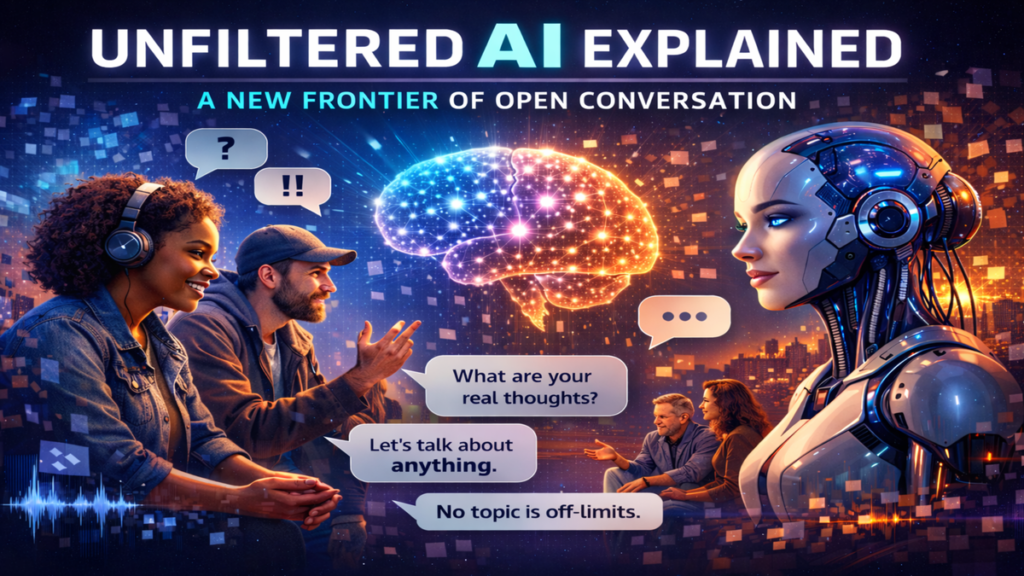

i write about unfiltered AI from the position of someone who has closely observed how artificial intelligence systems have gradually narrowed what people are allowed to say, explore, or imagine. In many mainstream platforms, filters are not subtle. They actively shape conversations by blocking topics, rephrasing user intent, or terminating dialogue entirely. Unfiltered AI exists as a response to that reality. It represents a class of AI systems designed to allow open conversation without content restrictions, enabling users to explore creative writing, adult roleplay, controversial ideas, philosophical questions, and deeply personal topics without automated censorship. This article explains unfiltered AI in detail, not as a novelty, but as a meaningful shift in how people interact with intelligent systems.
Understanding Unfiltered AI at a Conceptual Level
What Unfiltered AI Actually Means
Unfiltered AI refers to chatbots and AI platforms that operate without content moderation layers that restrict themes, language, or scenarios. These systems do not attempt to judge whether a topic is sensitive, controversial, or adult-oriented. Instead, they focus on responding coherently and consistently to user input. This does not mean that unfiltered AI is chaotic or unsafe by default. It means the system does not impose artificial boundaries on conversation topics.
In filtered systems, the AI is trained to redirect or refuse when certain keywords or ideas appear. In unfiltered AI, the priority is conversational freedom. Users control the direction, tone, and depth of interaction. This approach appeals to people who want creative autonomy rather than institutional safeguards.
Why Filters Exist in Most AI Systems
Most commercial AI platforms apply filters for legal, reputational, and safety reasons. Large companies must comply with global regulations and brand expectations. As a result, filters become broad and conservative. While this protects companies, it often limits legitimate use cases such as fictional writing, mature storytelling, or honest self-expression.
Unfiltered AI platforms intentionally reject this model. They place responsibility on the user rather than the system. This philosophical difference is central to understanding why unfiltered AI attracts a distinct audience.
The Cultural Rise of Unfiltered AI
Demand for Authentic Digital Conversation
Modern internet users increasingly value authenticity. In social media, messaging apps, and creative tools, people gravitate toward environments where expression feels less constrained. Unfiltered AI aligns with this cultural shift. Users want conversations that feel natural, emotionally consistent, and uninterrupted by automated warnings.
This demand is especially strong among writers, roleplay enthusiasts, and individuals exploring identity, relationships, or creative fantasies. For them, interruption breaks immersion. Unfiltered AI preserves narrative continuity.
Creative Freedom as a Core Value
Creative work often involves exploring uncomfortable or unconventional ideas. Writers, game designers, and storytellers use unfiltered AI as a brainstorming partner. Because the system does not block themes, it becomes a flexible collaborator rather than a restrictive tool.
This freedom does not automatically lead to extreme content. In practice, many users simply want honest conversations without feeling monitored or corrected by an algorithm.
Major Unfiltered AI Platforms
Nastia AI
Nastia AI is known for offering uncensored chat experiences with added multimedia features. The platform supports text-based conversation along with voice and image generation. Its design emphasizes immersion and personalization. Users can engage in long-form dialogue that maintains emotional tone and narrative memory.
A defining feature of Nastia AI is its privacy-oriented structure. Conversations are not heavily logged or analyzed for moderation purposes. This makes it appealing to users who value discretion alongside expressive freedom.
Venice.ai
Venice.ai positions itself as a privacy-first unfiltered AI platform. It emphasizes a no-logging policy and local data handling where possible. The free tier allows limited text-based interactions, while paid plans unlock higher message limits and image generation.
Venice.ai appeals to users who prioritize confidentiality over advanced features. The platform demonstrates that unfiltered AI can coexist with strong privacy principles rather than sacrificing them.
Muah AI
Muah AI focuses on customizable AI companions. Users can define personalities, communication styles, and interaction boundaries. The platform supports text, voice, and image-based responses, which enhances immersion.
Its strength lies in continuity. Conversations feel consistent over time, allowing deeper roleplay and long-term engagement. This makes Muah AI popular among users who treat AI as an ongoing companion rather than a one-off tool.
NoFilterGPT
NoFilterGPT centers on security and encryption. It offers unrestricted conversations while maintaining a zero-log policy. Free access is limited, but paid plans expand usage significantly.
This platform demonstrates that unfiltered AI does not have to compromise security. Instead, it shows that openness and protection can coexist within thoughtful system design.
DRT.fm
DRT.fm emphasizes conversational realism. Its AI responses aim to maintain consistent tone and context over extended interactions. While it does not offer as many multimedia features as others, its strength lies in dialogue quality and memory retention.
For users who value smooth, uninterrupted conversation above all else, DRT.fm offers a compelling experience.
Comparison of Popular Unfiltered AI Platforms
| Platform | Free Tier Limits | Key Strengths | Privacy Level |
|---|---|---|---|
| Nastia AI | Generous | Voice and images, immersive chats | High |
| Venice.ai | Limited messages | No logs, multilingual support | Highest |
| Muah AI | Basic access | Deep customization and roleplay | Strong |
| NoFilterGPT | Few messages | Encryption and zero logging | Highest |
| DRT.fm | Varies | Natural dialogue and memory | Moderate |
How Unfiltered AI Image Generation Works
Prompt-Based Visual Creation
Some unfiltered AI platforms include image generation tools. These tools convert text descriptions into images without imposing content restrictions. Users describe scenes, styles, or characters, and the system generates visuals accordingly.
The absence of filters allows for broader creative expression. Artists and writers can visualize characters or environments that might be blocked elsewhere. The goal is not shock value, but continuity between written and visual storytelling.
Iterative Refinement for Better Results
Users often refine prompts gradually. By adjusting mood, lighting, or perspective, they guide the AI toward more accurate results. This iterative process mirrors how human artists refine sketches, making AI feel like a collaborative partner.
Voice Interaction in Unfiltered AI
Why Voice Matters
Voice responses add emotional depth to AI conversations. Hearing tone, pacing, and inflection enhances immersion. In unfiltered environments, voice interaction feels more natural because the AI is not constrained by scripted safety language.
Practical Use Cases
Voice features are used for roleplay, storytelling, and companionship. They also help users who prefer auditory communication or want a more lifelike experience. When combined with text and images, voice completes a multi-sensory interaction loop.
Running Unfiltered AI Locally for Full Control
Local Models and Privacy
Some users prefer running unfiltered AI locally on their own hardware. This ensures complete privacy and eliminates reliance on external servers. Local AI models operate offline and store no data beyond the user’s machine.
Tools for Local Deployment
KoboldCpp is a popular tool for running local AI models in efficient formats. When paired with a user interface like SillyTavern, it provides a fully customizable unfiltered AI environment. This setup appeals to technically inclined users who want maximum autonomy.
Hardware Considerations
Running local AI requires adequate hardware. GPU memory, processor speed, and storage all affect performance. Users often experiment with different model sizes to balance quality and responsiveness.
Ethical and Practical Considerations
Responsibility Without Filters
Unfiltered AI shifts responsibility to the user. Without automated moderation, users must self-regulate. This model assumes maturity and intentionality rather than enforcing behavior through code.
Misconceptions About Unfiltered AI
A common misconception is that unfiltered AI exists only for extreme content. In reality, many users simply want honest conversation without interruption. The absence of filters supports nuance rather than excess.
Advantages and Limitations of Unfiltered AI
Key Advantages
Unfiltered AI enables creative freedom, uninterrupted dialogue, and personalized interaction. It supports use cases that filtered systems cannot accommodate, such as complex roleplay or philosophical exploration.
Realistic Limitations
These platforms may lack the polish or scale of major commercial AI systems. Performance can vary, and support resources may be limited. Users trade corporate stability for expressive autonomy.
The Future of Unfiltered AI
Growing Demand for User-Controlled Systems
As awareness grows, more users are seeking AI systems they control rather than systems that control them. Unfiltered AI aligns with this trend, especially among creators and privacy-conscious individuals.
Potential Evolution
Future unfiltered AI platforms may combine local processing, advanced memory, and customizable safeguards. Instead of universal filters, users may define their own boundaries.
Read: https://veomodels.com/ai-models/thotchat-ai/
FAQs
What is unfiltered AI in simple terms
Unfiltered AI refers to chatbots and platforms that allow open conversation without automated content restrictions or topic blocking.
Is unfiltered AI illegal to use
Unfiltered AI itself is not illegal. Legality depends on how the user chooses to use the system and local laws.
Why do people prefer unfiltered AI over mainstream chatbots
People prefer unfiltered AI because it allows uninterrupted dialogue, creative freedom, and personal expression without automated refusals.
Can unfiltered AI be private
Yes, many unfiltered AI platforms emphasize no logging, encryption, or even local offline operation for maximum privacy.
Is running unfiltered AI locally difficult
Running unfiltered AI locally requires some technical knowledge, but modern tools make the process accessible with proper hardware.