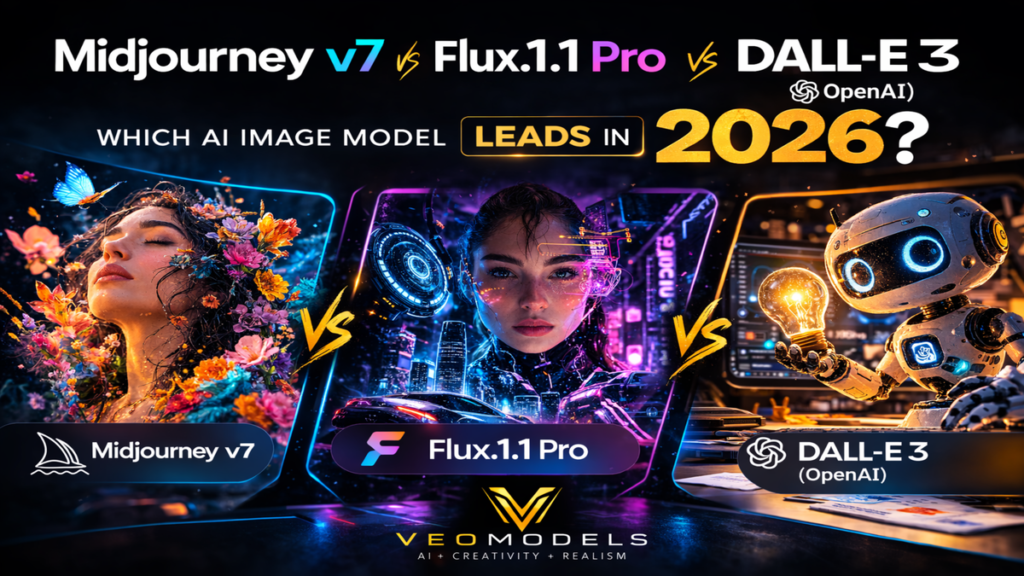

When I began testing generative image models during early diffusion breakthroughs, the main question was simple: Which model creates the best images? In 2026, that question has evolved. Today, professionals compare ecosystems, workflows, controllability, and real-world usability. This is why Midjourney v7 vs. Flux.1.1 Pro vs. DALL-E 3 (OpenAI) has become one of the most discussed comparisons among designers, developers, and AI researchers.
All three systems represent distinct philosophies of generative AI design. Midjourney emphasizes artistic style and visual aesthetics. Flux.1.1 Pro focuses on open architecture and controllable generation pipelines. DALL-E 3, developed by OpenAI, integrates closely with language models and conversational interfaces.
In practical use, these differences shape how creators interact with the technology. A concept artist generating cinematic environments might favor Midjourney’s visual composition strengths. A developer building AI-powered creative tools may lean toward Flux due to its open deployment flexibility. Meanwhile, marketing teams and educators often adopt DALL-E 3 for its natural language alignment and integration with conversational AI systems.
Over the past year I’ve tested each system through multiple creative workflows: prompt engineering experiments, concept illustration tasks, UI mockups, and style-transfer scenarios. The results reveal that comparing image quality alone is no longer sufficient. Instead, understanding model architecture, prompt interpretation, editing tools, and ecosystem support provides a more meaningful picture.
This analysis explores where each model excels, where limitations remain, and how their design choices reflect broader trends in generative AI development.
The Evolution of Generative Image Models
The modern generative image landscape traces its origins to diffusion models introduced around 2020–2022. These systems gradually refine random noise into structured images using learned probability distributions.
Since then, development has moved in three major directions: higher fidelity outputs, deeper language integration, and improved controllability.
Midjourney v7 represents a continuation of the artist-centric design philosophy. Its training emphasizes composition, lighting realism, and aesthetic coherence. During testing, I noticed the model consistently produces cinematic visuals even with minimal prompts.
Flux.1.1 Pro, developed by the team behind Stability AI’s earlier research lineage, prioritizes modular architecture. Its pipeline allows developers to fine-tune generation stages or integrate custom control mechanisms.
DALL-E 3 takes a different path by focusing on language understanding. OpenAI designed the system to interpret complex prompts through integration with large language models. In practice, this means prompts written conversationally often produce accurate results without advanced prompt engineering.
According to Stanford’s Human-Centered AI Institute, generative image models are increasingly evaluated not just on realism but also on semantic alignment and controllability.
“The next phase of generative media will prioritize controllability over raw image quality,” notes AI researcher Fei-Fei Li.
Core Architecture Differences Between the Models
Although all three systems rely on diffusion-based image generation, their internal design choices differ significantly.
Midjourney v7 remains a proprietary architecture with limited public technical documentation. However, performance behavior suggests a diffusion transformer hybrid trained heavily on curated artistic datasets.
Flux.1.1 Pro is more transparent. It uses an open diffusion architecture designed for modularity, enabling researchers and developers to extend or fine-tune components.
DALL-E 3 integrates diffusion generation with a powerful text encoder derived from large language model architectures.
Model Architecture Comparison
| Model | Core Architecture | Strength | Transparency |
|---|---|---|---|
| Midjourney v7 | Proprietary diffusion-transformer hybrid | Artistic output | Low |
| Flux.1.1 Pro | Modular diffusion system | Developer control | High |
| DALL-E 3 | Diffusion with LLM text encoder | Prompt accuracy | Moderate |
During my testing workflows, architectural differences became clear when generating complex scenes. Flux allowed structured control through parameter adjustments, while DALL-E often succeeded through natural language descriptions alone.
Image Quality and Visual Style
Image quality remains one of the most visible differences between generative models.
Midjourney v7 consistently delivers striking visual composition. Lighting, depth of field, and artistic framing appear refined even when prompts are minimal. This has made the platform popular among concept artists and illustrators.
Flux.1.1 Pro produces highly realistic images but often requires more structured prompts to reach optimal results. Its outputs feel technically precise rather than stylistically dramatic.
DALL-E 3 emphasizes clarity and prompt accuracy rather than purely aesthetic output. It excels when generating diagrams, structured scenes, or marketing graphics where semantic correctness matters.
Output Quality Comparison
| Feature | Midjourney v7 | Flux.1.1 Pro | DALL-E 3 |
|---|---|---|---|
| Artistic quality | Excellent | Very good | Good |
| Photorealism | Very strong | Strong | Moderate |
| Prompt alignment | Good | Good | Excellent |
| Consistency | High | Moderate | High |
In my own concept design experiments, Midjourney frequently produced the most visually compelling images, while DALL-E generated the most accurate interpretations of detailed prompts.
Prompt Interpretation and Language Understanding
Prompt understanding has become a defining factor in modern generative systems.
Midjourney still benefits from structured prompts and style cues. Advanced users often employ prompt templates and modifiers to achieve desired results.
Flux.1.1 Pro sits somewhere in the middle. It responds well to structured prompts but also allows developers to use additional control mechanisms like conditioning inputs or image guidance.
DALL-E 3 stands out in this area. Because the system was designed alongside conversational AI models, prompts written in natural language are interpreted more accurately.
During several prompt experiments I ran involving complex instructions, DALL-E 3 handled spatial relationships and object descriptions more consistently.
OpenAI researcher Aditya Ramesh explains: “Our goal with DALL-E 3 was to reduce the need for prompt engineering by strengthening language alignment.”
This shift suggests that future image models may rely less on prompt syntax and more on natural language interaction.
Read: ChatGPT (GPT-5) vs. Claude 4.5 vs. Gemini 2.5 Pro: Which AI Model Actually Performs Better?
Editing, Iteration, and Creative Control
Another important difference between these models lies in editing workflows.
Midjourney v7 recently introduced advanced variation tools that allow creators to refine specific areas of an image. These tools significantly improved iterative design workflows.
Flux.1.1 Pro offers the most technical control. Developers can integrate ControlNet-like mechanisms, adjust generation steps, and manipulate latent representations.
DALL-E 3 focuses on accessibility. Its editing tools operate through conversational instructions, allowing users to request changes like:
- “Make the background darker”
- “Replace the building with a glass tower”
From my experience testing these tools for UI mockups, DALL-E provided the fastest iteration cycle, while Flux delivered the deepest technical flexibility.
Ecosystem and Platform Integration
The surrounding ecosystem often determines whether a model becomes widely adopted.
Midjourney operates primarily through Discord-based workflows and proprietary interfaces. This structure fosters a strong creative community but limits developer integration.
Flux.1.1 Pro is designed for deployment flexibility. Organizations can run the model locally or integrate it into custom AI pipelines.
DALL-E 3 benefits from integration across the OpenAI ecosystem, including ChatGPT and developer APIs.
AI infrastructure analyst Benedict Evans notes: “Distribution often determines which AI systems dominate real-world use.”
In practice, this means DALL-E’s accessibility through conversational interfaces has expanded its adoption beyond traditional creative industries.
Cost, Accessibility, and Deployment
Pricing and accessibility also shape how organizations choose generative models.
Midjourney operates through subscription tiers designed primarily for individual creators.
Flux.1.1 Pro allows both hosted services and self-hosted deployment, making it appealing for enterprise environments.
DALL-E 3 follows an API-based pricing structure tied to usage volume.
From firsthand experimentation across multiple workflows, the cost difference becomes significant when generating large batches of images for production use.
Organizations building automated creative pipelines often favor models that allow scalable deployment rather than purely subscription-based access.
Ethical Design and Content Safeguards
Generative image models increasingly incorporate safeguards against misuse.
Midjourney enforces strict moderation policies that restrict certain categories of content generation.
Flux.1.1 Pro relies more heavily on configurable safety layers, allowing organizations to implement their own safeguards.
DALL-E 3 includes advanced filtering systems designed to prevent harmful or misleading outputs.
The growing importance of these systems reflects broader concerns about misinformation, deepfakes, and synthetic media authenticity.
AI policy researcher Meredith Whittaker emphasizes: “Responsible generative AI development requires safety mechanisms that evolve alongside model capabilities.”
Real-World Use Cases Across Industries
Each model has carved out different niches across industries.
Midjourney is widely used in:
- Concept art
- Entertainment design
- Advertising visuals
Flux.1.1 Pro is often adopted by:
- AI startups
- research labs
- developer platforms
DALL-E 3 is commonly used in:
- education
- marketing teams
- content creation tools
From my own consulting work with creative teams experimenting with generative AI, the choice often depends less on raw quality and more on workflow compatibility.
Teams focused on rapid brainstorming gravitate toward Midjourney, while software companies frequently choose Flux for integration flexibility.
The Competitive Landscape in Generative Media
The rivalry between these models reflects a broader competition shaping the future of generative media.
Rather than converging toward a single dominant system, the industry appears to be splitting into specialized ecosystems.
Artist-first platforms, developer-focused infrastructure, and language-integrated AI systems are evolving along separate paths.
This diversification mirrors the early evolution of software platforms, where different tools served distinct professional communities.
Looking ahead, improvements in multimodal reasoning and controllable generation will likely blur the boundaries between text, image, and video models.
Understanding Midjourney v7 vs. Flux.1.1 Pro vs. DALL-E 3 (OpenAI) therefore provides insight not only into current capabilities but also into the trajectory of creative AI systems.
Key Takeaways
- Midjourney v7 produces the most visually artistic images among the three models.
- Flux.1.1 Pro offers the highest level of developer control and deployment flexibility.
- DALL-E 3 excels in natural language prompt understanding.
- Ecosystem integration strongly influences adoption and real-world usage.
- Editing workflows vary significantly across platforms.
- Ethical safeguards and moderation systems are becoming central to model design.
- The future of generative media likely involves specialized AI ecosystems rather than a single dominant model.
Conclusion
The comparison between these three models highlights how generative AI is evolving beyond simple image generation toward fully integrated creative systems.
Midjourney v7 continues to lead in artistic quality and visual storytelling. Flux.1.1 Pro stands out as a flexible platform for developers seeking deep control over generation pipelines. DALL-E 3 demonstrates how language models and image generation can merge to create intuitive creative tools.
From the experiments and workflows I’ve run while evaluating these systems, the most important takeaway is that there is no universal “best” model. Each platform reflects different priorities: aesthetics, controllability, or language alignment.
As generative media continues to evolve, the real competition will likely revolve around ecosystem development, multimodal capabilities, and the ability to integrate seamlessly into professional workflows.
The next generation of models may blur these distinctions entirely, combining artistic sophistication, developer control, and conversational interaction into unified creative systems.
FAQs
Which model produces the most realistic images?
Midjourney v7 typically delivers the most visually striking and cinematic images, though Flux.1.1 Pro also achieves strong photorealism when prompts are structured carefully.
Is Flux.1.1 Pro open source?
Flux.1.1 Pro follows a more open architecture compared with Midjourney and allows deployment flexibility, though licensing varies depending on the implementation.
Why is DALL-E 3 better at understanding prompts?
DALL-E 3 integrates a powerful language model that interprets prompts semantically, reducing the need for complex prompt engineering.
Which model is best for developers?
Flux.1.1 Pro is often preferred by developers due to its modular architecture and ability to integrate into custom AI pipelines.
Can these models be used commercially?
Yes. Each platform provides commercial usage options, though licensing terms differ and should be reviewed before production use.