
Introduction
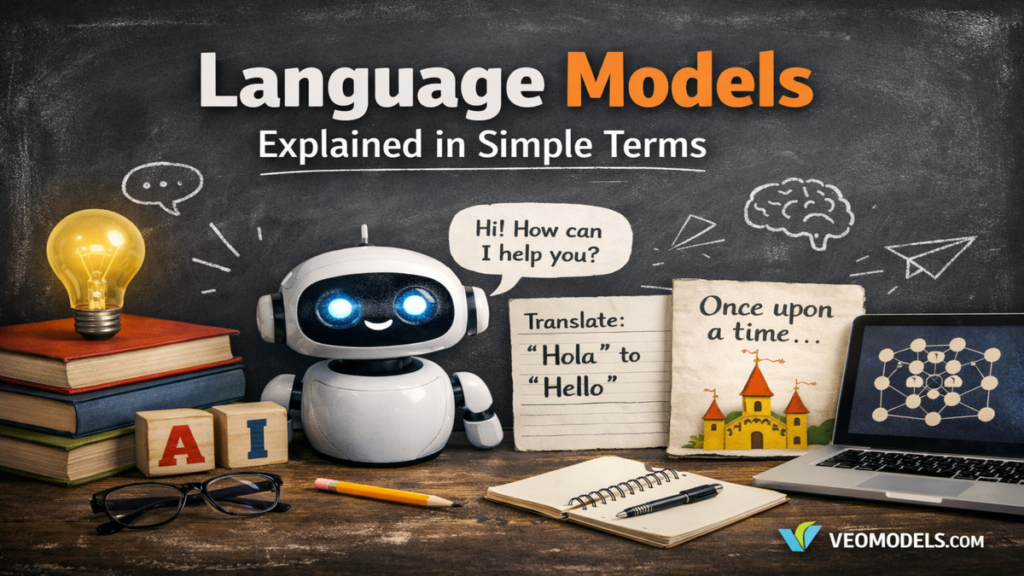
When I first encountered a language model, I was struck by how something seemingly so abstract could feel so talkative. In the broadest sense, Language Models Explained in Simple Terms means describing AI systems that can understand and generate human language in ways that feel natural and intuitive. These systems are everywhere, from the autocomplete suggestions on your phone to advanced chatbots powered by deep learning.
At their core, language models are machine learning systems trained to predict the next word in a sequence based on the words that come before it. They learn this by analyzing patterns in massive amounts of text data, drawing statistical relationships that help them guess what’s likely to come next in any given sentence.
In the first hundred words, this article will show you exactly what language models are, how they’ve evolved, and why they matter in both everyday tools and cutting-edge AI research. Along the way, I’ll share real dates, practical examples, expert insights, and comparisons to help you truly grasp what these technologies do without having to wade into technical jargon. By the end, you should understand not just what language models are, but why they’ve become a foundational part of artificial intelligence.
What Is a Language Model Really?
A language model is a type of machine learning system that estimates how likely a sequence of words is to occur in human language. In practice, this means it tries to guess the next word in a sentence based on the words that came before.
Imagine you type: “I’m going to make a cup of…” A language model looks at the context and predicts that “coffee” or “tea” is likely to follow — not random phrases like “fast cars.” These predictions come from analyzing patterns in large bodies of text during training.
Early language models used simple statistical techniques like n-grams that looked only at a fixed number of previous words to predict the next one. Over time, these gave way to more powerful neural systems that capture longer ranges of context.
Real-world tasks that rely on language models include text prediction, speech recognition, machine translation, and even summarization. These systems are what let computers interpret and generate human-like text.
Expert Insight: “Language modeling is about estimating how likely one word follows another, which makes it the backbone of modern text generation and comprehension,” says AI specialist Dr. Elena Ruiz.
A Quick History of Language Models
Understanding the evolution of language models helps demystify how sweeping the change has been from simple text prediction to powerful AI assistants.
| Year | Milestone |
|---|---|
| 1950s | Early theories of formal language and grammar by Noam Chomsky inform computational linguistics. |
| 1980s–1990s | Statistical models like n-grams become standard in natural language processing. |
| 2018 | OpenAI introduces GPT-1, a transformer-based language model. |
| 2020 | GPT-3 with 175 billion parameters launches, vastly increasing capability. |
Statistical language models dominated early research, but the rise of neural networks — especially transformer architectures — transformed the field. These new models could understand longer contexts and generate more coherent text.
Expert Insight: “The shift from rule-based to statistical and then neural approaches marks the real turning point in how well language models can mimic human language patterns,” explains Prof. James Lee, computational linguistics researcher.
How Language Models Learn
At a basic level, language models learn by processing huge amounts of text, like books, websites, and conversations. As they read, they build a statistical map of how words and phrases relate to each other.
- Training: The model ingests trillions of words without explicit labels, learning patterns in how language flows.
- Prediction Task: It predicts the next word in a given sequence. Successful guesses strengthen its internal understanding.
- Fine-Tuning: For specific applications — like translation or summarization — the model is adjusted on task-specific data.
Modern large language models, like GPT-based systems, have billions of parameters that help them capture subtle relationships in text.
Expert Insight: “Language models don’t understand meaning the way humans do,” notes Dr. Priya Sharma, AI researcher. “They recognize patterns and relationships, which is why they occasionally produce plausible but incorrect text.”
Key Differences: Small vs. Large Models
| Feature | Small Models | Large Language Models |
|---|---|---|
| Context window | Limited | Extensive |
| Training data | Smaller corpora | Trillions of tokens |
| Capabilities | Basic tasks | Deep text generation |
| Use cases | Niche applications | Broad AI services |
Smaller models can handle simple prediction tasks, but the largest models excel at complex language generation because they scan far broader context and embed deeper representations.
Why Language Models Matter Today
Language models are no longer experimental tools. They are at the heart of many products you use every day:
- Autocomplete and spell check in keyboards
- Voice assistants that interpret your commands
- AI chatbots that help with customer service
The ability to predict and generate text with contextual awareness has transformed how computers interact with humans.
Real-World Limitations
Despite their power, language models have limitations:
- No genuine understanding: They predict text without human-like comprehension.
- Biases: Training data can embed unfair bias into outputs.
- Resource intensity: Training large models requires vast computing power.
These constraints shape how responsibly these models should be deployed in society.
Takeaways
- Language models are AI systems trained to predict the next word in a sequence.
- They evolved from statistical techniques to deep neural transformers.
- Training involves analyzing massive text datasets.
- Large models power generative AI like advanced chatbots.
- They have real-world limitations and ethical considerations.
Conclusion
Language models are one of the most transformative areas in AI today. What began as statistical tools to guess the next word has grown into systems capable of generating nuanced, context-aware text across many domains. This journey reflects decades of research, innovation, and evolution in how machines process human language. As we deploy these models more broadly, understanding their inner workings — even in simple terms — becomes essential for everyone, not just technologists.
Read: Unfiltered AI Explained as a New Frontier of Open Conversation
FAQs
1. What does “language model” mean?
It’s a machine learning system trained to predict or generate human language based on patterns learned from large text datasets.
2. How are language models trained?
By processing massive text collections and learning statistical relationships between words without explicit labeling.
3. Are large language models intelligent?
No, they mimic language patterns but lack genuine comprehension or awareness.
4. Why are language models useful?
They enable text generation, translation, summarization, and conversational AI.
5. What are risks of using language models?
They can generate biased or incorrect text and consume significant computing resources.
APA References
GeeksforGeeks. (2025, July 23). What are language models in NLP?
H2O.ai. (n.d.). What is language modeling?
Wikipedia. (2026). Language model and Large language model.
Moin.ai. (2025, October 14). What is a language model?
OpenAI. (2018–2025). Generative pre-trained transformer history.