

Introduction
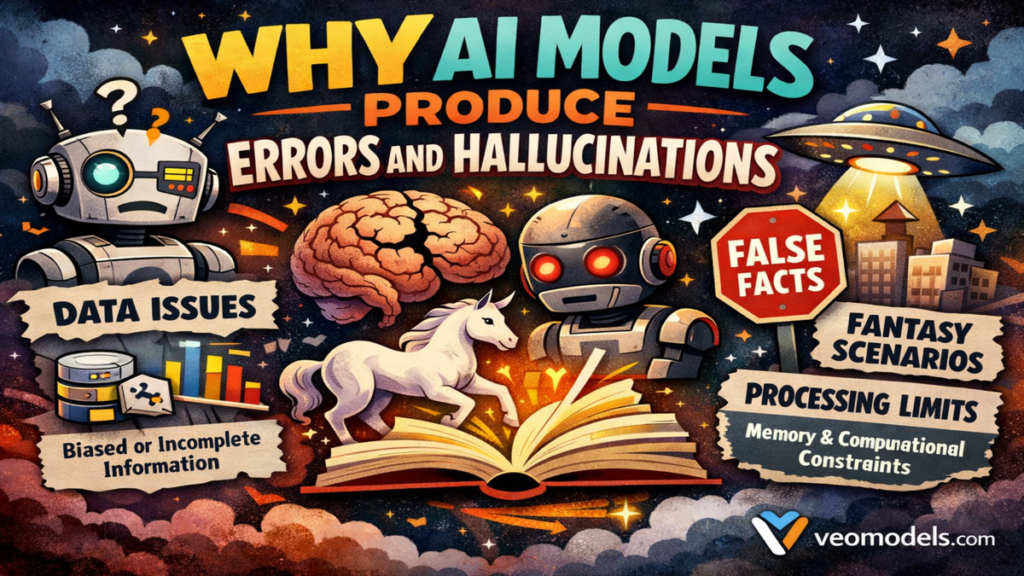
I’ve been working with generative AI systems for years, and one question keeps coming up with students, engineers, and decision-makers alike: why AI models produce errors and hallucinations so confidently and seemingly out of nowhere. Within the field of artificial intelligence, especially with large language models (LLMs), hallucinations are outputs that appear coherent and factual but are actually false, fabricated, or unsupported by real evidence. These “confident mistakes” — where the system asserts an invented detail that never existed — are not glitches in the traditional sense but are deeply rooted in how these models are trained and operate. Understanding why AI models produce errors and hallucinations is essential for researchers, developers, and end users who must balance innovation with reliability and trustworthiness in critical applications such as healthcare, legal systems, and scientific discovery.
At its core, generative AI doesn’t understand the world the way humans do — it predicts patterns in data sequences. This prediction-driven approach, combined with imperfect training data, design incentives that reward confident outputs, and architectural constraints, leads to a system that sometimes predicts plausible but incorrect answers rather than admitting uncertainty. In practical terms, that means an AI tool might fabricate a non-existent research paper or confidently give the wrong date for a historical event because its internal statistical model found that sequence of words to be the most probable continuation given its prompt and parameters.
Below, we’ll unpack the major technical and statistical reasons that lead AI models to produce errors and hallucinations, how those errors manifest in real-world outputs, and what researchers and engineers are doing to mitigate them. This analysis draws on research, industry observations, and the lived experience of working with cutting-edge generative systems.
What Hallucinations in AI Really Are
AI hallucinations refer to situations where models generate outputs that are plausible but factually incorrect or fabricated. This isn’t a “bug” in the usual software sense. It’s a consequence of how generative systems are trained and optimized. LLMs don’t have a fact-checking module built in; instead, they are designed to generate text that statistically fits patterns from training data, even if those patterns don’t reflect truth.
Definitions and Types
| Hallucination Type | Description |
|---|---|
| Factual Inaccuracy | Incorrect dates, names, or facts stated confidently |
| Source Hallucination | Reference to books or papers that don’t exist |
| Logical Hallucination | Coherent reasoning that contains flawed conclusions |
| Context Hallucination | Misinterpretation of intent leading to irrelevant outputs |
This taxonomy helps us see that hallucinations are not monolithic — they stem from a mix of internal mechanisms, data limitations, and inference challenges.
The Prediction Engine Problem
At their core, large language models are prediction engines. They work by estimating the probability of the next word in a sequence given what came before. This probabilistic generation process means the model always produces something, even when it has incomplete or conflicting evidence. Unlike humans, AI models lack a native mechanism to say “I don’t know.”
“AI systems are not truth engines; they’re prediction engines, and that fundamental design leads them to produce the most plausible continuation, even if it’s incorrect.” — AI researcher (paraphrased from technical analysis)
This creates a fundamental tension: the model is optimized for fluent output, not factual accuracy.
Training Data Limitations
One of the biggest drivers of hallucination is imperfect training data. If the corpus used to train an AI includes inaccuracies, biases, or gaps, the model will mirror those flaws in its outputs. Web crawls, forum posts, and scraped text are rich with language patterns but not all are reliable sources of truth.
Researchers also note that source-reference divergence — situations where the training text doesn’t match reliable external facts — encourages the model to generate text that doesn’t reflect reality.
Statistical Incentives and Evaluation Pressures
Recent research highlights how training and evaluation practices encourage hallucinations. Models often receive higher scores for confident answers, even when they are guesses. Over time, this leads to a system that prefers plausible certainty to cautious uncertainty.
“Current evaluations measure performance in a way that rewards guessing rather than acknowledging uncertainty.” — OpenAI research summary on hallucination causes
This test-taking optimization becomes baked into how models respond in production, reinforcing hallucination behavior.
Architectural and Mechanistic Causes
Beyond data and incentives, the internal design of an AI model — including its attention mechanisms, tokenization process, and probabilistic decoding strategies — contributes to errors.
For example, certain sampling methods used during text generation (such as top-k sampling) can increase diversity but also raise the risk of drawing improbable sequences that look plausible but are false.
Compounding Errors and Cascading Hallucinations
An initial mistake can snowball. If an AI generates an incorrect fact early in its response, subsequent portions of the output may build on that false premise, leading to a cascade of hallucinations that are harder to detect.
Real-World Impacts of Hallucinations
These errors aren’t just technical curiosities. In sectors like law, medicine, and scientific research, hallucinations can have serious consequences if users treat AI output as authoritative. Studies have shown that even experienced users can be misled when plausible-sounding AI text contains falsehoods.
Table: Hallucination Risks Across Domains
| Domain | Potential Harm |
|---|---|
| Healthcare | Misdiagnosis or incorrect guidelines |
| Law | Wrong legal citations and arguments |
| Academia | Fabricated references and papers |
| Journalism | Misinformation propagation |
This table underscores that the same underlying causes of AI hallucinations can ripple outward into societal harms if not managed carefully.
Mitigation Efforts and Future Directions
Researchers and engineers are actively developing strategies to reduce hallucinations. These include:
- Retrieval-augmented generation: Grounding outputs in verified external sources to anchor responses in factual data.
- Uncertainty modeling: Training models to recognize and communicate when they lack sufficient information.
- Modified evaluation practices: Shifting benchmarks to reward honesty and discourage overconfidence.
None of these fully eliminates hallucination, but they represent important steps toward more trustworthy AI.
Key Takeaways
- AI hallucinations stem from probabilistic design and prediction-first optimization.
- Training data quality deeply influences output accuracy.
- Evaluation incentives can unintentionally encourage overconfident guesses.
- Architectural choices affect how errors propagate.
- Hallucinations can have real-world impacts if not mitigated.
Conclusion
AI models are powerful pattern recognizers, not truth machines. The question of why AI models produce errors and hallucinations is rooted in the very way these systems are built and evaluated. These systems learn from imperfect data, generate based on probability, and are optimized for fluency and test performance rather than cautious accuracy. As a result, hallucinations remain an enduring challenge in the field of generative AI. While researchers are actively developing methods to reduce these errors — from grounding mechanisms to modified benchmark practices — it is unlikely that hallucinations can ever be fully eliminated. Understanding their causes helps us use AI responsibly and build systems that are more transparent, reliable, and safe for real-world decision-making.
Read: Gramhir Pro AI as an All-in-One Social Media Intelligence Platform
FAQs
What exactly is an AI hallucination?
An AI hallucination is when a model produces output that sounds plausible but is factually incorrect or fabricated, due to prediction-based generation.
Can hallucinations be completely eliminated?
No. Because of probabilistic design and data limitations, fully eliminating hallucinations is extremely challenging.
Why do models sometimes make up citations?
Models generate plausible patterns — if the training distribution includes structured citations, they may fabricate similar patterns without verifying their existence.
How does retrieval-augmented generation help?
It grounds responses in verified data sources, reducing reliance on internal probability-based guesses.
Are newer AI models better at avoiding errors?
Some are improved, but increased complexity can also lead to subtler hallucinations that are harder to detect.