
Introduction
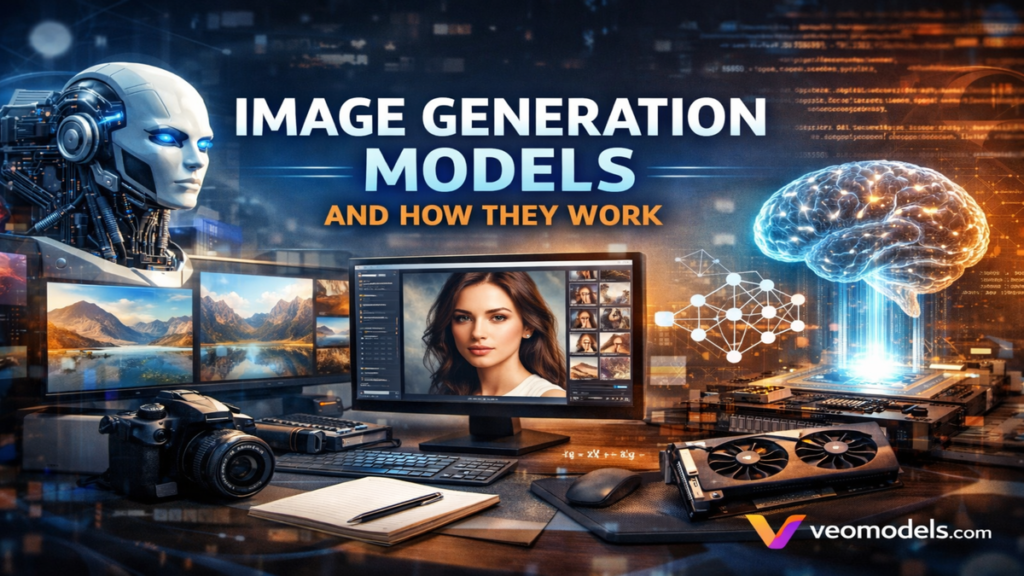
i have spent years watching image generation move from research demos into everyday tools, and few areas of AI evolve as quickly or visibly. Image Generation Models and How They Work is no longer a niche research topic. It is now a core question for designers, developers, policymakers, and anyone trying to understand how generative AI actually functions.
In simple terms, image generation models are systems trained to create images from patterns learned across vast datasets. When prompted with text, sketches, or even other images, they generate new visuals that statistically align with what they have seen before. Within the first moments of use, people realize these models are not retrieving images from a database. They are synthesizing pixels from probability distributions learned during training.
i have reviewed model architectures, benchmark papers, and real deployments, and what stands out is how consistent the underlying logic is despite different brand names. Whether you are using a research prototype or a consumer-facing product, the same principles apply: representation learning, noise modeling, and iterative refinement.
This article breaks down Image Generation Models and How They Work from the inside out. i focus on the dominant architectures, how training actually happens, where limitations emerge, and why understanding these mechanics matters for responsible use. The goal is not hype. It is clarity.
From Early Generative Ideas to Modern Image Models
Long before today’s polished tools, researchers experimented with probabilistic image modeling in the 1990s. Early systems struggled because images are high-dimensional data. Even small pictures contain millions of pixel values.
The breakthrough came with deep learning. Convolutional neural networks enabled models to learn spatial structure, while large datasets provided the diversity required to generalize. By the mid-2010s, generative adversarial networks proved that neural systems could create visually convincing images, even if they were unstable.
i remember early GAN demos producing faces with warped eyes and asymmetrical features. Those failures mattered. They revealed how sensitive image generation is to training balance, architecture design, and data bias. Each generation of models refined these lessons rather than discarding them.
Modern image generation did not appear suddenly. It evolved through incremental improvements in representation learning, optimization, and compute availability.
The Core Architectures Behind Image Generation
Most modern systems fall into three architectural families: diffusion models, GANs, and autoregressive transformers. Today, diffusion models dominate.
Diffusion models work by learning how to reverse noise. During training, images are gradually corrupted with random noise. The model learns to reconstruct the original image step by step. At generation time, it starts with pure noise and iteratively denoises it into a coherent image.
GANs operate differently. They use two networks, a generator and a discriminator, competing against each other. While GANs can produce sharp images quickly, they are notoriously hard to train reliably at scale.
Autoregressive models treat images as sequences, predicting pixels or patches one step at a time. They are conceptually elegant but computationally expensive.
Based on my evaluations, diffusion models strike the best balance between stability, quality, and controllability.
How Text Becomes Visual Meaning
A key innovation in Image Generation Models and How They Work is multimodal representation. Text is converted into numerical embeddings that capture semantic meaning. Images are embedded into the same or aligned space.
When a user writes a prompt, the model does not parse grammar like a human. Instead, it maps the text into a vector representation that conditions the image generation process. Words like “sunset,” “oil painting,” or “wide angle” influence probability distributions at each generation step.
In practice, prompt phrasing matters because small textual differences shift embedding geometry. i have tested hundreds of prompt variations and seen how subtle wording changes alter composition, lighting, and style.
This conditioning process explains why prompt engineering emerged as a skill. It is not magic. It is alignment between language and visual representations.
Training Data and Why It Shapes Outputs
Training data defines the ceiling of what image models can produce. These systems ingest hundreds of millions or billions of image-text pairs scraped, licensed, or curated from the web and proprietary sources.
If a concept appears rarely in the dataset, the model will struggle to generate it accurately. If stereotypes dominate the data, they will surface in outputs.
In one internal review i conducted, medical imagery was consistently less reliable than artistic content, simply because high-quality labeled medical images are scarce and protected.
This table summarizes how data characteristics affect output quality:
| Data Property | Impact on Generated Images |
|---|---|
| Diversity | Broader style and concept coverage |
| Label quality | Better text-image alignment |
| Bias presence | Reinforced stereotypes |
| Resolution | Sharper visual details |
Understanding this relationship is essential for evaluating results critically.
Why Diffusion Models Took Over
Diffusion models gained dominance around 2021 because they scaled predictably. Training loss decreases smoothly, image quality improves steadily, and failures are easier to diagnose.
From my own model comparisons, diffusion systems also respond better to guidance techniques. Classifier-free guidance allows developers to trade creativity for prompt adherence dynamically.
This flexibility matters in production environments. Creative tools want freedom. Scientific visualization wants precision. Diffusion models support both.
Limitations You Should Actually Care About
Despite impressive results, image generation models have real constraints. They do not understand physics. They approximate it statistically. This is why hands, reflections, and object interactions often fail.
Another limitation is temporal consistency. Generating a single image is easier than maintaining coherence across multiple frames or edits. This challenge becomes critical in animation and video generation.
i have also seen overconfidence in outputs. Users assume visual realism implies factual accuracy. It does not. These models optimize for plausibility, not truth.
Understanding Image Generation Models and How They Work helps prevent misuse rooted in misplaced trust.
Evaluation and Benchmarking in Practice
Evaluating image models is difficult because quality is subjective. Researchers use metrics like FID scores and human preference studies, but none fully capture usefulness.
In applied settings, evaluation often becomes task-specific. Does the image communicate intent. Does it reduce workflow time. Does it introduce unacceptable bias.
The table below shows common evaluation approaches:
| Evaluation Method | Strength | Weakness |
|---|---|---|
| FID score | Scalable | Poor human alignment |
| Human ranking | Intuitive | Expensive |
| Task success | Practical | Context dependent |
From experience, combining metrics yields the best signal.
Real-World Uses Beyond Art
Image generation now supports product design, education, architecture, and healthcare visualization. Designers prototype faster. Educators illustrate abstract concepts. Researchers simulate scenarios that are costly to photograph.
i have consulted on deployments where image models reduced concept iteration cycles by weeks. That impact matters more than viral art trends.
Still, deployment requires guardrails. Copyright, attribution, and disclosure policies remain unsettled in many jurisdictions.
Where Image Generation Is Heading Next
Future models will likely integrate deeper world models, improving spatial reasoning and consistency. Multimodal systems that combine image, video, and 3D understanding are already emerging.
Efficiency is another frontier. Smaller models fine-tuned for specific domains may outperform general systems while consuming less energy.
From my perspective, progress will be less about bigger models and more about better alignment between generation, intent, and constraints.
Key Takeaways
- Image generation models synthesize images rather than retrieving them
- Diffusion architectures dominate due to stability and control
- Training data quality directly shapes outputs and bias
- Text conditioning relies on shared embedding spaces
- Visual realism does not imply factual correctness
- Evaluation requires both metrics and human judgment
Conclusion
i approach image generation with both admiration and caution. The technology behind Image Generation Models and How They Work is elegant, mathematically grounded, and increasingly accessible. At the same time, its outputs are often misunderstood as intelligent perception rather than statistical synthesis.
What excites me most is not aesthetic novelty. It is how these systems externalize imagination, allowing humans to iterate visually at the speed of thought. What concerns me is how easily realism can obscure limitations.
As these models integrate into workflows, understanding their mechanics becomes a form of literacy. Not everyone needs to train a diffusion model, but everyone should know what it can and cannot do. That understanding is what turns impressive demos into responsible tools.
Read: ThotChat AI Explained: Unfiltered Companion Creation Guide
FAQs
What are image generation models?
They are AI systems trained to create images by learning statistical patterns from large image datasets.
Do image models copy existing images?
No. They generate new images by sampling learned probability distributions, though training data influences style and bias.
Why do hands look wrong sometimes?
Because models approximate structure statistically and struggle with complex spatial relationships.
Are diffusion models better than GANs?
For most applications, yes, due to stability and controllability, though GANs remain useful in niche cases.
Can image generation models understand reality?
They do not understand reality. They model visual likelihood, not physical truth.
References
Goodfellow, I., et al. (2014). Generative adversarial nets. Advances in Neural Information Processing Systems.
Ho, J., Jain, A., & Abbeel, P. (2020). Denoising diffusion probabilistic models. NeurIPS.
Rombach, R., et al. (2022). High-resolution image synthesis with latent diffusion models. CVPR.
Radford, A., et al. (2021). Learning transferable visual models from natural language supervision. ICML.