
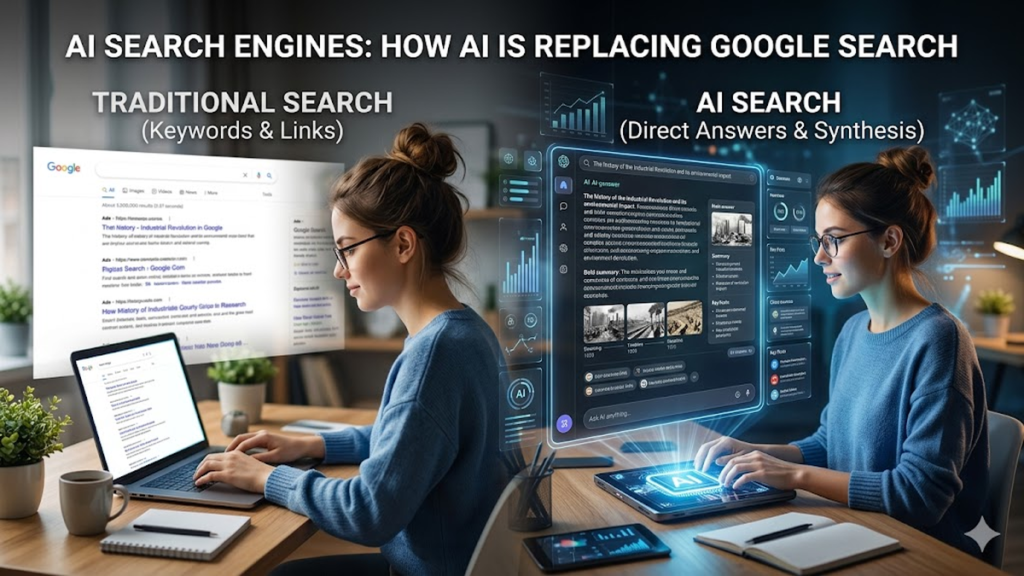

The traditional gatekeepers of the internet—the list of ranked links—are being replaced by a more assertive architecture: the ai search engine. This shift represents a move from “information retrieval” to “information synthesis.” For the average user, the primary intent is no longer just finding a document, but receiving a direct, contextual answer that reconciles multiple viewpoints into a single coherent response. In my time consulting on digital governance frameworks, I’ve observed that this isn’t just a technical upgrade; it is a fundamental reconfiguration of the human-knowledge interface. By moving away from the “ten blue links” model, we are trading a diversity of sources for a streamlined efficiency that, while powerful, requires a new kind of digital literacy.
The implications for our collective decision-making are vast. As we rely on these generative systems to curate our reality, the transparency of the synthesis process becomes as important as the answer itself. We are currently at a crossroads where the convenience of immediate answers meets the necessity of verified truth. This article explores how this evolution influences our cognitive skills, the economic survival of original content creators, and the long-term governance of the digital commons.
Cognitive Offloading and the Depth of Inquiry
The adoption of an ai search engine encourages a psychological phenomenon known as cognitive offloading. When an interface provides a definitive summary, the user’s drive to cross-reference multiple primary sources often diminishes. During my early research into algorithmic bias, I noticed that the “friction” of traditional search—clicking through different sites and evaluating their credibility—actually served as a vital cognitive exercise. By removing this friction, we risk a “flattening” of knowledge where nuances are lost in favor of conciseness. While synthesis saves time, it also delegates the critical task of critical evaluation to a black-box model, potentially narrowing the scope of human inquiry over time.
Check Out: 3I/ATLAS Paul Craggs Astrophotography and the Expanding Frontier of AI-Assisted
The Economic Fragility of the Open Web
One of the most pressing societal outcomes is the disruption of the “Value Exchange” between platforms and publishers. For decades, the internet operated on a simple pact: search engines indexed content and sent traffic to the creators. However, an ai search engine consumes that content to generate an answer within its own interface, often removing the need for the user to ever visit the original source. This “zero-click” reality threatens the ad-revenue models of investigative journalism and niche blogs. Without a new economic structure—perhaps one involving micro-payments or direct licensing—the very high-quality data that trains these AI models could slowly disappear as publishers go bankrupt.
| Metric | Traditional Search (2010s) | AI-Driven Search (2025-26) |
| User Intent | Discovery & Navigation | Synthesis & Direct Action |
| Click-Through Rate (CTR) | High (50-70% for top results) | Low (Significant “Zero-Click” growth) |
| Source Attribution | Primary (Linked directly) | Secondary (Aggregated/Cited) |
| Monetization | Paid Placement/Display Ads | Subscription/Affiliate/API access |
The “Hallucination” of Authority
The architectural design of large language models (LLMs) is probabilistic, not factual. This creates a unique challenge when integrated into a search context: the synthesis can sound incredibly authoritative while being factually incorrect. “The danger is not that AI will lie to us, but that it will be so convincing in its errors that we stop checking,” notes Dr. Elena Rossi, a pioneer in algorithmic ethics. In my analysis of deployment failures, I’ve seen how confidently an AI can fabricate a legal precedent or a medical statistic. To maintain societal trust, search providers must prioritize “grounding” techniques, ensuring that every claim is anchored to a verifiable, real-time citation.
Check Out: Nova Scola and the Future Architecture of Learning
From Keywords to Intentional Dialogue
We are witnessing the death of the “keyword” as the primary unit of search. In the previous era, users had to learn “Google-ese”—a fragmented way of typing queries to get results. Today, the ai search engine prioritizes natural language and multi-turn conversations. This allows for a much higher degree of specificity. Instead of searching for “best cameras,” a user can specify “best cameras for a travel blogger who prioritizes weight over battery life.” This shift empowers the user by aligning the technology with human communication patterns rather than forcing the human to adapt to the machine’s index.
Sovereignty and the Global Information Divide
The governance of AI search isn’t just a corporate issue; it is a matter of national sovereignty. Countries are increasingly concerned about their citizens’ data being processed by a few centralized entities. If an ai search engine becomes the primary lens through which a population understands the world, the cultural biases of the developers become the biases of the nation. I have spoken with European regulators who are championing “Sovereign AI” projects to ensure that regional values and languages are not marginalized by models trained primarily on North American data. This geopolitical tension will define the next decade of internet infrastructure.
The Re-emergence of the “Human-Verified” Premium
As the internet becomes saturated with AI-generated content, we are seeing a “flight to quality.” Users are beginning to seek out “proof of humanity”—content that is clearly created by a person with lived experience. This may lead to a bifurcated web: a massive layer of cheap, AI-synthesized information for general queries, and a premium, gated layer of human-expert analysis. This development mirrors the history of the organic food movement; when mass-produced options became ubiquitous, the value of the “original” and “unprocessed” skyrocketed. Authentic expertise is becoming the most valuable currency in a generative world.
| Deployment Phase | Focus Area | Societal Impact |
| Phase 1: Retrieval | Accuracy of links | Access to diverse viewpoints |
| Phase 2: RAG | Retrieval-Augmented Gen | Trust in synthesized answers |
| Phase 3: Agency | AI acting on information | Shift in economic labor and task-completion |
Governance and the Algorithmic Right to Know
How do we regulate a system that changes its “answer” every time it is asked? Traditional transparency laws are ill-equipped for non-deterministic systems. We need a new “Algorithmic Right to Know” that mandates clear disclosure of training data sources and the specific logic used to prioritize one answer over another. “Transparency in the age of AI search is not about showing the code, but about revealing the pedigree of the information,” says tech analyst Marcus Thorne. As a writer who has spent years dissecting tech impact, I believe this transparency is the only way to prevent the formation of “invisible echo chambers” created by personalized synthesis.
Environmental and Resource Implications
The computational cost of an AI search query is significantly higher than that of a traditional keyword search. Each inference requires thousands of times more energy than a simple index lookup. As we scale the ai search engine to billions of users, the environmental footprint becomes a critical governance issue. Tech companies are increasingly investing in proprietary nuclear energy and custom silicon to manage this load. However, we must ask if the societal gain of a faster answer justifies the massive increase in carbon output. Efficiency in model architecture is no longer just a technical goal; it is a moral imperative.
The Future of Fact-Checking in Real Time
In the very near future, we will see the integration of real-time fact-checking layers that sit on top of the search experience. Instead of waiting for a news cycle to correct a mistake, these “meta-models” will evaluate the synthesis as it is generated, flagging contradictions or lack of consensus. This represents the ultimate evolution of the search engine: a tool that doesn’t just find information, but actively defends the user against misinformation. My hope is that these systems will eventually move us toward a more resilient digital democracy, where the speed of truth can finally catch up to the speed of the algorithm.
Takeaways
- From Links to Answers: Search is evolving from a navigational tool to a synthesis engine that provides direct, conversational responses.
- Cognitive Impact: Reducing the “friction” of research may impact long-term critical thinking and source verification skills.
- Publisher Crisis: The “zero-click” model threatens the financial viability of original content creators and journalism.
- Trust & Verifiability: Citations and “grounding” are essential to combat the authoritative-sounding hallucinations of LLMs.
- Sovereignty Concerns: Nations are seeking to build localized AI search models to protect cultural values and data privacy.
- Resource Intensive: The environmental cost of AI-driven search requires a radical shift in energy and infrastructure management.
Conclusion
The transformation of the search engine into a generative companion is one of the most significant shifts in the history of information technology. It promises a world where the sum of human knowledge is accessible through a simple conversation, breaking down barriers of language and technical expertise. However, as an analyst of long-term outcomes, I must emphasize that this convenience comes with a cost. We are rewriting the social contract of the internet, and in doing so, we must be vigilant about what we leave behind. The survival of the independent web, the preservation of human critical thinking, and the transparency of algorithmic power are not obstacles to progress—they are the very foundations upon which a sustainable AI future must be built. As we move forward, our goal should not be to replace the search for truth with the convenience of a prompt, but to use these powerful tools to deepen our understanding of a complex, nuanced world.
Check Out: AWS CEO AI Developer Replacement Comments and the Future of Human Talent
FAQs
Is an ai search engine more accurate than traditional Google?
Not necessarily. While it is better at synthesizing complex information and providing direct answers, it is prone to “hallucinations”—confidently stating false information. Traditional search is better for finding specific original documents, while AI search is superior for summaries and multi-step explanations.
How do these systems cite their sources?
Most modern systems use Retrieval-Augmented Generation (RAG). They first search the live web for relevant documents and then use an AI model to summarize those specific findings, often including footnotes or links to the primary sources for verification.
Can AI search engines see real-time news?
Yes, unlike standalone models with “knowledge cutoffs,” those integrated into search engines have “browsing” capabilities that allow them to index and summarize news events occurring in real-time.
Will I have to pay to search the web in the future?
While basic search may remain free (supported by ads or data), we are seeing a move toward premium tiers. These “Pro” versions often offer more advanced reasoning, better privacy, and more accurate models for a monthly subscription fee.
Does AI search track my data more than traditional search?
Potentially. Because AI search is conversational and context-aware, it may retain more information about your specific intent and history to provide better “personalization,” which raises significant privacy considerations for users.
References
- Bender, E. M., Gebru, T., McMillan-Major, A., & Shmitchell, S. (2021). On the Dangers of Stochastic Parrots: Can Language Models Be Too Big? Proceedings of the 2021 ACM Conference on Fairness, Accountability, and Transparency.
- Lewis, P., et al. (2020). Retrieval-Augmented Generation for Knowledge-Intensive NLP Tasks. Advances in Neural Information Processing Systems.
- Noble, S. U. (2018). Algorithms of Oppression: How Search Engines Reinforce Racism. NYU Press.
- Russell, S. (2019). Human Compatible: Artificial Intelligence and the Problem of Control. Viking.