
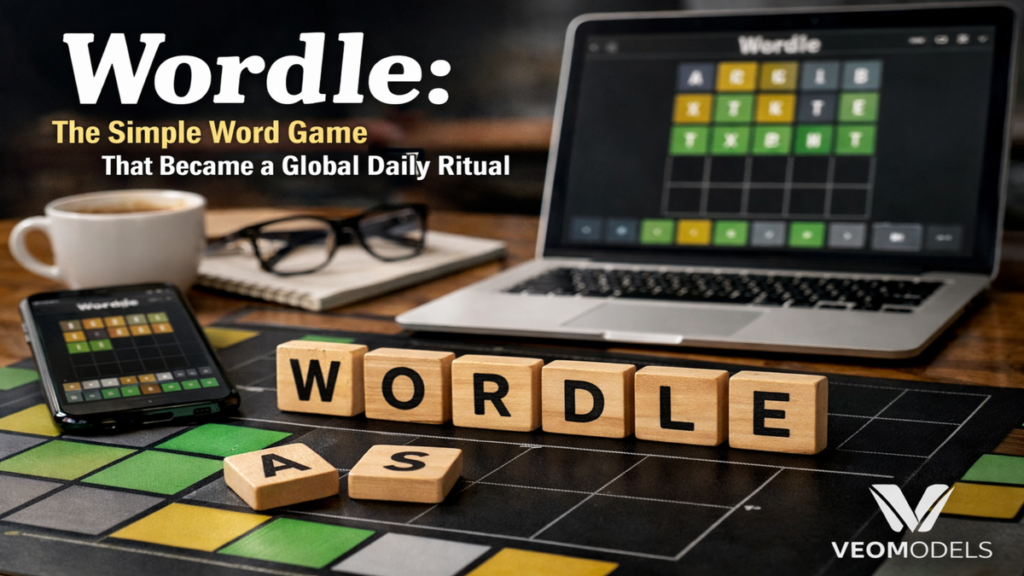

I often find that the most influential digital experiences are not the most technically complex ones. Instead, they succeed because they tap into something fundamentally human. Wordle is a perfect example of this phenomenon. The game, which asks players to guess a five-letter word within six attempts, looks almost trivial when compared with the sophisticated AI-driven systems dominating today’s tech headlines. Yet its impact has been remarkable.
Wordle exploded in popularity in late 2021 and early 2022, becoming a daily ritual for millions of players worldwide. What made it special was not graphics, algorithms, or monetization strategies. Instead, it was its elegant constraint: one puzzle per day, shared simultaneously across the globe.
The simplicity masked a powerful design philosophy. Each day’s puzzle invited players into a shared intellectual challenge, while the now-famous colored grid allowed them to share results without revealing the answer. This blend of puzzle solving, minimal design, and social storytelling helped Wordle spread across social media at unprecedented speed.
From a technology perspective, Wordle demonstrates something essential about digital products: engagement often comes from thoughtful design rather than feature complexity. In an era of AI-powered recommendation systems and immersive media platforms, Wordle shows that a minimalist experience can still reshape online culture.
Understanding why Wordle succeeded reveals broader insights about digital interaction, behavioral design, and how simple technologies can scale into global phenomena.
The Origins of Wordle
Wordle began not as a startup project or a commercial venture but as a personal gift. Software engineer Josh Wardle created the game in 2021 for his partner, who enjoyed word puzzles. Initially, the game existed as a private web page shared only among friends and family.
As Wardle expanded the word list and refined the puzzle mechanics, the game gradually attracted more players. What distinguished Wordle from other word puzzles was its strict constraint system. Each day offered a single puzzle shared by every player worldwide.
This design removed a common source of fatigue found in many mobile games: endless gameplay loops. Instead, Wordle became a brief, intentional activity that players could complete in a few minutes.
The game’s rise accelerated dramatically in late 2021 when players began sharing their results on Twitter using colored square emojis. These grids showed how quickly someone solved the puzzle without revealing the solution itself.
By January 2022, Wordle had grown from a few dozen players to millions. The sudden surge demonstrated how digital culture can amplify simple experiences when they encourage community participation.
Read: Virtual Private Networks in the Age of Intelligent Infrastructure
Why Wordle’s Design Works So Well
Wordle’s success is deeply tied to its minimalist design philosophy. The game uses only a handful of mechanics:
- Guess a five-letter word
- Receive color-coded feedback
- Refine guesses until the answer appears
Despite its simplicity, this structure triggers several psychological mechanisms that sustain engagement.
First, the puzzle activates pattern recognition and vocabulary recall, creating a satisfying cognitive challenge. Second, the six-guess limit introduces mild tension without overwhelming players.
Perhaps most importantly, Wordle avoids the “infinite gameplay” model common in mobile apps. Instead, it encourages anticipation for the next day’s puzzle.
Technology researcher Ethan Mollick once noted:
“Constraints are often what make digital experiences memorable.”
Wordle’s daily limitation transforms a small puzzle into a routine habit. Instead of binge playing, users return once per day, creating a ritual rather than a distraction.
The Social Media Effect Behind Wordle
A defining feature of Wordle’s rise was its shareable results grid. Players could post a series of colored squares that represented their guesses.
This design choice accomplished three things simultaneously:
- It preserved the puzzle’s solution.
- It allowed players to show performance.
- It created visual curiosity among observers.
The grid became instantly recognizable across social platforms. Unlike screenshots of gameplay, the emojis formed a coded language that other players understood.
Social sharing turned Wordle into a collective event. Millions of people attempted the same puzzle each day and compared strategies afterward.
Technology journalist Casey Newton observed:
“Wordle transformed social feeds into puzzle scoreboards.”
The viral loop emerged organically rather than through algorithmic promotion. Each shared result invited others to join the experience.
Wordle and the Power of Minimal Software
One surprising aspect of Wordle is how technically lightweight it is. The entire game runs in a simple browser interface with minimal infrastructure.
| Feature | Wordle Implementation |
|---|---|
| Platform | Web browser |
| Core mechanics | Word guessing algorithm |
| Data requirements | Minimal |
| Monetization | None at launch |
| User accounts | Not required |
This lean architecture allowed the game to scale quickly without major engineering resources.
From a systems perspective, Wordle highlights a recurring pattern in digital innovation: simple products often outperform complex ones when they solve a clear problem.
In this case, the problem was not productivity or efficiency but entertainment through daily intellectual play.
The New York Times Acquisition
In January 2022, The New York Times acquired Wordle for a reported low seven-figure sum. The acquisition aligned with the publication’s strategy to expand its digital games portfolio.
The Times had already achieved significant success with puzzles like the NYT Crossword and Spelling Bee, both of which contribute to subscriber growth.
| Game | Launch Year | Key Feature |
|---|---|---|
| NYT Crossword | 1942 | Daily puzzle tradition |
| Spelling Bee | 2018 | Vocabulary challenge |
| Wordle | 2021 | Global shared puzzle |
By integrating Wordle into its games ecosystem, the publication strengthened its reputation as a digital puzzle platform.
The acquisition also ensured long-term stability for the game while preserving its core mechanics.
Cognitive Benefits of Playing Wordle
Although Wordle is primarily entertainment, it also exercises several cognitive skills.
Players must evaluate letter placement, recall vocabulary, and adjust strategies based on partial information.
Educational psychologist Dr. Michelle Steiner explains:
“Word puzzles strengthen pattern recognition and linguistic memory.”
Regular puzzle solving can improve mental flexibility and problem-solving speed. Wordle’s short gameplay sessions make it accessible for players across age groups.
Because each puzzle requires logical deduction rather than memorization, the experience remains engaging even after months of play.
The game therefore sits at an intersection between entertainment and cognitive training.
Wordle’s Influence on Game Design
Wordle inspired a wave of spin-off puzzle games across the internet. Developers quickly adapted the format to new themes.
Examples include:
- Heardle – music guessing puzzles
- Worldle – geography challenges
- Nerdle – math-based puzzles
These variations demonstrate how adaptable the core mechanic is. The formula of “limited guesses plus daily puzzles” can be applied to many knowledge domains.
Game designers began exploring how similar mechanics could encourage habit-forming engagement without addictive loops.
Wordle effectively introduced a new category of “daily micro-games.”
How Wordle Reflects Changing Digital Habits
Modern digital platforms often compete for as much user attention as possible. Wordle breaks that pattern by limiting playtime.
This approach aligns with a broader shift toward intentional digital experiences.
Instead of encouraging endless scrolling or continuous play, Wordle provides a brief mental challenge that fits naturally into daily routines.
For many players, the puzzle becomes part of a morning ritual alongside reading news or drinking coffee.
Technology sociologist Nathan Jurgenson once wrote:
“The internet’s most meaningful experiences are often the simplest ones.”
Wordle reinforces this idea by demonstrating that engagement does not require constant stimulation.
The Future of Wordle and Daily Puzzle Culture
Looking ahead, Wordle’s long-term influence may extend beyond the puzzle itself.
The game has already proven that minimal software experiences can reach global audiences when they combine thoughtful design with social sharing.
As digital entertainment evolves, more developers may experiment with similar models:
- limited daily interaction
- shared global challenges
- lightweight technical infrastructure
Such approaches could reshape how casual games are designed.
Wordle’s legacy may ultimately be less about the puzzle and more about what it revealed: digital culture still values simplicity.
Key Takeaways
- Wordle began as a personal project created by software engineer Josh Wardle.
- Its daily puzzle constraint helped transform it into a global digital ritual.
- Social media sharing played a major role in the game’s viral spread.
- Minimal design and simple mechanics contributed to long-term engagement.
- The New York Times acquired Wordle in 2022 to expand its puzzle platform.
- Wordle inspired a new generation of daily puzzle games.
- The game illustrates how simple digital experiences can outperform complex platforms.
Conclusion
When I examine digital products that achieve lasting cultural impact, they often share a common trait: simplicity paired with thoughtful design. Wordle embodies that principle perfectly.
The game’s success demonstrates that meaningful digital experiences do not always require complex algorithms, massive data pipelines, or immersive graphics. Sometimes, a small idea executed elegantly can resonate with millions of people.
Wordle transformed a basic word puzzle into a shared daily event across the internet. Players from different countries, professions, and age groups all gather around the same challenge every day.
Beyond entertainment, the game reveals something important about technology design. People value experiences that respect their time, encourage creativity, and foster community.
In a digital landscape increasingly dominated by complex platforms and attention-driven systems, Wordle reminds us that the most powerful innovations can also be the simplest.
FAQs
What is Wordle?
Wordle is a daily word puzzle where players guess a five-letter word within six attempts using color-coded feedback.
Who created Wordle?
Wordle was created by software engineer Josh Wardle in 2021 as a personal project.
Why did Wordle become so popular?
Its simple gameplay, daily puzzle format, and shareable results helped the game spread rapidly across social media.
Is Wordle free to play?
Yes. Wordle remains free to play on The New York Times Games platform.
How often does Wordle update?
The game releases a new puzzle once per day worldwide.