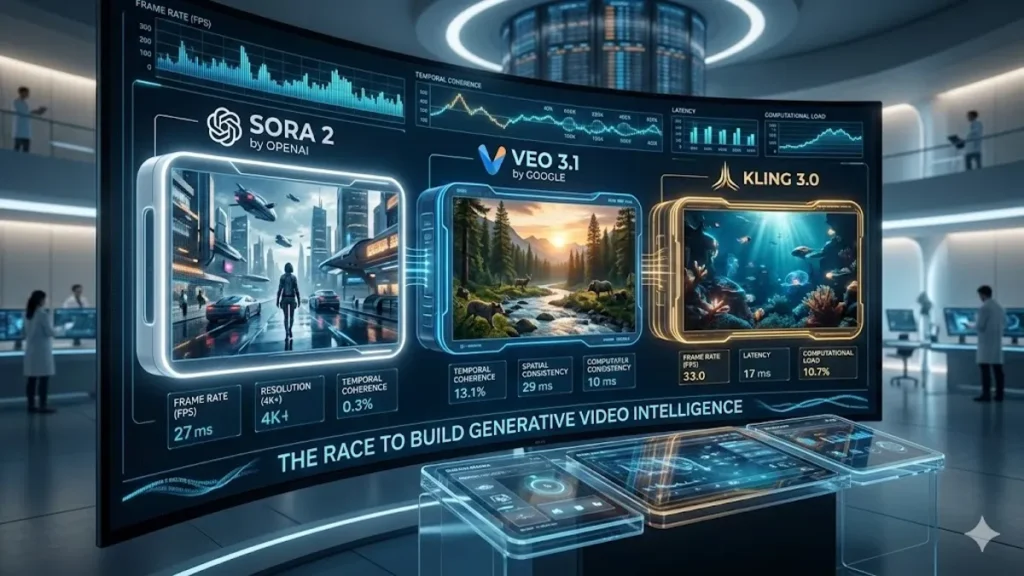

In recent years, generative AI has moved beyond producing text and images into one of the most technically demanding frontiers in machine learning: video generation. When researchers and developers discuss the current state of this field, the comparison that most often surfaces is OpenAI Sora 2 vs. Google Veo 3.1 vs. Kling 3.0. These three systems represent the cutting edge of generative video technology, each built on different assumptions about how machines should model motion, narrative structure, and physical reality.
From my perspective studying emerging technology infrastructure, video generation reveals something profound about AI progress. Images can be convincing even with small imperfections. Video cannot. The human brain is exceptionally sensitive to inconsistencies in motion, lighting, and spatial relationships. A model that produces stunning still images can still fail dramatically once those images must evolve across time.
The systems emerging from OpenAI, Google DeepMind, and Kuaishou attempt to solve precisely that problem. Their models must interpret language prompts, simulate physical environments, track objects across frames, and maintain coherence over multiple seconds of generated footage.
The debate around OpenAI Sora 2 vs. Google Veo 3.1 vs. Kling 3.0 is therefore about much more than creative novelty. It represents a global effort to teach machines how the visual world behaves across time. The outcome of this effort may fundamentally reshape filmmaking, education, simulation, advertising, and even scientific visualization.
Understanding how these systems differ requires examining their architecture, training data, design philosophy, and the practical constraints shaping their development.
Why Video Generation Is Harder Than Image Generation
Image generation models reached impressive realism because they only needed to predict a single visual state. Video models face a far more complex challenge: predicting how scenes evolve from one frame to the next.
Every frame introduces new variables. Lighting changes as objects move. Shadows shift. Camera angles evolve. Characters interact with environments. Each of these elements must remain consistent across dozens or hundreds of frames.
From my experience analyzing machine learning systems, the difficulty lies in temporal modeling. The model must not only produce convincing visuals but also understand cause and effect.
Computer vision pioneer Fei-Fei Li once explained:
“Visual intelligence requires understanding how objects interact and change over time.”
A person walking through a snowy landscape creates footprints, disturbs snow particles, and casts changing shadows. Generating these interactions convincingly requires a model that understands physical relationships rather than merely producing visually appealing frames.
The competition between OpenAI Sora 2 vs. Google Veo 3.1 vs. Kling 3.0 therefore revolves around how effectively each system learns this dynamic behavior.
Read: Finding the Best API Search Company’s Homepage: What Actually Matters
The Architectural Philosophies Behind the Models
Although public technical details remain limited, available research papers and demonstrations suggest distinct architectural approaches behind these video systems.
OpenAI’s Sora models appear to combine diffusion models with transformer-based spatial reasoning. Diffusion architectures gradually construct images by reversing noise, while transformers help track spatial relationships across frames.
Google’s Veo platform integrates video generation with the company’s broader multimodal AI research. DeepMind’s work on world modeling and reinforcement learning likely influences how Veo interprets scene structure and narrative flow.
Kuaishou’s Kling models emphasize efficient high-resolution generation. The platform appears optimized for generating longer clips suitable for social media and entertainment content.
| Model | Organization | Design Priority | Notable Capability |
|---|---|---|---|
| Sora 2 | OpenAI | Physical realism | Complex environmental motion |
| Veo 3.1 | Google DeepMind | Narrative coherence | Cinematic scene transitions |
| Kling 3.0 | Kuaishou | High-resolution visuals | Long-duration clips |
Each architecture reflects different assumptions about what matters most in generative video.
OpenAI Sora 2 vs. Google Veo 3.1 vs. Kling 3.0
The direct comparison of OpenAI Sora 2 vs. Google Veo 3.1 vs. Kling 3.0 highlights how companies are approaching generative video from different angles.
OpenAI’s Sora emphasizes simulation fidelity. Demonstrations frequently showcase scenes involving natural environments, animals, or complex physical interactions. These examples suggest a model optimized for learning physical dynamics.
Google’s Veo models focus more on storytelling structure. Many examples highlight cinematic camera movements, scene composition, and longer narrative continuity.
Kling takes yet another approach. Developed by Chinese technology company Kuaishou, the system prioritizes high-resolution output and stylistic flexibility, making it particularly suited to entertainment and social media content.
From my observations analyzing early demonstrations, each system excels in different aspects of video generation. None has yet solved every challenge simultaneously.
Training Data: The Hidden Engine of Video AI
Behind every generative video system lies an enormous training dataset.
Video data is dramatically larger than image data. A single second of footage may contain dozens of frames, each representing a unique visual state.
Training models such as Sora or Veo requires access to massive video corpora containing diverse motion patterns, lighting conditions, and environmental contexts.
| Training Factor | Image Models | Video Models |
|---|---|---|
| Frames per example | 1 | 24–60 |
| Data storage | Terabytes | Petabytes |
| Training complexity | High | Extremely high |
| Motion understanding | Not required | Essential |
From my experience reviewing AI infrastructure, the training process for video models can require weeks or months of continuous computation across thousands of GPUs.
This computational intensity partly explains why only a handful of organizations are currently capable of developing such systems.
The Physics Problem in AI Video
One of the most fascinating challenges in video generation is teaching models the basic laws of physics.
Objects fall due to gravity. Water splashes when disturbed. Fabric moves differently from metal. Human movement follows anatomical constraints.
These rules are rarely explicitly programmed into AI models. Instead, they are learned implicitly from data.
Computer scientist Andrew Zisserman summarized this challenge succinctly:
“Video models must learn not just appearance but behavior.”
In demonstrations of OpenAI Sora 2 vs. Google Veo 3.1 vs. Kling 3.0, viewers often notice whether physics appears believable. A convincing clip must preserve the natural relationships between objects and forces.
Small inconsistencies quickly break the illusion of realism.
Creative Control and Prompt Engineering
As video models become more powerful, creators are discovering that generating useful content requires careful prompt design.
Prompt engineering for video often involves describing:
- scene composition
- lighting conditions
- camera movement
- character actions
- environmental context
Unlike text models, video generators must translate prompts into multi-layered visual sequences.
In my own evaluation of generative tools, I find that models vary significantly in how controllable they are. Some systems produce visually impressive clips but struggle to follow detailed instructions.
The differences observed in OpenAI Sora 2 vs. Google Veo 3.1 vs. Kling 3.0 may ultimately come down to how effectively each system balances creativity with user control.
Real-World Applications Emerging
Generative video is already beginning to influence several industries.
Film studios are exploring AI-assisted storyboarding and previsualization. Advertising agencies are experimenting with rapid concept videos generated from campaign scripts. Educational platforms are testing animated explanations produced directly from lesson plans.
In conversations with creative technologists, I frequently hear a similar observation: the speed of iteration is transformative.
Ideas that once required weeks of production can now be prototyped within minutes.
AI researcher Yann LeCun described generative media as:
“A new creative interface between imagination and computation.”
While fully automated filmmaking remains far away, AI-generated video may significantly change how visual ideas are explored and refined.
Infrastructure and Compute Demands
Training video generation models requires extraordinary computational resources.
The systems used to develop models like Sora and Veo rely on large clusters of GPUs or specialized AI accelerators capable of handling enormous neural networks.
Even generating a short video clip can involve thousands of inference steps across complex diffusion pipelines.
Engineers are therefore experimenting with techniques to reduce computational costs, including:
- diffusion acceleration methods
- video-specific transformer architectures
- distributed generation pipelines
These infrastructure challenges mean that generative video technology is currently concentrated among companies with substantial AI research budgets.
The Global Race in Generative Media
The development of AI video models has become a truly global competition.
OpenAI and Google represent major American efforts, while Chinese companies such as Kuaishou are advancing rapidly with models like Kling.
The comparison of OpenAI Sora 2 vs. Google Veo 3.1 vs. Kling 3.0 reflects not only technological rivalry but also different ecosystems of research and innovation.
Competition between these systems may accelerate progress as companies experiment with new architectures, datasets, and training strategies.
Generative video is quickly becoming one of the most dynamic areas of AI research.
What the Next Generation of Video Models Might Achieve
Looking ahead, several breakthroughs may shape the next generation of video generation systems.
Researchers are exploring 3D-aware generative models capable of understanding spatial environments rather than simply generating sequences of images.
Another area of research involves long-duration video generation, where models produce coherent scenes lasting several minutes.
Integration with language models is also likely to deepen. Future systems may generate entire narratives, scripts, and visual scenes from a single prompt.
The ongoing comparison of OpenAI Sora 2 vs. Google Veo 3.1 vs. Kling 3.0 therefore represents only an early stage in the evolution of generative video intelligence.
Key Takeaways
- Generative video represents one of the most complex challenges in modern AI.
- Sora prioritizes physical realism and environmental simulation.
- Veo focuses on cinematic storytelling and narrative flow.
- Kling emphasizes resolution and media-ready visuals.
- Training video models requires enormous datasets and computational power.
- Temporal consistency remains the central technical challenge.
- Generative video may significantly transform media production workflows.
Conclusion
The emergence of advanced generative video models marks a turning point in artificial intelligence. While image generation introduced machines capable of producing convincing visuals, video generation requires something deeper: an understanding of how the world changes over time.
The ongoing comparison of OpenAI Sora 2 vs. Google Veo 3.1 vs. Kling 3.0 reveals three distinct strategies for solving this problem. OpenAI appears to emphasize physical realism, Google focuses on narrative structure, and Kuaishou prioritizes visual clarity and media-ready output.
At present, none of these systems fully solves the challenge of long, controllable, perfectly coherent video generation. Yet the pace of progress suggests that these limitations may diminish rapidly.
For creators, educators, and technologists, the rise of generative video represents more than a new tool. It signals the beginning of a new medium where storytelling, simulation, and imagination increasingly merge with computational creativity.
FAQs
What is OpenAI Sora 2?
OpenAI Sora 2 is a generative AI system designed to create realistic video sequences from text prompts while preserving spatial and temporal consistency.
What makes Google Veo 3.1 different?
Google Veo 3.1 focuses on cinematic storytelling and integrates multimodal AI techniques developed within the DeepMind research ecosystem.
What is Kling 3.0 used for?
Kling 3.0 is a video generation model developed by Kuaishou that produces high-resolution clips designed for media and entertainment content.
Which model currently produces the best videos?
Each system excels in different areas. Sora often demonstrates strong physical realism, Veo emphasizes narrative flow, and Kling produces highly detailed visuals.
Will AI replace traditional video production?
AI video systems will likely augment rather than replace filmmakers, accelerating prototyping and enabling new creative workflows.