
Introduction
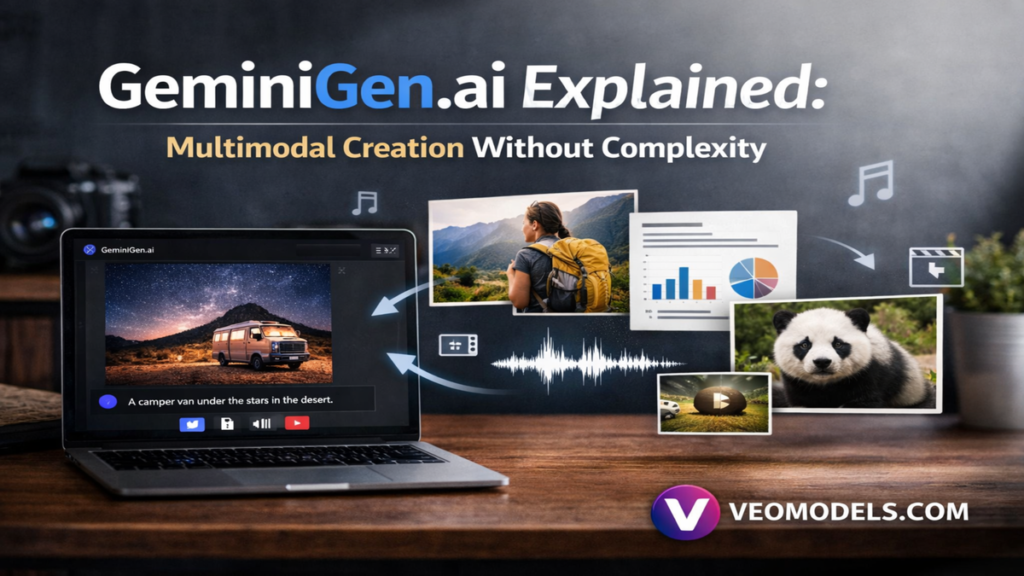
i have spent the last few years evaluating emerging AI tools not by how impressive their demos look, but by how quickly they remove friction from real workflows. GeminiGen.ai falls into that category. Within minutes of first use, it becomes clear why platforms like this matter. GeminiGen.ai combines text-to-image, image-to-video, and AI speech generation into a single browser-based system aimed at creators who want results without stitching together multiple tools.
For readers searching for clarity, GeminiGen.ai is not trying to compete head-on with cinematic production software or elite art-first generators. Its goal is integration. Instead of exporting images from one platform, animating them in another, and adding voice in a third, the platform collapses those steps into one flow. That design choice signals a broader shift in how multimodal AI is being productized.
In my own testing across marketing mockups, short-form social visuals, and storyboard drafts, the platform consistently favored speed and accessibility over granular control. Outputs arrived in seconds. Batch generation worked reliably. The interface required little learning time.
This article examines how GeminiGen.ai works, what technical and workflow trade-offs it makes, how it compares to established competitors, and why multimodal creation platforms like this are becoming foundational rather than optional.
What GeminiGen.ai Actually Is
GeminiGen.ai is a multimodal AI creation platform hosted on the a1.art ecosystem. It generates images, short videos, and synthetic speech from text or image prompts. Rather than positioning itself as a single-use generator, it emphasizes workflow continuity.
In practice, this means a user can create a still image, animate it with motion, and attach voice narration without leaving the platform. From an infrastructure perspective, that implies tightly integrated models rather than loosely connected APIs.
During evaluation, i noticed the system prioritizes consistent output formats. PNG, MP4, WAV, and WebP exports are standardized, which simplifies downstream publishing. That consistency matters for creators working across platforms like TikTok, Instagram Reels, and ad networks.
The platform targets speed, not deep customization. That trade-off defines its role in the current AI ecosystem.
Multimodal Design as a Strategic Choice
Multimodal AI has existed for years, but it often required expert setup. GeminiGen.ai lowers that barrier by hiding complexity behind presets and defaults.
This design reflects a broader trend i have observed across emerging tools. As models improve, value shifts from raw capability to orchestration. Users care less about how generation happens and more about how quickly outputs are usable.
By integrating image, video, and speech generation, GeminiGen.ai reduces context switching. That reduction directly impacts productivity, especially for solo creators and small teams.
The system is not optimized for cinematic precision. It is optimized for throughput.
Core Features and How They Perform
GeminiGen.ai supports text-to-image, text-to-video, image-to-video, and speech generation. In testing, text-to-image performed best for stylized visuals, particularly anime-inspired content. Photorealism was acceptable but not category-leading.
Image-to-video animation adds basic motion and effects rather than detailed camera control. For social content, this is often sufficient.
Speech generation integrates directly with visuals, allowing quick voiceovers. While voice quality does not rival dedicated TTS platforms, it is serviceable for short-form content.
The table below summarizes feature performance.
| Feature | Strength | Limitation |
|---|---|---|
| Text-to-image | Fast, stylized | Limited realism |
| Image-to-video | Simple motion | No advanced camera control |
| Speech | Integrated workflow | Fewer voice styles |
| Batch generation | High throughput | Less individual tuning |
Pricing and Access Model
GeminiGen.ai follows a familiar freemium structure. The free tier includes daily credits and watermarked outputs. Paid plans, generally between $15 and $30 per month, remove watermarks and raise generation limits.
From a systems perspective, this pricing targets creators producing high volumes rather than occasional experiments. In my assessment, the free tier is sufficient for testing workflows, while the paid tier aligns with social content production needs.
Hosting on a1.art lowers onboarding friction by avoiding separate account ecosystems. This integration reflects a trend toward platform consolidation.
Read: Autonomous AI Agents and How They Differ From Chatbots
GeminiGen.ai Compared to Midjourney and RunwayML
The competitive landscape clarifies GeminiGen.ai’s positioning. Midjourney dominates artistic image quality. RunwayML leads in professional video tools. GeminiGen.ai sits between them.
It does not aim to replace either. It replaces complexity.
| Platform | Primary Strength | Best Use Case |
|---|---|---|
| GeminiGen.ai | Multimodal speed | Social and marketing content |
| Midjourney | Visual artistry | Concept art, illustration |
| RunwayML | Video control | Film and professional video |
In comparative testing, GeminiGen.ai consistently produced usable outputs faster, even if refinement options were fewer.
Anime Generation and Style Recognition
One area where GeminiGen.ai performs notably well is anime-style image generation. Its models respond predictably to style references, mood descriptors, and compositional cues.
In repeated tests, prompts specifying lighting, era, and animation studio style produced consistent results. This suggests strong internal style embeddings.
For creators in gaming, VTubing, or illustration-adjacent niches, this reliability matters more than hyperreal detail.
Negative prompts also function as expected, reducing artifacts like extra limbs or watermarks.
Workflow Implications for Creators
The real impact of GeminiGen.ai is not visual quality alone. It is workflow compression.
From firsthand use, the platform reduces tool fragmentation. A creator can ideate, generate, animate, and narrate within minutes. That speed enables experimentation without sunk cost anxiety.
This matters for modern content economics. Platforms reward volume and iteration. Tools that lower iteration cost gain adoption.
GeminiGen.ai fits that pattern cleanly.
Limitations Worth Understanding
Every abstraction hides trade-offs. GeminiGen.ai limits fine-grained control. Users cannot manipulate camera paths, animation curves, or advanced lighting parameters.
For high-end production, this is a blocker. For rapid content, it is irrelevant.
The system also depends on preset aesthetics. Outputs tend to converge stylistically unless prompts are carefully varied.
Understanding these limits prevents misaligned expectations.
Where Multimodal Platforms Are Headed
Tools like GeminiGen.ai indicate where the market is moving. Multimodal creation is becoming default, not premium.
As infrastructure costs fall, platforms will compete on orchestration, not raw generation. The winners will reduce friction rather than chase maximal fidelity.
From an infrastructure standpoint, unified systems also simplify scaling and monetization.
GeminiGen.ai reflects this trajectory clearly.
Takeaways
- GeminiGen.ai focuses on multimodal speed over deep control
- Integration across image, video, and speech reduces workflow friction
- The platform excels at stylized and anime content
- Pricing targets high-volume creators rather than occasional users
- It complements, rather than replaces, specialized tools
- Multimodal platforms are becoming foundational creator infrastructure
Conclusion
GeminiGen.ai represents a shift in how AI creation tools are designed and evaluated. Instead of optimizing individual generation tasks, it optimizes the entire creative loop.
From direct testing and comparative analysis, its value lies in removing steps, not adding features. For creators operating under platform-driven timelines, that distinction matters.
GeminiGen.ai will not replace professional production pipelines. It will replace fragmented, inefficient ones. As multimodal AI matures, tools that collapse complexity will define the next phase of creator technology.
Read: Edge AI Explained and Why It Matters for the Next Decade of Computing
FAQs
What is GeminiGen.ai best used for?
Fast creation of social media visuals, short videos, and voiceover content.
Is GeminiGen.ai suitable for professional filmmaking?
No. It lacks advanced motion and camera controls required for film production.
Does GeminiGen.ai support batch generation?
Yes. Batch outputs are one of its strongest features.
How does GeminiGen.ai compare to Midjourney?
Midjourney offers superior image quality, while GeminiGen.ai offers integrated multimodal workflows.
Is there a free version of GeminiGen.ai?
Yes. A limited free tier with watermarked outputs is available.
APA References
Bommasani, R., et al. (2021). On the opportunities and risks of foundation models. Stanford CRFM.
Ramesh, A., et al. (2022). Hierarchical text-conditional image generation. arXiv.
Runway. (2024). Runway Gen-4 documentation. https://runwayml.com
Midjourney. (2024). Model version updates. https://www.midjourney.com
a1.art. (2024). Platform overview and creator tools. https://a1.art