
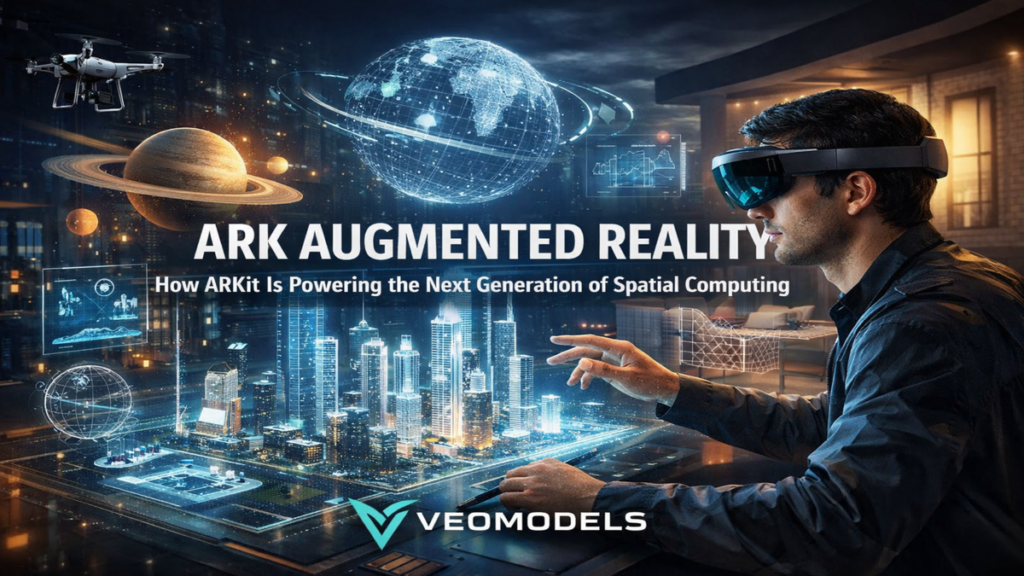

Over the past several years, I have spent considerable time studying how experimental technologies gradually become part of everyday digital infrastructure. One of the most interesting examples of that transition is ark augmented reality, particularly through Apple’s ARKit platform. ARKit has quietly turned millions of mobile devices into spatial computing tools capable of understanding and interacting with the physical world.
At its core, ARKit allows developers to place digital objects inside real environments using device cameras, motion sensors, and advanced computer vision systems. These objects behave as if they exist in the real world. They stay anchored to surfaces, respond to lighting conditions, and interact with the physical environment in convincing ways.
Within the broader discussion of ark augmented reality, ARKit is significant because it lowered the barrier to entry for augmented reality development. Rather than requiring specialized headsets or complex hardware setups, ARKit works directly on devices that many people already carry daily. This accessibility allowed developers to experiment with new ideas quickly and distribute AR experiences through existing mobile ecosystems.
As the framework evolved through multiple releases, Apple gradually added capabilities such as location-based anchors, full-body motion tracking, and high-resolution AR video capture. These improvements expanded ARKit from simple demonstrations into a robust platform used in retail, education, entertainment, architecture, and industrial training.
Today, ARKit represents more than a development toolkit. It is part of a broader shift toward spatial computing, where digital content becomes integrated with physical environments rather than confined to flat screens.
The Origins of Mobile AR Platforms
Before ARKit appeared in 2017, augmented reality existed primarily in research labs and experimental consumer products. Early AR systems required specialized hardware such as head-mounted displays or external tracking cameras. These setups were often expensive and difficult to deploy at scale.
Apple’s introduction of ARKit changed the landscape. Instead of relying on external equipment, ARKit used sensors already present in modern smartphones. Cameras, accelerometers, gyroscopes, and powerful mobile processors provided the foundation for mobile augmented reality.
The system combines these data sources to estimate device position within physical space. This technique, often called visual-inertial odometry, allows the device to track its movement in three dimensions while continuously analyzing the surrounding environment.
This technological approach allowed ark augmented reality applications to run smoothly on consumer devices. Developers could place virtual objects on detected surfaces such as tables or floors, and those objects remained stable even as users moved their devices around the room.
The success of this model demonstrated that augmented reality could be delivered through existing consumer hardware rather than entirely new device categories.
Read: How Browser Games Like “Steal a Brainrot Unblocked” Reflect the Evolution of Web Entertainment
Environmental Mapping and Spatial Awareness
For augmented reality to function convincingly, devices must understand their surroundings in real time. ARKit achieves this through continuous environmental mapping, where camera imagery and sensor data are analyzed to construct a digital representation of the physical space.
The first stage of this process involves plane detection. The system identifies horizontal and vertical surfaces such as tables, floors, or walls. These surfaces become stable locations where virtual objects can be placed.
Newer devices equipped with LiDAR sensors dramatically improve spatial mapping accuracy. LiDAR emits pulses of light and measures how long they take to return after hitting objects. This information allows ARKit to construct detailed three-dimensional meshes of entire environments.
These meshes enable advanced visual effects. Virtual objects can disappear behind real furniture or walls, creating convincing occlusion effects that strengthen the illusion of integration between digital and physical spaces.
Computer scientist Ronald Azuma, a foundational researcher in augmented reality, once wrote:
“Augmented reality succeeds when virtual objects appear to coexist with the real world in a seamless and meaningful way.”
ARKit’s environmental understanding system attempts to achieve exactly that outcome.
ARKit 6 and the Expansion of AR Capabilities
As Apple refined ARKit across several releases, the framework gradually expanded from basic object placement into a sophisticated spatial computing system. The introduction of ARKit 6 significantly improved both creative and technical capabilities.
One notable improvement was support for 4K video capture in augmented scenes. Developers can now record high-resolution AR experiences, which allows for professional-quality content creation and sharing.
Another advancement is the expansion of location anchors. These anchors allow digital content to appear at specific geographic coordinates. In supported cities, AR objects can remain anchored to real-world locations even when multiple users access them from different devices.
ARKit 6 also enhanced motion capture, enabling developers to track full-body movement more accurately. Animators and game developers can map human movement directly onto digital characters in real time.
The evolution of ARKit’s feature set reflects a broader trend in ark augmented reality development. As computing power increases and sensors improve, AR systems are becoming capable of understanding more complex physical environments.
Gaming and Interactive AR Experiences
Gaming was among the first industries to experiment with ARKit, and it remains one of the most creative areas of development. ARKit allows developers to transform ordinary physical spaces into interactive digital environments.
Early AR games often used tabletops or floors as playing fields where virtual characters could move and interact. Players navigated these environments by physically moving their devices around the scene.
More advanced titles now support shared AR sessions, where multiple players view the same digital environment simultaneously. This creates collaborative gameplay experiences anchored in real-world locations.
Game design for augmented reality introduces new creative considerations. Developers must account for unpredictable physical environments, lighting conditions, and available space.
Game researcher Katie Salen once observed:
“Play becomes more powerful when the boundary between player and environment disappears.”
Augmented reality gaming illustrates this idea clearly. The environment itself becomes part of the gameplay experience.
Educational Uses of Augmented Reality
Education has become one of the most promising domains for ark augmented reality. ARKit allows educators to present complex concepts through immersive visual models rather than static diagrams.
For example, biology students can examine detailed three-dimensional anatomical structures layered directly onto classroom environments. Engineering students can observe mechanical systems operating in real time through interactive models.
These experiences provide spatial context that textbooks cannot easily convey. Instead of imagining how systems operate, students observe and manipulate them directly.
The ability to scale models is particularly valuable. A molecular structure can be enlarged to room size, allowing students to explore it collaboratively.
Educational researchers increasingly argue that immersive technologies enhance understanding by connecting abstract information to physical experiences. ARKit-based applications help bridge this gap between conceptual learning and experiential exploration.
Retail and Consumer Visualization
Retailers were among the earliest commercial adopters of ARKit because the technology solves a specific problem in online commerce: customers cannot easily visualize products before purchasing them.
Augmented reality allows shoppers to place digital representations of products directly into their homes. Furniture retailers, for example, enable customers to preview how items will look in real environments before making purchasing decisions.
Cosmetics brands use facial tracking features to provide virtual makeup trials. Eyewear companies allow customers to test glasses frames through AR applications.
These experiences reduce uncertainty in purchasing decisions and improve customer engagement. Rather than browsing static images, users interact with products in their personal spaces.
For businesses, ark augmented reality tools also provide valuable data. Companies can analyze which products users preview most frequently and how long they interact with them.
This combination of visualization and analytics is transforming how digital retail experiences are designed.
Enterprise and Industrial Applications
Beyond consumer applications, augmented reality is increasingly used in industrial and enterprise environments. Companies deploy ARKit-based tools to assist with training, maintenance, and operational workflows.
Technicians can view step-by-step instructions overlaid directly onto equipment they are repairing. Complex machinery can be visualized in exploded views, showing how internal components interact.
Training simulations also benefit from AR. Instead of reading manuals, employees interact with digital models that demonstrate procedures in real time.
Logistics operations use AR navigation systems to highlight package locations or guide workers through warehouses more efficiently.
Technology strategist Kevin Kelly once remarked:
“The most transformative technologies are the ones that quietly disappear into everyday work.”
Enterprise augmented reality reflects this idea. The technology becomes an invisible layer supporting real-world tasks rather than a standalone experience.
AI, Knowledge Systems, and the Future of AR
Researchers are exploring new ways to combine augmented reality with artificial intelligence systems. One example is Microsoft’s ArK research initiative, which focuses on knowledge-based scene generation.
Instead of relying only on camera data, these systems use knowledge graphs and contextual reasoning to construct augmented environments. For instance, a training simulation might automatically generate an industrial workspace based on known relationships between equipment components.
This approach could enable AR systems to simulate complex scenarios such as emergency response situations, urban planning environments, or scientific experiments.
The integration of AI into ark augmented reality platforms could allow digital environments to adapt dynamically to user behavior and environmental conditions.
As AR systems become more intelligent, the boundary between simulation and physical experience may become increasingly fluid.
Infrastructure and the Architecture of AR Platforms
Large-scale augmented reality systems depend on complex infrastructure beyond the mobile device itself. Cloud computing, edge processing, and spatial data synchronization play critical roles in enabling persistent AR experiences.
Shared spatial anchors allow multiple users to interact with the same virtual objects within physical environments. Cloud services store these anchors and synchronize them across devices.
Analytics platforms track how users interact with augmented environments, providing developers with insights into usability and engagement patterns.
Edge computing helps process spatial data closer to users, reducing latency and improving responsiveness in complex AR scenes.
As AR applications become more sophisticated, infrastructure design will determine whether these experiences can scale reliably across large user populations.
Key Takeaways
- ARKit enables augmented reality experiences on iPhones, iPads, and spatial computing devices.
- Environmental mapping allows devices to understand real-world spaces in three dimensions.
- ARKit 6 introduced improvements including 4K AR recording and enhanced motion capture.
- Industries such as gaming, education, retail, and manufacturing use ARKit-based tools.
- Enterprise deployments increasingly rely on AR for training and workflow optimization.
- AI and knowledge systems may expand future augmented reality capabilities.
Conclusion
Looking at the broader evolution of augmented reality, it becomes clear that platforms succeed when they balance technological sophistication with accessibility. ARKit achieved this balance by embedding powerful spatial computing capabilities into everyday devices.
The growth of ark augmented reality applications across industries demonstrates that augmented reality is moving beyond novelty and becoming a practical interface for digital information. Instead of interacting with content solely through screens, users can experience data directly within their environments.
As computing power continues to increase and sensors improve, augmented reality platforms will likely become more intelligent and more deeply integrated with physical spaces. AI-driven spatial understanding, cloud synchronization, and new hardware categories will expand the possibilities of immersive digital experiences.
In that context, ARKit represents an important milestone. It transformed augmented reality from a specialized research technology into a widely accessible development platform capable of supporting real-world applications.
FAQs
What is ARKit used for?
ARKit is used to build augmented reality apps on Apple devices. It supports gaming, retail visualization, education tools, and industrial training systems.
Does ARKit require special hardware?
Most modern iPhones and iPads support ARKit. Devices with LiDAR sensors provide more accurate spatial mapping.
How accurate is ARKit spatial tracking?
ARKit uses camera analysis and motion sensors to track device movement with high accuracy, especially on devices equipped with LiDAR.
Can ARKit be used for enterprise applications?
Yes. Businesses use ARKit for equipment maintenance guidance, training simulations, and workflow assistance.
What is the future of mobile augmented reality?
Future AR systems will likely integrate AI, cloud infrastructure, and wearable spatial computing devices.
References
Apple Inc. (2022). ARKit developer documentation. https://developer.apple.com/augmented-reality/arkit/
Azuma, R. T. (1997). A survey of augmented reality. Presence: Teleoperators and Virtual Environments, 6(4), 355–385.
Billinghurst, M., Clark, A., & Lee, G. (2015). A survey of augmented reality. Foundations and Trends in Human–Computer Interaction, 8(2–3), 73–272.
Kelly, K. (2016). The inevitable: Understanding the 12 technological forces that will shape our future. Viking.