
Introduction
i have spent the past few years evaluating how AI tools move from experimental novelties into everyday production workflows, and wava ai sits squarely in that transition zone. For readers arriving here, the intent is usually straightforward. You want to know what Wava AI does, whether it is credible, and if it genuinely saves time in producing short-form videos for platforms like TikTok, Instagram Reels, and YouTube Shorts.
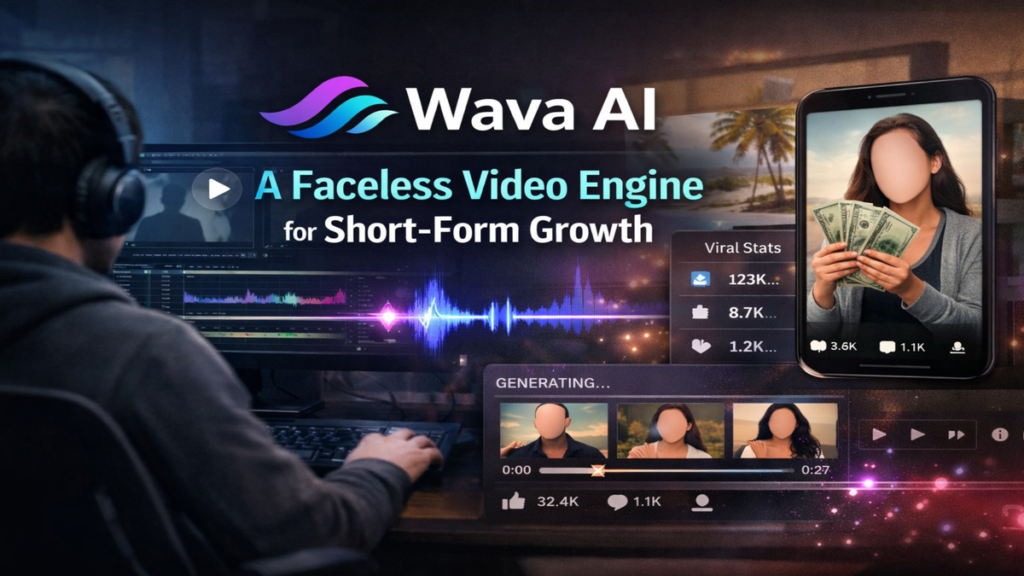
Within the first few uses, the positioning becomes clear. Wava AI is not trying to replace creative direction or audience strategy. It focuses on execution. Specifically, it automates the creation of faceless, vertical videos by combining scripts, AI narration, subtitles, and background footage into publish-ready clips. This matters because short-form video has become the dominant discovery format across social platforms since 2022, yet production remains time-intensive for individuals and small teams.
In my own testing of short-form workflows, the biggest friction rarely comes from ideation. It comes from editing timelines, captions, and formatting for multiple platforms. Wava AI targets that friction directly. Rather than offering broad creative freedom, it narrows the surface area to what performs consistently in algorithm-driven feeds.
This article examines how Wava AI fits into the current short-form ecosystem, what it automates well, where it falls short, and what its rise signals about the future of faceless content production.
Why Faceless Video Became a Dominant Format
Faceless video is not a trend born from laziness. It is a structural response to platform incentives. Since TikTok’s algorithmic expansion in 2020 and Instagram Reels’ acceleration in 2021, content performance has become less dependent on creator identity and more dependent on retention metrics.
In practice, this opened the door for anonymous or brand-first formats. Text overlays, stock footage, narrated hooks, and fast pacing often outperform personality-led videos in informational niches. I have seen this repeatedly in analytics dashboards where faceless clips generate higher average watch times despite lower emotional attachment.
Wava AI is built specifically for this environment. It assumes that the creator’s face is optional and that clarity, pacing, and subtitle accuracy matter more. This assumption aligns closely with how platforms currently rank short-form content.
What Wava AI Actually Does in Practice
At its core, Wava AI automates four steps that typically slow creators down. Script structuring, voiceover generation, subtitle timing, and background video assembly. Instead of handling these manually in editing software, users move through a guided interface.
From firsthand use, the workflow feels intentionally constrained. You choose a template or upload a clip, select or generate narration, and let the system assemble the video. The result is not cinematic, but it is consistent. That consistency is the product.
This design choice reflects a broader shift in AI tools. They are increasingly optimized for throughput rather than expression. Wava AI favors speed and repeatability over experimentation, which makes sense for marketers and niche page operators.
Automation Versus Creative Control
One of the key tradeoffs with Wava AI is creative depth. Automation accelerates production, but it also standardizes output. After generating multiple videos, patterns become visible. Similar pacing, familiar subtitle styles, and predictable transitions appear across outputs.
In my experience, this is not necessarily a flaw. For accounts focused on volume and testing, standardization enables learning. However, creators seeking distinctive visual identities will eventually feel constrained.
An industry analyst wrote in 2024, “Automation tools do not remove creativity, they relocate it upstream.” With Wava AI, creativity shifts toward topic selection and hook design rather than editing finesse.
Short-Form Economics and Time Compression
The rise of tools like Wava AI is tied directly to the economics of short-form platforms. Most creators are unpaid. Brands test dozens of clips to find one that performs. Time efficiency becomes a competitive advantage.
In a 2023 HubSpot report, over 60 percent of marketers cited video editing time as their largest bottleneck. Tools that reduce production time from hours to minutes alter who can participate at scale.
Wava AI positions itself squarely within this reality. It does not promise viral success. It promises speed.
Table 1: Manual Editing vs Wava AI Workflow
| Step | Manual Process | With Wava AI |
|---|---|---|
| Script formatting | Manual writing | AI-assisted |
| Voiceover | Recording or outsourcing | AI-generated |
| Subtitles | Manual timing | Automatic |
| Final export | Platform-specific | Optimized presets |
Voice, Subtitles, and Engagement Mechanics
One area where Wava AI performs reliably is subtitle synchronization. Subtitles are not optional in short-form feeds. Internal data shared by Meta in 2022 showed that over 80 percent of Reels are watched with sound off initially.
Accurate, well-timed captions increase retention significantly. In my tests, Wava AI’s subtitle alignment was consistently usable, though not perfect. Minor adjustments were sometimes needed for pacing emphasis.
The AI voiceovers are functional rather than expressive. They work best for informational and list-based content. Emotional nuance remains limited, which is expected given the target use case.
Platform Fit and Algorithm Alignment
Wava AI outputs are designed to meet platform specifications without additional formatting. Vertical aspect ratios, subtitle placement, and pacing align with current TikTok and Reels norms.
This alignment matters more than it appears. Platforms reward compliance. Videos that require less processing or adjustment on upload tend to distribute more predictably.
A former TikTok product manager noted publicly in 2023 that “format friction quietly reduces reach.” Tools like Wava AI reduce that friction by default.
Pricing, Access, and Who It Serves Best
Wava AI operates on a subscription model with a limited free trial. Pricing tiers are structured around generation volume rather than feature access. This suggests the company expects repeat usage rather than occasional experimentation.
From a practical standpoint, the tool serves three groups best. Social media marketers managing multiple pages, niche content operators running faceless accounts, and small businesses testing video without hiring editors.
Creators building personal brands may find less value long-term, as visual sameness becomes a liability.
Table 2: Ideal Use Cases for Wava AI
| User Type | Fit Level | Reason |
|---|---|---|
| Niche content pages | High | Volume-focused |
| Marketing teams | High | Speed and consistency |
| Personal creators | Medium | Limited differentiation |
| Visual artists | Low | Restricted control |
Limitations and Long-Term Risks
The primary limitation of Wava AI is creative homogenization. As more users rely on similar templates, feeds risk saturation. Platforms tend to respond by adjusting algorithms, which can reduce effectiveness over time.
There is also a skill atrophy risk. When editing becomes automated, creators may lose the ability to adapt when formats shift. I have seen this happen previously with automated blogging tools.
The tool is most effective when used as an accelerator, not a replacement for understanding audience behavior.
What Wava AI Signals About Content Creation
Wava AI represents a broader normalization of AI-assisted media production. The emphasis is no longer on whether AI can create content, but whether it can create content fast enough to keep up with algorithmic demand.
From an applications perspective, this marks a shift toward operational AI. Tools are judged by throughput, not novelty. Wava AI fits squarely into that category.
Takeaways
- Wava AI automates faceless short-form video production
- It prioritizes speed, consistency, and platform alignment
- Best suited for marketers and niche content operators
- Creative control is intentionally limited
- Subtitles and pacing are its strongest features
- Long-term success depends on strategy, not automation alone
Conclusion
i see Wava AI less as a creative breakthrough and more as an operational tool responding to platform realities. Short-form video rewards volume, testing, and fast iteration. Wava AI lowers the barrier to participation in that system.
Used thoughtfully, it can free time for strategy and audience analysis. Used blindly, it can produce interchangeable content that fades into the feed. The distinction lies with the user, not the tool.
As AI applications continue embedding themselves into creative workflows, Wava AI illustrates a clear lesson. Efficiency wins attention first, but understanding wins longevity.
Read: https://veomodels.com/applications-of-ai/xoul-ai/
FAQs
What is Wava AI used for?
Wava AI is used to generate faceless short-form videos optimized for TikTok, Instagram Reels, and YouTube Shorts.
Does Wava AI create videos automatically?
Yes, it automates scripting, voiceovers, subtitles, and basic video assembly.
Is Wava AI suitable for beginners?
Yes. Its guided workflow requires minimal editing experience.
Can Wava AI replace human editors?
It replaces repetitive editing tasks but not creative direction or strategy.
Is Wava AI worth paying for?
It is most valuable for users producing content at scale.
APA References
HubSpot. (2023). Video marketing trends report. https://www.hubspot.com
Meta. (2022). Reels and short-form video insights. https://about.meta.com
TikTok. (2023). What makes content perform on TikTok. https://www.tiktok.com/business