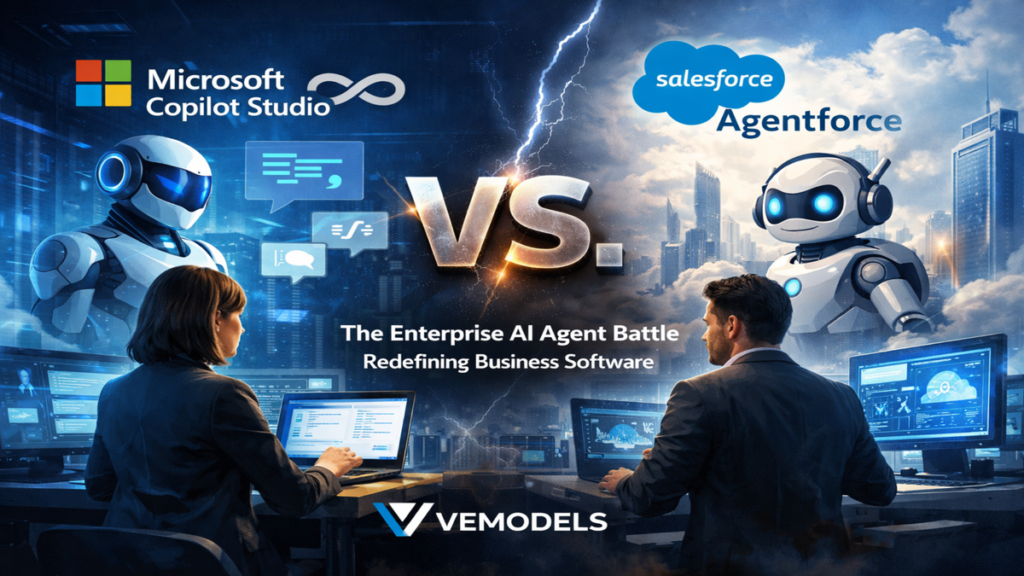

When enterprises began experimenting with AI chatbots nearly a decade ago, most of those systems were little more than scripted automation. They could answer simple questions, route support requests, or retrieve basic information. Today, that model is rapidly disappearing. Businesses are now deploying intelligent agents capable of interpreting complex requests, interacting with internal data systems, and executing workflows on behalf of employees. This shift is precisely why the debate around Microsoft Copilot Studio vs. Salesforce Agentforce has become increasingly important for enterprise technology leaders.
The two platforms represent competing visions of how AI agents should operate within organizations. Microsoft positions Copilot Studio as a universal framework for building intelligent assistants that integrate with productivity tools such as Microsoft 365, Teams, and enterprise databases. Salesforce, by contrast, has designed Agentforce as an AI layer deeply embedded in customer relationship management, enabling organizations to deploy autonomous agents across sales, marketing, and support operations.
From my perspective studying enterprise AI adoption, the real story is not simply which platform has stronger AI capabilities. Instead, it is about how each company is redefining the architecture of enterprise software. Rather than applications built around static interfaces, these platforms allow businesses to deploy networks of intelligent agents that interact with employees, customers, and data simultaneously.
Understanding the differences between Copilot Studio and Agentforce therefore offers a glimpse into how enterprise software may evolve over the next decade.
The Rise of AI Agents in Enterprise Software
For decades, enterprise systems relied on structured workflows designed by engineers and analysts. While effective, these systems were rigid. When conditions changed or unexpected scenarios occurred, humans had to intervene.
Generative AI has introduced a new model. Instead of rigid rule engines, businesses can deploy AI agents capable of interpreting language, analyzing context, and making decisions dynamically.
The comparison of Microsoft Copilot Studio vs. Salesforce Agentforce emerges directly from this transformation. Both platforms aim to help organizations create agents that can understand requests, retrieve relevant information, and complete tasks across enterprise systems.
Andrew Ng famously observed:
“AI is the new electricity powering industries in the same way electricity transformed manufacturing a century ago.”
In enterprise software, AI agents may play the same role electricity once did in factories: quietly powering the entire operational infrastructure.
Read: Perplexity Pro vs. OpenAI Search (SearchGPT) vs. Google (AI Overviews)
Microsoft Copilot Studio: Building AI Assistants for the Workplace
Microsoft Copilot Studio evolved from the company’s earlier Power Virtual Agents platform but expanded dramatically with the introduction of generative AI capabilities in 2023.
The platform enables organizations to create conversational AI agents that connect to internal knowledge bases, productivity tools, and enterprise data sources.
A distinctive aspect of Copilot Studio is its integration with Microsoft Graph. This unified data layer aggregates information from emails, documents, meetings, chats, and enterprise applications.
In practical terms, an employee might ask an internal Copilot agent:
- “Summarize last week’s project discussion.”
- “Find the latest product roadmap document.”
- “Generate a report from our CRM data.”
During my evaluation of workplace AI tools, this ability to access distributed organizational knowledge consistently emerges as one of Copilot Studio’s most powerful features.
By embedding AI agents directly within collaboration platforms like Microsoft Teams, the system allows employees to interact with enterprise knowledge conversationally rather than navigating complex software interfaces.
Salesforce Agentforce: AI Agents for Customer-Centric Operations
Salesforce introduced Agentforce as part of its broader AI platform strategy, focusing specifically on customer-facing workflows.
Where Microsoft’s system prioritizes internal productivity, Salesforce emphasizes the customer lifecycle. Agentforce agents operate within CRM environments to automate tasks such as support responses, sales assistance, and marketing personalization.
The platform leverages Salesforce Data Cloud, which consolidates customer data from multiple sources into unified profiles.
This unified data architecture enables agents to access:
- Customer interaction histories
- Purchase records
- Support tickets
- Marketing engagement data
Salesforce CEO Marc Benioff highlighted the company’s vision in 2024:
“The future of business software will be autonomous agents working alongside every employee.”
In practice, this means Agentforce agents can handle customer inquiries, suggest sales opportunities, and automate service workflows while maintaining contextual awareness of each customer relationship.
Microsoft Copilot Studio vs. Salesforce Agentforce: Platform Comparison
| Capability | Microsoft Copilot Studio | Salesforce Agentforce |
|---|---|---|
| Primary use case | Internal productivity automation | Customer relationship automation |
| Core ecosystem | Microsoft 365, Azure, Power Platform | Salesforce CRM ecosystem |
| Data layer | Microsoft Graph | Salesforce Data Cloud |
| Workflow automation | Power Automate | Salesforce Flow |
| Typical users | Employees and internal teams | Sales, marketing, support teams |
In many organizations evaluating Microsoft Copilot Studio vs. Salesforce Agentforce, the decision ultimately depends on which ecosystem already forms the backbone of enterprise operations.
Data Architecture and Knowledge Access
AI agents depend heavily on the quality and accessibility of the data they interact with.
Microsoft’s Copilot Studio relies on Microsoft Graph, which aggregates enterprise knowledge across productivity applications. This enables agents to retrieve contextual information from documents, communications, and collaboration tools.
Salesforce Agentforce relies on Data Cloud, which consolidates customer data from CRM systems, marketing platforms, and service interactions.
| Data Type | Copilot Studio | Agentforce |
|---|---|---|
| Internal documents | Strong integration | Limited |
| Customer records | Moderate | Very strong |
| CRM workflows | Via Dynamics | Native |
| Productivity data | Native | Minimal |
These structural differences shape how organizations deploy agents within their operations.
Automation and Workflow Execution
Answering questions is only one part of enterprise AI functionality. The true value of AI agents lies in their ability to execute tasks.
Microsoft Copilot Studio integrates deeply with Power Automate, enabling agents to trigger thousands of automated actions across connected applications.
Examples include:
- Updating project management systems
- Sending approval requests
- Generating reports
- Scheduling meetings
Salesforce Agentforce relies on Salesforce Flow to automate CRM-driven workflows.
Typical tasks include:
- Escalating support tickets
- Creating follow-up tasks for sales teams
- Triggering marketing campaigns
From a workflow perspective, both platforms aim to move beyond passive assistants toward active digital workers embedded within enterprise processes.
Security and Governance Considerations
AI adoption in enterprise environments requires careful governance frameworks.
Microsoft integrates Copilot Studio with Azure security tools, including identity management, access controls, and compliance monitoring.
Salesforce provides similar capabilities through its Trust Layer, which governs data usage, model access, and auditability.
AI governance researcher Helen Toner has emphasized:
“AI systems deployed at scale require governance structures as sophisticated as the systems themselves.”
These governance frameworks help enterprises ensure that AI agents operate within regulatory and organizational policies.
Developer Ecosystems and Customization
Enterprise AI platforms must accommodate both technical and non-technical users.
Microsoft’s approach integrates Copilot Studio into the broader Power Platform ecosystem, which includes Power Apps, Power Automate, and Power BI.
This enables developers and business analysts to build custom workflows, integrations, and dashboards around AI agents.
Salesforce provides similar extensibility through its developer ecosystem, including Apex programming, Lightning components, and Flow automation tools.
From firsthand observation in enterprise technology environments, platform familiarity often plays a decisive role in adoption decisions.
Organizations with Microsoft-heavy infrastructure frequently adopt Copilot-based agents, while Salesforce-centric businesses prefer Agentforce.
Real Enterprise Deployments
AI agents are already reshaping how organizations operate.
Copilot Studio deployments often focus on internal productivity:
- IT helpdesk automation
- Knowledge retrieval assistants
- Meeting summarization agents
- Document analysis tools
Agentforce deployments typically focus on customer engagement:
- Automated customer support agents
- Sales pipeline assistants
- Marketing personalization systems
According to Salesforce’s 2024 State of Service report, organizations using AI-driven service automation reduced average response times by nearly 30%.
These real-world deployments demonstrate the practical value of enterprise AI agents.
The Long-Term Evolution of Enterprise AI Platforms
The competition between Microsoft and Salesforce reflects a deeper transformation in enterprise computing.
Traditional software platforms were designed around static interfaces where users navigated menus and dashboards.
AI agent platforms invert this model. Instead of navigating software, users interact with intelligent agents that orchestrate workflows behind the scenes.
Copilot Studio represents Microsoft’s vision of AI embedded throughout productivity systems.
Agentforce represents Salesforce’s vision of AI embedded across the entire customer relationship lifecycle.
Over time, the boundaries between these systems may blur as businesses demand AI agents capable of operating across multiple platforms simultaneously.
Key Takeaways
- Copilot Studio emphasizes internal productivity automation across Microsoft ecosystems.
- Salesforce Agentforce focuses on AI-driven customer engagement within CRM environments.
- Data architecture strongly influences how each platform deploys AI agents.
- Workflow automation capabilities are central to both platforms’ enterprise value.
- Ecosystem alignment often determines which platform organizations adopt.
- AI agents are gradually replacing traditional rule-based automation systems.
Conclusion
The comparison of Microsoft Copilot Studio vs. Salesforce Agentforce illustrates how enterprise software is evolving from static applications toward intelligent operational systems.
Microsoft’s platform excels in environments where productivity tools, documents, and collaboration systems dominate daily workflows. Salesforce’s platform shines in organizations focused on managing complex customer relationships.
Both approaches reflect a broader transformation in enterprise technology. AI agents are no longer experimental tools. They are becoming core infrastructure for modern organizations.
As these platforms continue to evolve, businesses may increasingly deploy networks of agents capable of coordinating across internal operations and external customer interactions.
The companies that succeed in this transition will likely be those that treat AI not simply as a feature, but as the foundation of their operational architecture.
FAQs
What is Microsoft Copilot Studio used for?
Microsoft Copilot Studio enables organizations to create AI assistants that retrieve enterprise knowledge, automate workflows, and interact with productivity tools across Microsoft environments.
What is Salesforce Agentforce?
Salesforce Agentforce is an AI platform designed to deploy autonomous agents across customer service, sales, and marketing workflows within the Salesforce ecosystem.
Which platform is better for internal productivity automation?
Copilot Studio typically performs better for internal knowledge access and employee productivity tasks.
Which platform is best for customer service automation?
Salesforce Agentforce often excels in customer support environments due to its deep CRM integration.
Can enterprises use both platforms together?
Yes. Many organizations operate hybrid environments where Microsoft productivity tools and Salesforce CRM systems coexist.