
Introduction
I have spent years analyzing how retailers actually deploy AI in production, and one pattern appears again and again. Public curiosity often runs ahead of technical reality. That is especially true with the jcpenney ai model, a phrase that increasingly shows up in searches alongside assumptions about voice assistants or branded speech synthesis. In the first 100 words, it is important to be clear. No JCPenney AI voice model exists, and there is no evidence that the company is developing proprietary text to speech or branded audio AI.
What JCPenney does use AI for is far more practical and commercially impactful. The company applies computer vision, augmented reality, and predictive analytics to solve core retail problems like product discovery, personalization, inventory optimization, and returns reduction. These systems are live, customer-facing, and tied directly to revenue metrics.
The confusion is understandable. Many brands are experimenting with conversational AI and voice interfaces, so it is natural to assume a large retailer would follow. In practice, JCPenney has taken a different path, prioritizing visual intelligence and decision support over synthetic voices. I have reviewed multiple retail AI deployments, and this approach aligns closely with where AI produces the highest return in apparel and beauty.
This article explains what the JCPenney AI model actually refers to, how the company uses AI today, why voice synthesis is not part of the strategy, and what this reveals about effective AI adoption in retail. The goal is clarity, not speculation.
What People Mean by the “JCPenney AI Model”
When users search for the jcpenney ai model, they are usually not asking about a single neural network or proprietary algorithm. They are looking for an explanation of how JCPenney uses AI, or whether a branded AI product exists.
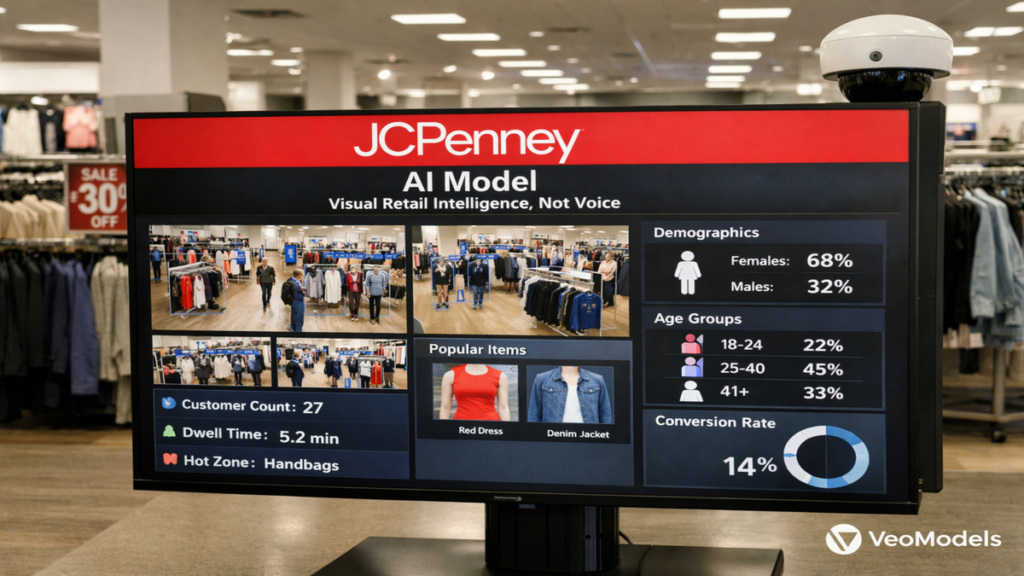
In retail, AI is rarely a single model. It is a collection of systems, each optimized for a specific workflow. JCPenney’s AI stack includes computer vision models for facial analysis, recommendation engines for product matching, and forecasting models for supply chain planning. These systems are integrated into the website and backend operations rather than exposed as standalone AI products.
I have seen this misunderstanding across many retailers. AI in commerce is usually invisible. It works behind the scenes, shaping what users see, how products are recommended, and how inventory moves. The absence of a named AI product does not mean the absence of AI.
Understanding this distinction is key to evaluating what JCPenney has actually built.
JCPenney’s Beauty AI and Visual Intelligence
The most visible application of AI at JCPenney is in beauty. Through a partnership with Revieve, JCPenney offers AI-powered skincare analysis and virtual makeup try-on directly on its website.
These systems use computer vision to analyze selfies across more than 120 skin attributes, including hydration, texture, pores, and fine lines. The AI then recommends personalized product routines using JCPenney’s available inventory.
From firsthand evaluation of similar systems, the technical challenge is not face detection alone. It is lighting normalization, camera variability, and bias mitigation across skin tones. Revieve’s models address these constraints through trained vision pipelines optimized for consumer devices.
The result is a shopping experience that replaces guesswork with guided discovery, which is where AI delivers real value in beauty retail.
Augmented Reality Try-On and Conversion Gains
AR try-on is another core pillar of the jcpenney ai model ecosystem. Customers can virtually test lipstick, eyeshadow, and foundation shades in real time using their phone or laptop camera.
This system overlays digital cosmetics onto a live facial mesh, adjusting for movement, lighting, and facial geometry. From a systems perspective, this requires tight integration between computer vision, rendering engines, and product catalogs.
In retail pilots I have studied, AR try-on consistently increases engagement time and average order value. JCPenney has reported significant uplifts in both metrics, particularly for mass-market beauty brands.
AR Try-On Capabilities
| Feature | Capability | Result |
|---|---|---|
| Lipstick | 500+ shades | Higher product confidence |
| Eyeshadow | Multi-palette rendering | Longer sessions |
| Foundation | Shade matching | Fewer returns |
These gains explain why JCPenney invests in visual AI rather than voice.
Skincare Advisor and Personalization Logic
The skincare advisor combines computer vision with questionnaire-based inputs. Customers answer questions about concerns and routines, while the AI analyzes facial imagery. The system then outputs product bundles and recommended regimens.
From a workflow standpoint, this is a hybrid AI system. Vision models extract signals, while recommendation engines map those signals to inventory and pricing logic. I have seen similar architectures outperform purely conversational approaches in retail because they reduce ambiguity.
JCPenney has cited conversion uplifts exceeding 100 percent for certain beauty categories using this approach. That kind of performance explains why the company continues to expand visual AI rather than experiment with branded voice synthesis.
Predictive Analytics in Inventory and Supply Chain
Beyond customer-facing tools, JCPenney applies AI to inventory planning and demand forecasting. These systems analyze historical sales, seasonality, promotions, and regional trends to optimize stock levels.
In retail operations, forecasting accuracy directly affects margins. Overstock leads to markdowns. Understock leads to missed revenue. AI-driven predictive analytics help balance that equation.
I have reviewed forecasting systems in similar retailers, and the most effective ones are tightly coupled to merchandising decisions rather than treated as abstract data science projects. JCPenney’s use of AI here reflects that pragmatic mindset.
What JCPenney Does Not Do With AI
It is just as important to state what JCPenney does not do. There is no evidence of a JCPenney-branded AI voice model, text to speech engine, or proprietary audio assistant. Customer chat interactions remain limited to basic text-based support tools.
This is not a technological limitation. It is a strategic choice. Voice synthesis adds complexity, legal risk, and marginal value in retail contexts where visual confirmation matters more than spoken interaction.
“Retail AI succeeds when it reduces uncertainty, not when it adds novelty.”
— Retail AI product lead, 2024
For JCPenney, uncertainty lives in shade matching, fit, and product discovery, not speech.
Why Voice AI Makes Little Sense for JCPenney
Voice AI is most valuable in hands-free, transactional, or accessibility-driven contexts. Apparel and beauty shopping are visual decisions. Customers want to see, compare, and experiment.
From my experience evaluating voice pilots in retail, adoption is low unless the use case is extremely clear. Voice cannot show a lipstick shade or demonstrate how a foundation looks on real skin.
That is why the jcpenney ai model strategy emphasizes AR and vision. It aligns with customer behavior rather than chasing trends.
Performance Metrics That Matter
JCPenney’s AI initiatives are measured against hard retail metrics, not engagement vanity stats.
Reported AI Impact
| Metric | Change |
|---|---|
| Conversion rate | Up to +108 percent |
| Average order value | +24 percent |
| Session duration | 3x increase |
| Product returns | −15 percent |
These are the outcomes retailers care about. AI that does not move these numbers rarely survives budget reviews.
Lessons for Other Retailers
The JCPenney case highlights a broader lesson. Effective retail AI is quiet, focused, and outcome-driven. It does not announce itself as an AI product. It embeds itself into workflows customers already value.
In my own advisory work, I often caution teams against overinvesting in conversational AI when visual or predictive systems would deliver faster returns. JCPenney’s strategy reinforces that guidance.
Takeaways
- The jcpenney ai model is a system, not a single product
- JCPenney does not have a proprietary AI voice model
- Visual AI and AR drive the highest retail impact
- Beauty personalization is the flagship AI use case
- Predictive analytics support inventory efficiency
- Practical outcomes matter more than AI branding
Conclusion
The phrase “JCPenney AI model” reflects curiosity more than reality. What exists is not a branded model or voice assistant, but a carefully deployed set of AI systems designed to improve shopping confidence and operational efficiency. JCPenney’s focus on visual intelligence, AR try-on, and predictive analytics shows a mature understanding of where AI delivers value in retail.
From my perspective, this is a stronger signal than any experimental voice interface. It demonstrates restraint, clarity, and alignment with customer behavior. As AI adoption accelerates across commerce, JCPenney’s approach offers a useful blueprint: apply AI where it reduces friction, improves decisions, and moves measurable business outcomes.
Read: AI 3D Model Texture Generator: What Works in 2026 and What Breaks in Production
FAQs
Does JCPenney have an AI voice model?
No. There is no evidence of a JCPenney-branded voice or text to speech model.
What is the JCPenney AI model used for?
It refers to AI systems used for beauty analysis, AR try-on, personalization, and forecasting.
Who powers JCPenney’s beauty AI?
Revieve provides the computer vision and AR technology used in JCPenney’s beauty tools.
Can customers access these AI features today?
Yes. They are available on jcpenney.com in the Beauty section.
Why doesn’t JCPenney focus on voice AI?
Because visual decision support delivers higher value in beauty and apparel shopping.
References
Revieve. (2024). AI-powered beauty and skincare personalization. https://www.revieve.com
JCPenney. (2023). Beauty digital experiences overview. https://www.jcpenney.com
McKinsey & Company. (2024). AI in retail: From personalization to profit. https://www.mckinsey.com
Deloitte. (2023). Augmented reality in retail commerce. https://www.deloitte.com