
Introduction
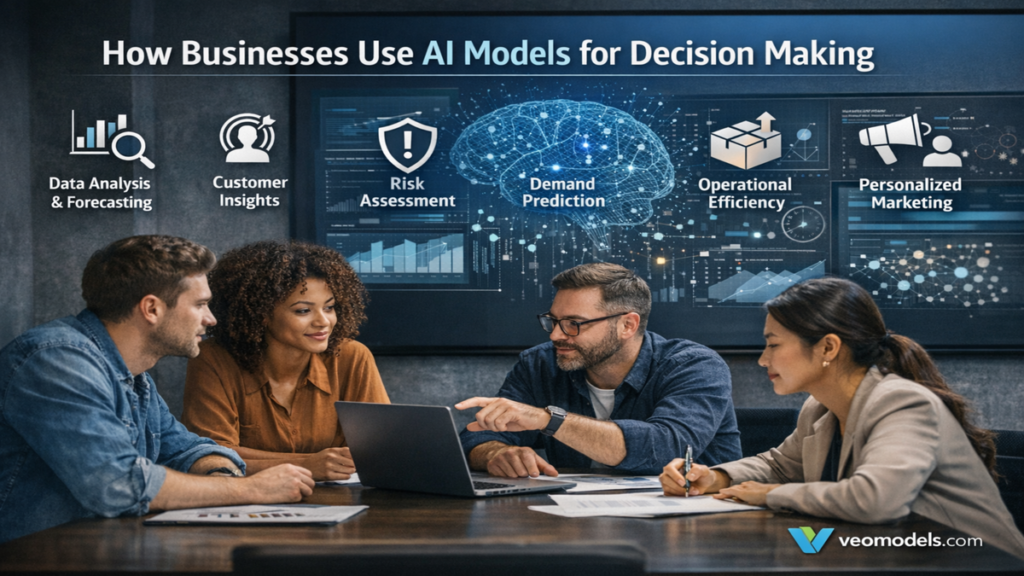
I have spent years observing how organizations translate emerging AI capabilities into everyday decisions, and one pattern stands out clearly. How businesses use AI models for decision making today is far less about automation replacing humans and far more about structured support systems reshaping how choices are evaluated, compared, and justified.
Within the first moments of most executive conversations, the real question is not whether AI works. It is where it works reliably, where it fails quietly, and how much trust decision makers should place in its outputs. AI models now influence pricing strategies, supply chain planning, hiring pipelines, medical triage, fraud detection, and customer engagement. Yet in nearly every successful deployment, AI operates as an advisory layer rather than an autonomous authority.
The past decade has seen AI move from experimental dashboards into operational workflows. What changed was not just model accuracy but organizational readiness. Businesses learned that decision quality depends as much on data governance, incentive alignment, and interpretability as it does on algorithms. Poorly framed objectives still produce flawed outcomes, even with advanced models.
This article examines how AI models are actually used in business decision making today. It focuses on concrete workflows, design trade-offs, and the human systems that determine success or failure. Rather than future speculation, the emphasis stays on observable practices shaping real outcomes across industries.
From Intuition-Led Decisions to Data-Augmented Judgment
For most of modern business history, strategic decisions relied heavily on managerial intuition supported by limited reporting. AI models introduced a shift, not by removing intuition, but by challenging it with probabilistic evidence.
In practice, AI models surface patterns humans miss at scale. Demand forecasting models identify seasonal fluctuations invisible in quarterly reports. Risk models flag weak signals long before losses appear on balance sheets. Yet these outputs rarely act alone. Executives still weigh political constraints, ethical considerations, and brand reputation alongside model predictions.
In one retail deployment I reviewed, AI improved inventory forecasting accuracy by over 18 percent. However, final stocking decisions remained human-led due to supplier relationships and regional preferences the model could not encode. This hybrid structure reflects a broader trend. Businesses use AI to narrow uncertainty, not to eliminate discretion.
The most effective organizations treat AI outputs as structured inputs rather than final answers. That framing preserves accountability while improving consistency and speed.
Decision Domains Where AI Models Add the Most Value
AI models are not equally effective across all decision types. They perform best in domains characterized by high data volume, repeatable patterns, and measurable outcomes.
Operational decisions such as demand planning, logistics routing, fraud detection, and predictive maintenance consistently show strong returns. These decisions benefit from statistical regularities and rapid feedback loops that allow models to recalibrate.
Strategic decisions show more nuanced results. AI can model scenarios, simulate outcomes, and stress-test assumptions, but it cannot account for regulatory shifts, competitor psychology, or cultural dynamics with full reliability.
Organizations that succeed clearly separate decision classes. AI leads where pattern recognition dominates. Humans lead where ambiguity, ethics, and long-term vision matter most.
How Businesses Use AI Models for Decision Making in Practice
In real deployments, how businesses use AI models for decision making follows a consistent workflow. Data ingestion, model inference, human review, and outcome tracking form a continuous loop rather than a linear pipeline.
AI models typically generate ranked recommendations rather than binary choices. For example, credit risk systems score applicants across probability bands instead of issuing approvals directly. Marketing systems rank customer segments by predicted responsiveness rather than launching campaigns autonomously.
Human reviewers intervene at predefined thresholds. High confidence cases move quickly. Edge cases receive manual scrutiny. This structure improves efficiency without surrendering control.
Over time, organizations refine these thresholds based on error tolerance, regulatory exposure, and reputational risk. The model adapts, but governance rules evolve alongside it.
Industry-Specific Applications and Decision Patterns
Different industries apply AI decision systems in distinct ways shaped by regulation and risk tolerance.
In healthcare, AI assists clinical decisions by flagging anomalies, prioritizing cases, and summarizing patient histories. Final diagnoses remain clinician-led due to ethical and legal accountability.
In finance, AI drives fraud detection, credit scoring, and algorithmic trading within tightly monitored boundaries. Regulatory audits demand transparency, limiting black-box adoption.
In manufacturing, predictive maintenance models directly trigger interventions due to clear cost-benefit ratios and low ethical risk.
Across sectors, deployment depth reflects consequence severity. The higher the human cost of error, the more advisory the AI role remains.
Table: Common Business Decisions Supported by AI Models
| Decision Area | AI Role | Human Oversight Level |
|---|---|---|
| Demand Forecasting | Predictive modeling | Moderate |
| Fraud Detection | Anomaly detection | High |
| Hiring Screening | Candidate ranking | Very high |
| Pricing Optimization | Scenario simulation | Moderate |
| Medical Triage | Risk prioritization | Extremely high |
This pattern highlights a consistent principle. AI scales analysis, while humans retain responsibility.
Organizational Trade-Offs and Hidden Costs
AI-driven decision systems introduce trade-offs that rarely appear in vendor marketing.
One major cost is data maintenance. Models degrade as markets shift, consumer behavior evolves, and external conditions change. Continuous retraining requires infrastructure investment and skilled oversight.
Another cost is cognitive complacency. Teams may over-trust model outputs, especially when performance has been strong historically. I have seen organizations miss emerging risks because teams deferred too quickly to automated recommendations.
There is also the cost of explanation. Regulators, customers, and internal stakeholders increasingly demand clarity around why decisions were made. Complex models increase justification overhead.
Successful organizations budget not just for model development, but for governance, audits, and human review capacity.
Read: Xoul AI and the Rise of Uncensored AI Companions
Table: Benefits vs Constraints of AI Decision Systems
| Benefit | Constraint |
|---|---|
| Faster analysis | Model drift risk |
| Pattern detection | Interpretability limits |
| Scalability | Data dependency |
| Consistency | Reduced flexibility |
Understanding these constraints prevents unrealistic expectations and improves adoption outcomes.
Expert Perspectives on AI and Decision Authority
Industry leaders consistently emphasize balance over automation.
Satya Nadella stated in 2023 that AI should “augment human judgment, not replace it,” reflecting Microsoft’s positioning of AI as a co-pilot rather than a decision-maker.
Andrew Ng has repeatedly warned that “most AI failures come from misaligned problem framing, not bad models,” underscoring the importance of organizational clarity.
Economist Ajay Agrawal notes that AI lowers the cost of prediction, not the cost of decision-making, shifting value toward human judgment and strategy.
These perspectives align closely with observed enterprise behavior.
Governance, Ethics, and Accountability Structures
AI decisions reshape accountability. When outcomes go wrong, responsibility cannot be deferred to software.
Leading organizations implement decision logs, model documentation, and override tracking. These systems create traceability without slowing operations excessively.
Ethical review boards increasingly evaluate high-impact AI deployments, particularly in hiring, lending, and healthcare. Bias testing and fairness audits are now standard practice rather than optional safeguards.
The maturity of governance frameworks often determines whether AI deployments scale or stall.
Why Human Judgment Remains Central
Despite technical advances, AI lacks contextual awareness, moral reasoning, and responsibility. Businesses recognize this limitation intuitively.
AI excels at prediction. Humans excel at meaning, values, and long-term consequence assessment. Effective decision systems integrate both.
In practice, the most successful teams view AI as a disciplined challenger to intuition rather than an unquestionable authority. This mindset preserves learning and adaptability over time.
Takeaways
- AI improves decisions by reducing uncertainty, not eliminating judgment
- Advisory systems outperform fully automated decision pipelines
- Industry regulation shapes AI deployment depth
- Data quality and governance drive long-term success
- Human oversight prevents silent failure modes
- Accountability remains a human responsibility
Conclusion
Understanding how businesses use AI models for decision making requires moving beyond headlines about automation. The real story is quieter and more structural. AI models now sit inside decision workflows as analytical engines that surface options, quantify risk, and challenge assumptions.
Organizations that succeed treat AI as infrastructure rather than authority. They invest in data quality, governance, and human oversight with the same seriousness as model development. They recognize trade-offs early and design systems that preserve accountability.
As AI capabilities continue to advance, decision quality will depend less on algorithmic novelty and more on institutional maturity. The future of AI-driven decision making belongs to organizations that respect both the power and the limits of machine prediction.
Read: Day AI: How Daily AI Assistants Are Quietly Reshaping Human Routines
FAQs
What does it mean to use AI models for decision making?
It means using AI to generate predictions, rankings, or scenarios that inform human decisions, not replace them.
Do AI models make final business decisions?
In most cases, no. Humans retain final authority, especially for high-impact choices.
Which decisions benefit most from AI support?
Operational decisions with high data volume and clear outcomes see the strongest results.
What risks do AI decision systems introduce?
Model drift, bias, over-reliance, and reduced transparency are common risks.
Is AI decision making regulated?
Yes. Many industries face growing regulatory requirements for explainability and fairness.
References
Agrawal, A., Gans, J., & Goldfarb, A. (2019). Prediction Machines. Harvard Business Review Press.
McKinsey Global Institute. (2023). The State of AI in Business. https://www.mckinsey.com
Ng, A. (2022). Machine Learning Yearning. https://www.deeplearning.ai
World Economic Forum. (2023). AI Governance and Business Decision Making. https://www.weforum.org