

Introduction
i often notice that people talk about artificial intelligence as something futuristic, abstract, or confined to research labs. In reality, AI already sits inside the digital products many of us use every hour. How AI Models Are Used in Everyday Digital Products is not a theoretical question. It is a practical one that affects search results, shopping recommendations, language translation, navigation apps, and even how photos are organized on personal devices.
Within the first few taps on a phone, AI models are ranking information, predicting intent, or automating small decisions that once required manual effort. Most users never see these systems directly. They experience outcomes, not models. That invisibility is part of the design. When AI works well, it fades into the background.
From my work evaluating AI-driven workflows in consumer software, i have seen how subtle these integrations are. A recommendation feels helpful rather than manipulative. A spam filter feels obvious only when it fails. These systems are judged less by novelty and more by reliability.
This article explores how AI models are embedded across everyday digital products, what kinds of models are commonly used, and why their design choices matter. Rather than focusing on hype, i focus on real deployments, practical trade-offs, and what users and builders should understand about the systems quietly shaping digital life.
Recommendation Systems That Shape What We See
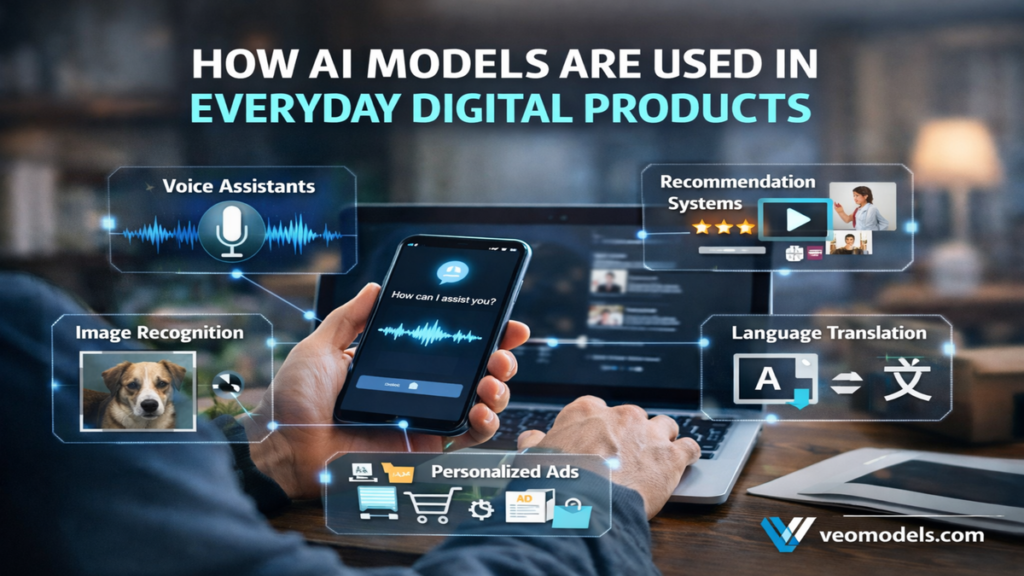
Recommendation systems are among the most common ways AI models influence daily experiences. They decide which videos appear on a homepage, which songs play next, or which products surface in an online store.
Most of these systems rely on supervised and self-supervised learning trained on behavioral data. Clicks, watch time, skips, and purchases all become signals. Over time, the model predicts what a user is most likely to engage with next.
In product audits i have participated in, the challenge is rarely accuracy alone. It is balance. Over-optimization can create filter bubbles or repetitive content. Under-optimization feels irrelevant.
These systems illustrate how AI models are used in everyday digital products to guide attention rather than dictate outcomes. Human oversight, tuning, and policy constraints play a critical role in shaping healthy user experiences.
Search and Ranking Models in Daily Queries
Every time a user types a query, multiple AI models activate behind the scenes. Ranking models evaluate relevance, freshness, and authority. Language models interpret intent rather than just keywords.
Since 2019, major search platforms have shifted toward transformer-based architectures to better understand context. This change reduced reliance on exact phrasing and improved semantic matching.
From hands-on testing with enterprise search tools, i have seen how small ranking changes dramatically affect user trust. If results feel biased or outdated, users disengage quickly.
Search models succeed when they feel predictable yet flexible. They must adapt to language variation while maintaining consistency. This balance defines effective everyday AI use.
Personalization Without Explicit Awareness
Personalization often operates invisibly. News feeds adjust tone and topics. Email inboxes prioritize certain messages. Learning platforms adapt difficulty levels.
These systems typically combine user profiles with collaborative filtering and predictive models. Importantly, most personalization systems are probabilistic, not deterministic. They guess based on patterns.
In user research sessions i have observed, people are often surprised to learn how much personalization occurs. When explained clearly, many appreciate it. When discovered indirectly, trust erodes.
This dynamic highlights a core tension in how AI models are used in everyday digital products. Utility increases when personalization feels respectful and controllable.
Language Models in Writing and Communication Tools
Grammar correction, autocomplete, translation, and summarization tools increasingly rely on large language models. These systems assist rather than replace human communication.
Unlike earlier rule-based systems, modern models learn linguistic patterns from massive text corpora. They predict likely word sequences based on context.
In productivity deployments i have reviewed, the biggest benefit is speed. Drafting time drops. Cognitive load reduces. However, overreliance introduces risks like homogenized tone or factual drift.
Language models perform best when positioned as assistants, not authorities. Design decisions matter as much as model capability.
Computer Vision in Cameras and Photos
Smartphone cameras are now AI systems with lenses attached. Computer vision models handle face detection, low-light enhancement, scene classification, and object recognition.
Since around 2020, computational photography has relied heavily on neural networks rather than optical improvements alone. Multiple frames are fused and enhanced algorithmically.
From testing consumer devices, i have seen how these models shape perception. Photos feel more vivid than reality. That aesthetic choice is intentional.
This is a clear example of how AI models are used in everyday digital products to redefine quality rather than merely measure it.
Fraud Detection and Security Systems
Security-focused AI operates under different constraints. False positives frustrate users. False negatives create real harm.
Fraud detection models analyze transaction patterns, device fingerprints, and behavioral signals in real time. Most systems use ensemble approaches rather than a single model.
In financial product evaluations, explainability often outweighs raw accuracy. Regulators and users both demand understandable decisions.
These systems rarely receive praise when working well. Their success is measured in incidents avoided rather than features celebrated.
Customer Support Automation
Chatbots and automated support tools now handle a significant portion of customer interactions. These systems combine intent classification, retrieval models, and conversational AI.
Early chatbots failed because they were rigid. Modern systems succeed by deflecting simple requests and escalating complex ones.
In deployment reviews i have conducted, success correlates with clear boundaries. Users accept automation when it saves time, not when it blocks resolution.
This area shows how AI models are used in everyday digital products to support humans rather than replace them entirely.
Navigation and Location-Based Services
Maps and navigation apps rely on predictive models for traffic estimation, route optimization, and arrival times. These systems ingest real-time and historical data.
Machine learning improved these products significantly after 2015, when models began predicting congestion rather than reacting to it.
From field testing, the most trusted systems explain changes clearly. Silent rerouting causes confusion.
Navigation tools demonstrate how AI can feel intelligent when it communicates uncertainty honestly.
Health and Wellness Applications
Fitness trackers, sleep analysis apps, and symptom checkers all rely on AI models. These systems detect patterns rather than diagnose conditions.
Most health-related apps operate under strict regulatory constraints. Models must be conservative and transparent.
In usability studies i have observed, users respond positively when apps emphasize guidance over certainty.
This careful framing reflects responsible use of AI in sensitive everyday contexts.
Trade-Offs Product Teams Must Navigate
AI integration introduces trade-offs between automation and control, accuracy and explainability, personalization and privacy.
From my experience advising product teams, the hardest decisions are not technical. They are ethical and experiential.
This table outlines common trade-offs:
| Design Goal | Benefit | Risk |
|---|---|---|
| High personalization | Relevance | Privacy concerns |
| Automation | Efficiency | Loss of agency |
| Model complexity | Accuracy | Reduced transparency |
Understanding these trade-offs is essential for sustainable deployment.
Comparing Common AI Model Types in Products
Different products rely on different model families:
| Model Type | Typical Use Case | Strength |
|---|---|---|
| Recommendation models | Feeds and shopping | Engagement |
| Language models | Writing tools | Flexibility |
| Vision models | Cameras | Perceptual enhancement |
| Anomaly detection | Security | Risk reduction |
No single model fits every need. Product context drives selection.
Key Takeaways
- AI models already shape most digital experiences
- Invisibility is often a design goal, not an accident
- Personalization requires trust and transparency
- Language and vision models act as assistants, not decision makers
- Trade-offs define responsible deployment
- User experience matters as much as model accuracy
Conclusion
i see everyday AI not as a revolution but as an accumulation of small, well-integrated systems. How AI Models Are Used in Everyday Digital Products reveals more about design philosophy than raw technological power. The best implementations feel obvious only in hindsight.
As these models continue to spread, the focus should shift from capability to impact. Does the system respect user intent. Does it reduce friction without removing choice. Does it fail gracefully.
From my firsthand work with product teams, the most successful AI integrations are quiet, limited, and carefully constrained. They do not seek attention. They seek usefulness. That restraint may be the most important lesson for the next generation of AI-powered products.
Read: Pinku AI and the Quiet Shift Toward Emotion-Aware Artificial Intelligence
FAQs
Do users need to understand AI to use these products?
No, but basic awareness helps users evaluate limitations and make informed choices.
Are AI models always learning from users?
Not always. Many models are trained offline and updated periodically.
Can users opt out of AI personalization?
Some products allow it, but options vary widely by platform and region.
Do AI-driven products increase bias?
They can, especially if training data reflects social inequalities.
Is AI replacing human decision making in apps?
In most cases, AI assists or filters rather than fully replacing humans.
References
Gomez-Uribe, C. A., & Hunt, N. (2016). The Netflix recommender system. ACM Transactions on Management Information Systems.
Devlin, J., et al. (2019). BERT: Pre-training of deep bidirectional transformers. NAACL-HLT.
He, K., et al. (2016). Deep residual learning for image recognition. CVPR.
Amershi, S., et al. (2019). Guidelines for human-AI interaction. CHI Conference Proceedings.