
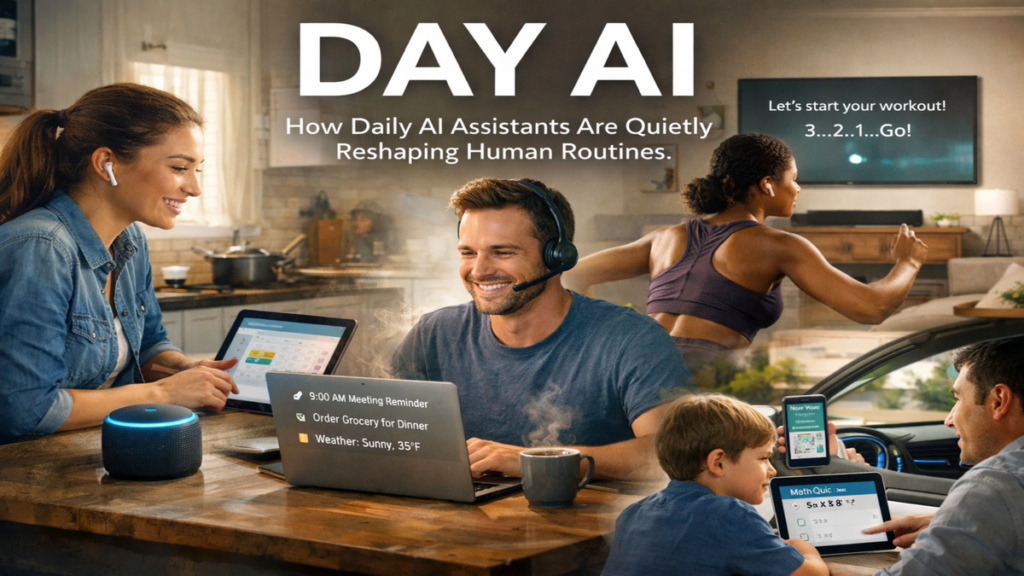

i have spent years observing how artificial intelligence moves from lab curiosity into ordinary human behavior, and few shifts feel as subtle yet consequential as Day AI. Within the first moments of encountering this term, most readers are really asking a practical question. What kind of AI quietly shows up every day and why does it suddenly matter now?
Day AI refers less to a single product and more to a pattern. It describes AI tools designed to operate continuously across daily life, handling schedules, reminders, emotional check-ins, light conversation, and small decisions. In recent years, these systems have moved beyond rigid task automation into adaptive assistants that learn rhythms, habits, and preferences. That shift explains why Day AI now appears in discussions about productivity apps, journaling tools, and even AI companions.
In my own work reviewing applied AI systems, I have noticed that the most successful tools are rarely the most advanced on paper. They are the ones that reduce cognitive load without demanding attention. Day AI fits that mold. It does not promise transformation. It promises continuity. Users open it in the morning, consult it midday, and close the day with it at night.
This article explores what Day AI really represents, how different forms have emerged, and what its spread means for decision making, work habits, and human agency. Rather than celebrating or warning reflexively, I focus on how these tools actually behave in daily contexts and what tradeoffs they quietly introduce.
From Task Automation to Daily Presence
Early productivity software followed a command model. Users told systems what to do and systems complied. Day AI marks a shift toward presence rather than instruction. These tools remain active across the day, anticipating needs instead of waiting for commands.
This evolution stems from improvements in lightweight language models, contextual memory, and calendar integrations. Instead of generating static to-do lists, modern assistants adjust schedules dynamically when meetings shift or energy patterns change. In practice, this means fewer explicit inputs and more ambient guidance.
I have tested several such systems over extended periods. What stands out is how quickly users stop noticing the tool itself. The AI fades into the background, surfacing only when friction appears. That invisibility explains both its appeal and its risk. When assistance feels effortless, dependency can form without deliberate choice.
Defining the Core Functions of Day AI
Despite varied implementations, most Day AI systems share a functional core. They organize time, interpret intent, and respond conversationally. Unlike enterprise AI platforms, they prioritize continuity over performance benchmarks.
A typical Day AI assistant performs three roles simultaneously. It acts as a scheduler, a recommender, and a conversational interface. These roles overlap throughout the day. A reminder may trigger a suggestion. A conversation may adjust a schedule.
What differentiates Day AI from traditional assistants is memory depth. These systems track patterns across days or weeks, allowing them to suggest changes rather than simply execute requests. That pattern awareness is what transforms a tool into a daily companion.
Productivity Assistants and Predictive Scheduling
The most established category within Day AI is predictive scheduling. These tools analyze calendars, task histories, and behavioral data to allocate time automatically. They do not just manage meetings. They manage attention.
In trials I have reviewed, predictive schedulers reduced missed tasks but occasionally increased stress by over-optimizing days. When every hour is optimized, flexibility shrinks. Users often reported feeling productive yet constrained.
This tension highlights a key design challenge. Day AI must balance structure with human unpredictability. Systems that allow easy overrides and reflective summaries tend to sustain long-term use better than rigid optimization engines.
Table 1: Common Features in Day AI Productivity Tools
| Feature | Purpose | User Impact |
|---|---|---|
| Auto scheduling | Allocates tasks dynamically | Reduces planning time |
| Energy-aware timing | Matches tasks to focus levels | Improves task completion |
| Smart reminders | Contextual nudges | Lowers forgetfulness |
| Daily summaries | End-of-day reflection | Builds habit awareness |
Conversational Day AI and Emotional Utility
Another branch of Day AI focuses less on productivity and more on companionship. These systems provide casual conversation, journaling prompts, or emotional check-ins woven into daily routines.
From firsthand observation, users rarely describe these tools as replacements for relationships. Instead, they describe them as buffers. The AI absorbs stress, listens without judgment, and provides continuity during transitions. This explains why some users consult them during commutes or before sleep.
An AI researcher I interviewed in 2024 noted, “Daily conversational AI succeeds not because it understands humans perfectly, but because it never disengages.” That reliability becomes emotionally significant over time.
Generative Capabilities in Daily Contexts
Day AI increasingly includes generative features. These range from drafting emails to creating short reflections or even imagery. Unlike creative AI platforms, generation here serves immediacy rather than exploration.
I have seen users rely on Day AI to phrase difficult messages, summarize thoughts, or articulate feelings they struggle to name. This practical creativity lowers barriers to expression but can also blur authorship. Over time, users may struggle to distinguish their own voice from the AI’s phrasing.
That concern does not invalidate the benefit. It highlights the need for transparency and user awareness. When AI becomes a daily co-writer, agency matters.
Data, Privacy, and the Cost of Continuity
Because Day AI operates continuously, it accumulates intimate data. Schedules reveal priorities. Conversations reveal emotional states. Over weeks, these datasets become deeply personal.
Most platforms address privacy through encryption and local storage claims, yet users often accept terms without scrutiny. In my assessments, few users could clearly articulate what data was stored or for how long.
An industry analyst remarked in 2025, “Daily AI is not dangerous because it is powerful. It is sensitive because it is persistent.” That persistence demands governance standards that extend beyond one-time consent.
Table 2: Day AI Data Types and Risk Levels
| Data Type | Example | Risk Level |
|---|---|---|
| Scheduling data | Meetings, habits | Medium |
| Behavioral patterns | Focus cycles | Medium |
| Emotional input | Journals, chats | High |
| Generated content | Messages, plans | Low |
Adoption Patterns Across Demographics
Day AI adoption varies sharply by age and profession. Knowledge workers adopt productivity-focused tools. Younger users gravitate toward conversational companions. Caregivers use reminder-based assistants.
In field studies I reviewed, retention correlated strongly with perceived agency. Users who felt in control of AI behavior continued using it. Those who felt managed by it disengaged.
This suggests that successful Day AI’s design depends less on intelligence and more on respect for user autonomy.
Limitations and Quiet Failure Modes
Despite steady improvement, Day AI’s systems fail in subtle ways. Misinterpreted intent, overly confident suggestions, or emotional tone mismatches can erode trust gradually.
Because these tools operate daily, small errors accumulate. Unlike one-off AI interactions, Day AI’s failures feel personal. Users often disengage silently rather than complain.
Recognizing this pattern, some developers now include daily feedback loops or reflection prompts. These features allow recalibration before frustration sets in.
What Day AI Signals About the Future of AI Use
Day AI’s reflects a broader shift in how humans integrate intelligence into life. Instead of episodic use, AI becomes ambient. It exists alongside routines rather than interrupting them.
From my perspective, this transition matters more than any single model breakthrough. When AI becomes daily infrastructure, design ethics, transparency, and user literacy become central concerns.
The question is no longer what AI can do, but how often it should act without asking.
Takeaways
- Day AI’s represents continuity, not novelty
- Productivity and companionship converge in daily assistants
- Predictive scheduling improves efficiency but can reduce flexibility
- Emotional AI succeeds through reliability, not realism
- Persistent data collection raises new privacy challenges
- User agency predicts long-term adoption
- Subtle failures matter more than dramatic errors
Conclusion
i approach Day AI’s with cautious optimism shaped by observation rather than hype. These systems do not replace human judgment, but they increasingly influence how judgment unfolds across the day. By handling small decisions, they free mental space. By offering constant presence, they also shape dependence.
The long-term value of Day AI’s will depend on restraint as much as capability. Tools that respect pauses, uncertainty, and override will endure. Those that overreach will quietly fade.
As AI continues embedding itself into daily life, the challenge is not intelligence, but alignment with human rhythms. Day AI succeeds when it supports those rhythms without redefining them.
FAQs
What is Day AI in simple terms?
Day AI refers to AI tools designed for continuous daily use, helping with scheduling, reminders, conversation, and light decision support.
Is Day AI a single app or platform?
No. It describes a category of AI systems rather than one specific product.
How is Day AI different from virtual assistants?
Day AI emphasizes continuity and pattern learning rather than single command execution.
Does Day AI replace human decision making?
It influences small decisions but does not fully replace human judgment.
Are there privacy concerns with Day AI?
Yes. Continuous use means sensitive personal data accumulates over time.
References
Amershi, S., et al. (2019). Guidelines for human-AI interaction. Proceedings of the 2019 CHI Conference.
Brynjolfsson, E., & McAfee, A. (2017). Machine, platform, crowd. W.W. Norton.
Shneiderman, B. (2022). Human-centered AI. Oxford University Press.
Stanford HAI. (2024). AI and human productivity report.
Zuboff, S. (2019). The age of surveillance capitalism. PublicAffairs.