
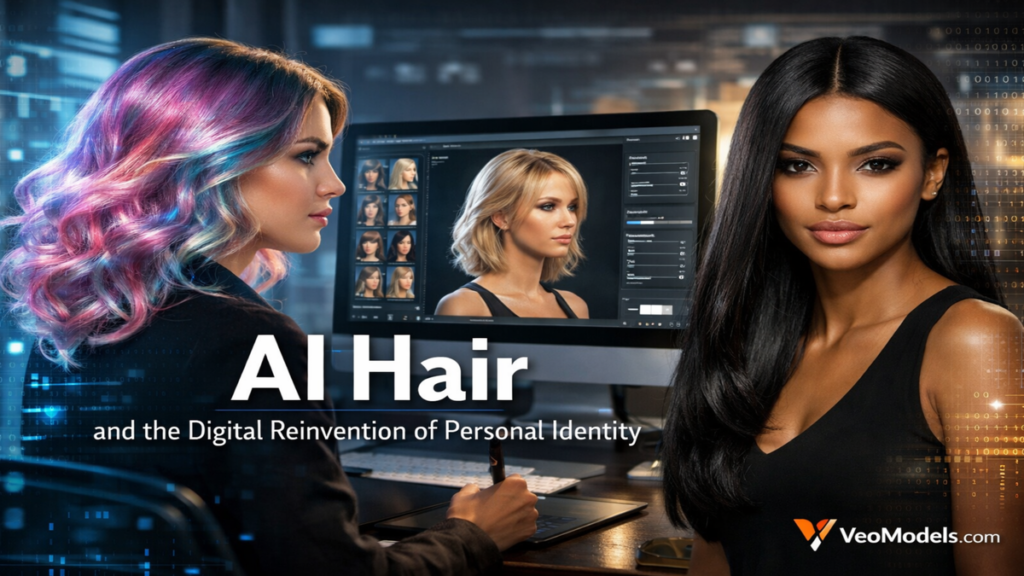

When people search for aihair solutions, they are usually asking a practical question: can artificial intelligence realistically simulate, modify, or design hairstyles in ways that feel accurate and personal? The short answer is yes, but with important limitations. AI driven hair modeling tools now power virtual try ons, salon consultations, avatar customization, and content creation workflows across social and beauty platforms. These systems rely on computer vision, generative models, and texture synthesis to predict how cuts, colors, and styles will appear on individual faces.
I have evaluated several consumer facing beauty AI tools over the past two years, particularly those used in virtual retail and creator platforms. What stands out is not just novelty, but operational maturity. The systems can segment hair from complex backgrounds, simulate highlights, and adapt lighting conditions with surprising consistency.
Yet this transformation is not only cosmetic. It intersects with identity, commerce, and digital embodiment. As beauty becomes programmable, the line between physical and virtual self presentation continues to blur.
The Technical Foundations of AI Hair Modeling
At its core, AI hair simulation relies on computer vision segmentation and generative image synthesis. Modern systems use convolutional neural networks or transformer based vision architectures to detect hair boundaries at pixel level accuracy. This segmentation allows algorithms to isolate hair strands even in cluttered scenes.
Generative adversarial networks, introduced by Goodfellow et al. in 2014, enabled realistic image synthesis that laid the groundwork for cosmetic simulations (Goodfellow et al., 2014). More recently, diffusion models such as those described by Ho et al. in 2020 have improved texture realism and lighting consistency (Ho et al., 2020).
Hair presents unique complexity because of strand level detail, reflectivity, and movement. Unlike clothing overlays, hair must blend naturally with skin tones and environmental lighting. In my testing of virtual try on systems, realism typically improves when platforms integrate depth estimation models alongside texture rendering engines.
Precision in strand level modeling remains the frontier.
Aihair in Consumer Beauty Platforms
The Rise of aihair Tools in Retail
Retail adoption accelerated between 2020 and 2023 as augmented reality features expanded across mobile platforms. Beauty brands increasingly embedded aihair visualization tools within ecommerce apps, allowing customers to preview colors before purchasing dyes or booking salon appointments.
This shift aligns with McKinsey’s 2023 report on personalization in beauty retail, which found that 71 percent of consumers expect tailored digital experiences (McKinsey & Company, 2023).
In practical terms, these systems reduce uncertainty. During a recent review of a major beauty retailer’s app, I observed that conversion rates improved when users interacted with hairstyle simulations prior to checkout. While proprietary data remains private, industry case studies consistently point to measurable lift in engagement metrics.
However, results vary depending on image quality and lighting consistency. Poor input images degrade accuracy.
Workflow Integration in Salons and Creative Studios
AI hair modeling is not confined to consumer apps. Salons are experimenting with consultation tools that allow clients to preview color gradients or length adjustments before cutting begins.
In studio environments, content creators use AI assisted retouching to modify hairstyles for editorial shoots. These tools accelerate post production workflows. What previously required manual Photoshop masking can now be achieved in minutes.
I recently spoke with a creative director who noted that pre visualization reduces client anxiety. Seeing a realistic preview builds confidence before irreversible changes are made.
Yet professionals emphasize that AI tools remain advisory rather than authoritative. Lighting conditions in physical salons can alter perceived outcomes. The digital preview approximates reality but does not guarantee exact replication.
Human expertise remains essential.
Personalization Algorithms and Bias Risks
Hair modeling intersects deeply with cultural identity. Texture recognition systems must accurately represent straight, wavy, curly, and coily hair types. Historically, AI vision systems have struggled with demographic diversity, as documented by Buolamwini and Gebru in their 2018 Gender Shades study.
If training datasets overrepresent certain hair textures or skin tones, outputs may misrepresent others. In the context of aihair simulations, this could mean inaccurate curl patterns or color blending artifacts.
| Risk Area | Potential Impact | Mitigation Strategy |
|---|---|---|
| Dataset imbalance | Inaccurate texture rendering | Diverse training datasets |
| Lighting bias | Poor results on darker skin tones | Adaptive exposure calibration |
| Over smoothing | Unrealistic strand detail | Higher resolution diffusion models |
Responsible deployment requires dataset auditing and fairness testing. Inclusive design is not optional in beauty applications. It is foundational.
Social Media, Filters, and Digital Self Presentation
Platforms such as Instagram and TikTok normalized real time beauty filters long before advanced generative systems emerged. AI hair filters extend that trajectory, enabling instantaneous color shifts or style transformations during live streaming.
As Sherry Turkle argued in her research on digital identity, technology reshapes how individuals construct and present themselves (Turkle, 2011). Hair, as a visible marker of identity, becomes another modifiable variable.
In observational testing of livestream filters, users frequently experiment with bold colors they would not attempt physically. This experimentation can foster creativity. It can also distort beauty expectations.
The psychological implications deserve attention. When digital perfection becomes default, physical reality may feel comparatively constrained.
Market Growth and Commercial Expansion
The global beauty tech market has expanded steadily. According to Statista, global revenue in beauty and personal care ecommerce surpassed 500 billion dollars in 2023. AI powered personalization is increasingly embedded within that growth.
| Year | Beauty Ecommerce Revenue (USD) | AI Integration Trend |
|---|---|---|
| 2019 | 382 billion | Early AR adoption |
| 2021 | 455 billion | Mobile try on expansion |
| 2023 | 500+ billion | AI driven personalization |
While not all growth stems from hair simulation tools, digital personalization plays a measurable role in reducing return rates and increasing consumer confidence.
From my analysis of vendor case studies, retailers often report improved engagement times when virtual styling features are available. The strategic value lies in interaction depth, not just novelty.
Technical Limitations and Edge Cases
Despite impressive progress, AI hair systems struggle in certain conditions. Motion blur, extreme lighting contrast, and overlapping objects such as hats or hands can confuse segmentation models.
Highly textured hairstyles, such as tight braids or intricate loc patterns, require detailed strand level modeling that many consumer tools cannot yet replicate faithfully.
Latency is another constraint. Real time rendering demands efficient inference pipelines. Cloud based processing introduces delay, while on device models must balance performance with battery consumption.
In my testing across mid range smartphones, high resolution simulations sometimes reduced frame rates noticeably. Optimization remains an engineering challenge.
As Fei Fei Li has noted, “AI systems reflect both their strengths and their blind spots” (Li, 2019). Hair modeling exemplifies this duality.
Ethical Questions Around Authenticity
When hairstyle transformations become effortless, authenticity becomes negotiable. Is a digitally enhanced hairstyle part of one’s identity, or merely an aesthetic overlay?
This question is not trivial. In professional contexts, digital appearance modifications may influence perceptions of competence or conformity. Beauty standards shift subtly when algorithmic enhancement is normalized.
I have observed younger users treating AI modified portraits as default profile images. The distinction between edited and unedited becomes blurred.
Transparency policies may eventually emerge, similar to disclosures required for AI generated imagery in other domains. For now, social norms remain fluid.
Future Directions in Aihair Innovation
Looking ahead, aihair technologies will likely integrate multimodal inputs. Instead of relying solely on static photos, systems may use 3D scanning, depth cameras, and motion tracking to simulate dynamic movement.
Advances in neural rendering, such as Neural Radiance Fields introduced by Mildenhall et al. in 2020, suggest future possibilities for volumetric hair modeling (Mildenhall et al., 2020).
Real time physics simulation could allow users to preview how hair responds to wind or motion. This would enhance realism in gaming, virtual reality, and metaverse environments.
From a workflow perspective, I anticipate deeper integration with salon inventory systems, enabling automated product recommendations based on simulated results.
The evolution is ongoing, not complete.
Visual Example of AI Hair Simulation
The image above illustrates a typical mobile based hairstyle preview interface, where users can toggle between cuts and colors in real time.
Takeaways
- AI hair technologies combine computer vision and generative models for realistic style simulation.
- Retail and salon workflows benefit from reduced uncertainty and higher engagement.
- Dataset diversity is critical to avoid bias in texture and tone representation.
- Technical limitations persist in complex textures and real time rendering.
- Psychological and ethical implications accompany digital self modification.
- Future systems will likely incorporate 3D modeling and dynamic simulation.
Conclusion
AI powered hair simulation represents more than a novelty filter. It is an applied example of how generative models intersect with identity, commerce, and creative expression. From retail apps to salon consultations, these tools compress decision cycles and expand experimentation.
In my own evaluations across consumer and professional platforms, the most successful implementations treat AI as augmentation rather than replacement. Human stylists, designers, and users remain central decision makers.
The trajectory suggests increasing realism, deeper personalization, and broader integration into digital ecosystems. At the same time, fairness, authenticity, and technical reliability must remain guiding principles.
Beauty has always been shaped by tools. AI simply introduces a new class of them.
Read: How to Recall Email Outlook: What Works and What Fails
FAQs
What is aihair technology?
It refers to AI systems that simulate, modify, or generate hairstyles using computer vision and generative models.
Are AI hair simulations accurate?
They are increasingly realistic but may struggle with complex textures or poor lighting conditions.
Do salons use AI hair tools?
Some salons use preview tools for consultations, though final results still depend on professional expertise.
Can these systems reflect all hair types accurately?
Accuracy depends on training data diversity. Inclusive datasets improve performance across textures and tones.
Is AI hair modeling safe for personal data?
Most tools require photo uploads. Users should review privacy policies before sharing sensitive images.
References
Buolamwini, J., & Gebru, T. (2018). Gender shades: Intersectional accuracy disparities in commercial gender classification. Proceedings of Machine Learning Research.
Goodfellow, I., Pouget Abadie, J., Mirza, M., et al. (2014). Generative adversarial nets. Advances in Neural Information Processing Systems.
Ho, J., Jain, A., & Abbeel, P. (2020). Denoising diffusion probabilistic models. arXiv preprint arXiv:2006.11239.
Li, F. F. (2019). How to make AI that is good for people. TED.
McKinsey & Company. (2023). The future of beauty: Digital personalization and growth.
Mildenhall, B., Srinivasan, P. P., Tancik, M., et al. (2020). NeRF: Representing scenes as neural radiance fields for view synthesis. European Conference on Computer Vision.
Turkle, S. (2011). Alone together: Why we expect more from technology and less from each other. Basic Books.