
I approach this topic from a place of long fascination with how simple shapes become powerful symbols once artificial intelligence enters the creative process. When I first explored ball centered visual generation, I noticed how a single round form could shift between realism, fantasy, abstraction, and emotion depending on prompt structure and model choice. This article explores the full creative ecosystem around AI driven bola imagery, from concept and prompt design to tools, workflows, and artistic control, written as a complete and independent guide.
Understanding the Concept of AI Bola Art
At its core, bola imagery revolves around spherical forms. These can be literal objects such as soccer balls or symbolic shapes such as glowing orbs, planets, energy cores, or abstract spheres. Artificial intelligence expands this idea by interpreting text, style references, lighting cues, and environmental context to produce images that feel intentional rather than random.
I see bola art as an ideal testing ground for AI creativity because the form is simple, yet the variation is infinite. A ball can represent sport, power, mystery, motion, or even consciousness. When AI models are trained on vast visual data, they learn how surfaces reflect light, how motion blurs edges, and how environments interact with round objects. This makes bola art especially effective for studying realism, depth, and texture generation.
Why Ball Based Imagery Works So Well With AI
From my experience, round objects are easier for diffusion models to stabilize compared to complex human anatomy. A sphere has consistent geometry, which allows the model to focus on materials, lighting, and mood. This results in cleaner outputs and fewer distortions.
Another reason bola imagery excels lies in symbolism. Across cultures, spheres represent unity, completeness, and motion. AI models trained on sports photography, fantasy illustrations, and cinematic visuals naturally associate balls with energy and narrative. This allows creators to produce emotionally engaging images with fewer prompt words.
Creative Styles Commonly Used in Bola Imagery
Photorealistic Sports Visuals
Realistic soccer and sports visuals remain one of the most popular applications. AI excels at rendering wet grass, stadium lighting, surface stitching, and motion blur. When I work in this style, I focus on environmental realism rather than overloading the prompt with adjectives.
A realistic bola image usually benefits from:
- Precise lighting conditions
- Surface material details such as leather or synthetic textures
- Context like stadiums, rain, or crowd blur
- Controlled depth of field
Fantasy and Mythical Orbs
Fantasy bola imagery transforms spheres into magical objects. These may float, glow, or emit energy. I find this style particularly effective when using volumetric lighting and atmospheric effects.
Fantasy bolas often include:
- Runes or symbols engraved on surfaces
- Light rays and mist
- Mystical environments like forests or ruins
- Non realistic color palettes
Abstract and Cinematic Spheres
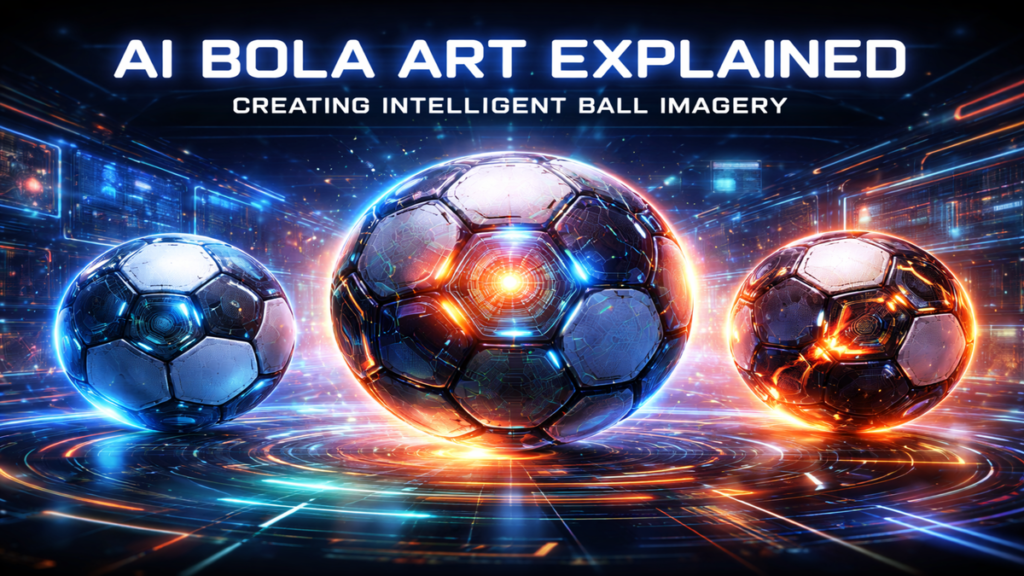
Abstract bola art removes literal meaning and focuses on visual impact. Metallic shards, glowing cracks, and cinematic contrast dominate this style. These images often resemble concept art from science fiction films.
This category benefits from:
- Dramatic lighting contrast
- High speed motion effects
- Unreal Engine or cinematic render references
- Emphasis on color grading
Stylized and Anime Inspired Designs
Stylized bola imagery can turn a ball into a character, emblem, or animated object. I often experiment with anime models when aiming for playful or symbolic interpretations rather than realism.
Prompt Engineering for Bola Art
Prompt design is where most creators struggle. I learned early that effective bola prompts balance specificity with creative freedom. Too little detail leads to generic images. Too much detail causes visual confusion.
Core Prompt Structure
A strong bola prompt usually follows a layered structure:
- Object definition
- Material and texture
- Environment
- Lighting and mood
- Style or engine reference
For example, defining whether the bola is leather, crystal, or metallic immediately shapes the output. Environmental cues such as stadiums or forests ground the image in context. Lighting instructions determine realism or fantasy tone.
Importance of Negative Prompts
Negative prompts are equally important. I consistently exclude unwanted artifacts such as blur, deformation, duplicated objects, or distorted shapes. This step alone dramatically improves output quality.
Using Seeds and Steps for Consistency
Reproducibility matters when refining a visual concept. By locking seeds and increasing inference steps, I can iterate variations without losing the original composition. This is essential for professional workflows where consistency matters.
Platforms That Excel at Bola Art Creation
OpenDream
This platform stands out for its balance between control and speed. I appreciate how it offers multiple models suited for realism, anime, and experimental creativity. Bola prompts perform especially well when leveraging higher guidance scales and longer step counts. Gallery exploration helps refine ideas before final generation.
a1.art
This tool focuses strongly on ball and orb themed generation. Its simplicity makes it approachable for beginners, while style filters allow quick experimentation. I find it useful for rapid concept testing rather than final production imagery.
NightCafe
NightCafe excels in fantasy visuals. When creating glowing or mystical bola art, this platform often produces richer atmospheres. The free tier encourages experimentation across different artistic styles.
Craiyon
Although limited in resolution, this generator offers unlimited access and fast results. I sometimes use it to explore composition ideas before recreating the concept in higher fidelity tools.
Comparison of Bola Generation Capabilities
| Platform | Strengths | Ideal Use Case | Limitations |
|---|---|---|---|
| OpenDream | High realism, prompt control, reproducibility | Professional visuals, detailed sports imagery | Credit limits on free tier |
| a1.art | Fast generation, bola focused styles | Quick concepts, casual creation | Watermarks on free outputs |
| NightCafe | Fantasy depth, artistic variety | Magical or cinematic bolas | Free credits limited |
| Craiyon | Unlimited access, no login | Rough drafts, experimentation | Lower image quality |
Artistic Control Through Materials and Environments
Material choice defines realism. Leather implies sport and tradition. Crystal suggests magic or energy. Metal communicates power or futurism. I always decide material before anything else.
Environment adds narrative. A bola on wet grass feels alive and dynamic. A floating orb in space feels symbolic and vast. Matching environment to material creates visual harmony.
Lighting is the final layer. Soft light feels calm. Harsh contrast feels cinematic. Volumetric fog adds depth. I treat lighting as the emotional driver of the image.
Using Bola Art for Creative and Commercial Purposes
Bola imagery works well across industries. Sports branding, gaming assets, digital art collections, educational visuals, and concept design all benefit from this format.
For commercial use, I always verify platform licensing. Paid plans usually grant full rights, while free tiers may restrict usage or add watermarks. Understanding these boundaries protects long term projects.
Common Mistakes and How to Avoid Them
Overloading prompts is the most frequent issue. I recommend focusing on clarity rather than complexity. Another mistake involves ignoring negative prompts, which leads to visual noise.
Resolution expectations also matter. Free tools often limit output size. For professional work, investing in higher resolution generation saves time during post processing.
The Future of AI Bola Art
As models evolve, bola imagery will become more physically accurate and stylistically diverse. I expect improvements in reflective surfaces, motion physics, and environmental interaction. Interactive generation where users adjust lighting and materials in real time will likely become standard.
From my perspective, bola art represents a bridge between simplicity and expressive depth. It demonstrates how artificial intelligence transforms basic geometry into meaningful visual storytelling.
Read: https://veomodels.com/opendream-ai-art/
FAQs
How detailed should a bola prompt be for best results?
I recommend starting with object, material, and environment, then refining lighting and style through iteration rather than one long prompt.
Can bola imagery be used commercially?
Yes, but only when generated under licensing terms that allow commercial usage, usually found in paid plans.
Which style works best for beginners?
Photorealistic sports bolas are easier to control due to consistent geometry and familiar environments.
Why do some bola images look distorted?
Distortion often comes from missing negative prompts or conflicting style instructions within the prompt.
Is high resolution necessary for good bola art?
Higher resolution improves detail and realism, especially for textures and lighting, but concept work can begin at lower sizes.