

Introduction
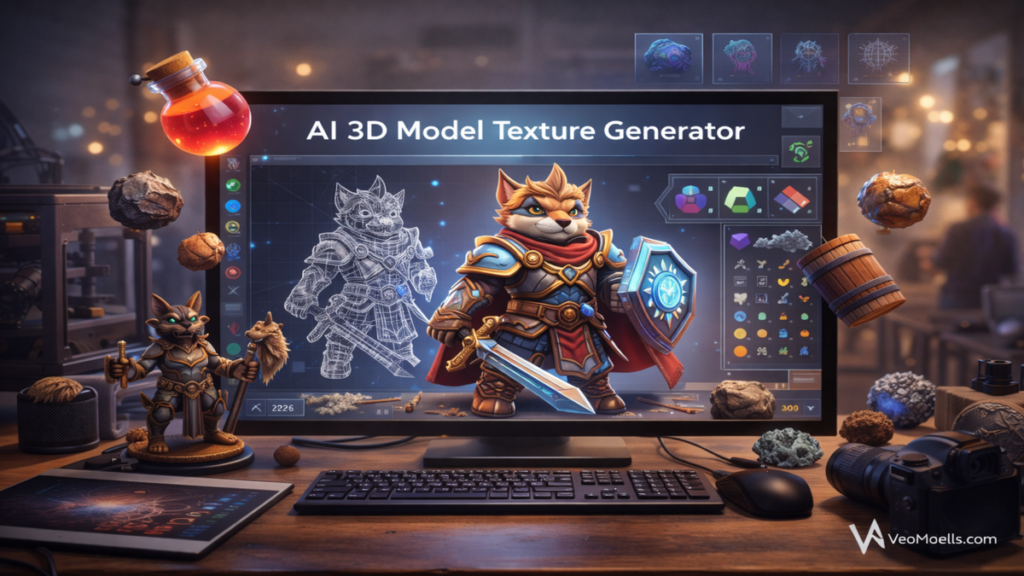
i keep seeing the same bottleneck in small studios and solo pipelines: the mesh is done, the UVs are acceptable, and then texturing becomes the slowest step by far. That is exactly where an ai 3d model texture generator can help, especially when you need consistent PBR maps for real-time engines. In plain terms, these tools turn a prompt or reference image into texture sets like base color, normal, roughness, and metallic, then apply them onto an existing model in minutes rather than days.
The buyer confusion usually comes from two places. First, “textures” can mean anything from a single color image to a complete PBR material stack that survives engine lighting and closeups. Second, many platforms are really two products: a texture generator and a mesh pipeline wrapped together. Meshy and Tripo, for example, position themselves as end-to-end systems that can texture assets and export them in standard 3D formats for downstream work. Meshy markets an AI texture generator for turning text or images into textures, alongside broad export support. Tripo emphasizes one-click PBR-ready texturing and local edits via Magic Brush.
In this guide, i will focus on practical adoption: what outputs you actually need for Unity, Blender, and Unreal, what formats matter, where quality often collapses, and how to pick a tool based on your constraints. I am treating this as workflow infrastructure, not a novelty feature, because a texture set that fails in engine is not “good enough” no matter how fast it generates.
The core idea: PBR maps are the deliverable, not a single image
A real production texture job is not just “make it look nice.” It is “make it respond to light correctly across engines.” That is why modern pipelines rely on PBR workflows, especially the metal roughness model used widely in real-time. The glTF 2.0 spec, for example, defines a “metallic-roughness material model” with base color, metallic factor, and roughness factor as key parameters. Unreal’s documentation similarly treats physically based materials as a system built around inputs like base color and metallic.
If you generate only a diffuse image, the asset may look acceptable in flat lighting and then fall apart under directional light, HDRI rotation, or gameplay movement. The practical standard in 2026 is a complete set: base color, normal, roughness, and metallic at minimum, sometimes AO and height depending on your target.
Expert quote: “The PBR model included in the core specification of glTF 2.0 is known as the metallic-roughness material model.”
Where these tools fit in real pipelines
An AI texturing tool is most useful when your bottleneck is iteration speed and consistency, not hand-painted hero detail. In practice, teams use these systems in three common situations: prototyping many looks fast, bringing rough assets up to baseline quality, and producing variation packs for large environments.
What changes the economics is time-to-first-usable. A generator that applies PBR maps onto an existing mesh lets you validate silhouette, scale, and lighting early. If the art direction changes, you regenerate instead of repainting from scratch. That is especially valuable for props, kitbash sets, and background characters.
One important boundary: these tools do not eliminate UV and topology reality. Even when the model is “auto-unwrapped,” seams and stretching show up as repeating artifacts and broken normals. My rule is simple: if the mesh is not clean enough for baking, it is not clean enough for AI textures either. The tool will output maps, but the surface will advertise your mesh problems.
The leading platforms: Meshy and Tripo in one practical comparison
Meshy’s pitch is that you can generate textures from text or image inputs, then export across multiple 3D formats used in production. Tripo leans into one-click 4K PBR-ready texturing and the ability to repaint localized issues using Magic Brush.
Here is the useful distinction i have observed when teams test both styles: Meshy feels like a broad asset pipeline with texturing as a major feature, while Tripo positions texturing as a controllable stage with explicit edit tools. If your workflow needs “generate, export, move on,” Meshy’s format breadth helps. If your workflow needs “fix that shoulder seam, repaint that helmet edge,” Tripo’s brush model is the more direct fit.
Expert quote: Tripo describes “One-Click Texturing & Magic Brush” for “PBR-ready textures” with “local repaint.”
Table: picking a tool based on outputs and workflow control
| Tool | What it is strongest at | Typical outputs you should expect | Export and handoff notes |
|---|---|---|---|
| Meshy.ai | Fast texture generation from text or image, broad pipeline integration | Texture generation and applied looks, often used with PBR workflows | Meshy highlights multi-format export support like FBX, GLB, OBJ and more |
| Tripo3D.ai | One-click PBR texturing plus localized fixups via Magic Brush | 4K PBR-ready textures, targeted repaint and correction | Also offers format tooling in its ecosystem, including GLB to USDZ conversion utilities |
| Polycam | Material generation oriented to creators, gated behind Pro and trials | Prompt-based textures and image-derived texture workflows | Useful when you need quick material looks rather than a full asset pipeline |
| PicLumen | Free, prompt-based texture generation with broad accessibility | Texture images suitable for material building | Often requires manual map creation or packing depending on your engine needs |
| Fast3D.io | Fast cloud generation plus PBR-oriented material synthesis messaging | PBR texture support is referenced in product materials | Treat as a pipeline you still validate in-engine, especially normals and roughness |
The workflow that reduces surprises in Unity, Blender, and Unreal
The fastest way to lose time is to generate textures first and discover later that your engine expects a different map convention. Unity’s Standard shader workflow, for instance, centers “smoothness,” which is often the inverse of roughness and may be packed into channels depending on the setup. Unreal, meanwhile, uses roughness directly and expects sensible metallic values, often 0 for non-metals and 1 for metals in pure cases. Blender’s glTF exporter documentation also outlines the metal roughness PBR channels it supports, which is useful when you are exporting GLB to hand off assets.
My practical checklist is boring but effective: confirm UVs, confirm tangent space normals are correct, confirm roughness versus smoothness expectations, then validate under three lighting conditions. If it looks correct under an HDRI, a hard key light, and a low-light scene, it is usually safe.
Expert quote: Unreal notes, “Nonmetals have Metallic values of 0 and metals have Metallic values of 1.”
ai 3d model texture generator quality is limited by mesh prep
This is the part most tool comparisons skip because it is not glamorous. Even the best generator cannot fix a mesh with inconsistent scale, broken smoothing groups, or chaotic UV islands. You will see it as crawling seams, mirrored text, or roughness that looks like plastic wrap.
If you are working on game assets, decimation and topology choices matter because they affect UV density and texel consistency. If you are working on product models, sharp edges and clean normals matter because they determine highlight behavior. In my own evaluations, the quickest win is to standardize a few mesh rules: keep UV islands stable, avoid extreme stretching, and keep texel density roughly consistent across parts that should share material character.
Treat the generator as a material authoring stage, not as a modeling repair tool. If you handle mesh hygiene first, you will get results that are easier to approve, easier to re-export, and less likely to break when an engine version changes.
Prompting for materials is closer to art direction than writing
Texturing prompts work best when you specify material, surface story, and rendering intent. “Rusted medieval armor” is a start, but “PBR, game-ready, worn steel plate, edge chipping, grime in creases, neutral albedo” produces outputs that behave better in engine lighting.
The reason is simple: these systems are trying to map language to physically meaningful texture variation. If you say “cinematic,” you might get high-contrast albedo that looks great in a preview but fails under realistic lighting. If you say “neutral albedo, roughness variation,” you get maps that survive real workflows.
If your tool supports image-to-texture, use it as a guardrail. A single reference photo can constrain hue and pattern frequency, which reduces weirdness. Meshy explicitly positions image input as part of its texture generator workflow.
Local edits and “fix it” tools are the real differentiator
For production use, the killer feature is not generation. It is correction. The ability to repaint a seam, reduce a repeating pattern, or fix an over-shiny patch without regenerating everything saves hours.
That is why Tripo’s Magic Brush narrative is meaningful. It frames editing as a first-class operation, not an afterthought. In practice, this is where many teams decide: do we want a one-shot generator, or do we want a generator plus a correction tool that keeps iteration tight?
If your pipeline already uses Substance 3D Painter, you may still adopt AI texturing as a starting point, then finish in Painter. Adobe’s PBR guide discusses how base color, metallic, and roughness outputs align with metallic workflows used by renderers and engines. The hybrid approach is increasingly common: generate quickly, then art-direct precisely.
Cloud versus local: latency, privacy, and integration trade-offs
Most of the leading options are cloud-first. That reduces GPU barriers but introduces two constraints: latency and data handling. If you are texturing proprietary characters or licensed product models, you need to understand what you are uploading and what the tool retains.
From a deployment perspective, API access matters when you want scale. Meshy documents a “Retexture API” intended to integrate AI retexturing into other applications. That is a signal the company expects pipeline automation use cases, not just individual creators clicking buttons.
I have seen teams succeed by formalizing a simple rule: early concept assets can be cloud-textured, but final hero assets follow stricter internal handling and manual review. That is not fear. It is normal governance for digital production.
How to evaluate outputs with a fast “engine reality” test
If you want a reliable evaluation method, do not judge in the tool’s preview alone. Export, import, and test in your target engine. This is where issues reveal themselves: normal map inversion, incorrect roughness response, or metallic values that cause plastics to behave like chrome.
A clean testing flow is: GLB into Blender for a sanity check, then into your target engine. Blender’s glTF documentation is useful here because it describes the PBR channels that map cleanly into glTF exports. Unreal’s physically based materials page is also a strong reference for what “correct” looks like under its shading model.
When you do this consistently, you build a practical intuition: which prompts lead to stable roughness maps, which tools oversaturate albedo, and where seam artifacts will appear. That is the difference between “AI texturing is cool” and “AI texturing saves us time.”
Takeaways
- PBR map completeness matters more than a pretty preview, especially for Unity and Unreal handoffs.
- Meshy and Tripo both target fast PBR-ready texturing, but Tripo emphasizes localized edits via Magic Brush.
- glTF’s metallic roughness model is a practical baseline for cross-tool material expectations.
- Mesh hygiene still determines outcome quality, especially UVs and normals.
- Always validate in-engine under multiple lighting conditions before calling an asset production-ready.
- API access becomes important when you want repeatable batch workflows.
Conclusion
i see an ai texturing tool as a pipeline accelerator, not a replacement for material judgment. When an ai 3d model texture generator outputs clean base color, normal, roughness, and metallic maps that behave predictably under engine lighting, it can compress days of work into a short iteration loop. When it does not, it can waste time by hiding mesh and workflow problems behind a nice thumbnail.
The practical path is to choose tools based on correction control, export reliability, and your engine’s expectations. Use cloud generation for speed, then validate like a production artist: check map conventions, test lighting, and fix seams with targeted edits rather than endless regenerations. The teams that win with these tools are the ones that treat them like a repeatable stage in a professional pipeline, with clear acceptance tests and realistic quality thresholds.
Read: Ai Startup Bluejay Funding Rise of Agent QA as a Serious Category
FAQs
What outputs should i require from an AI texturing tool?
At minimum: base color, normal, roughness, and metallic maps. Those align with common PBR workflows in engines and glTF.
Will these tools work if my model has bad UVs?
They will produce textures, but seams and stretching often become more visible. Clean UVs and normals are still the foundation for good results.
Why does roughness look “wrong” in Unity sometimes?
Unity often uses smoothness conventions or packed channels depending on shader workflows, so roughness may need inversion or repacking.
Is GLB a good export choice for handoff?
Yes, GLB is a practical container for geometry plus PBR material data in many workflows, especially when you validate through Blender and glTF tooling.
How do i pick between Meshy and Tripo for texturing?
If you need broad pipeline export and fast generation, Meshy’s positioning and formats may fit. If you need localized repaint and correction, Tripo’s Magic Brush focus is a strong signal.
References
Adobe. (n.d.). The PBR guide, part 2.
Blender Foundation. (n.d.). glTF 2.0 import export manual.
Blender Foundation. (n.d.). Principled BSDF manual.
Epic Games. (n.d.). Physically based materials in Unreal Engine.
Khronos Group. (2021). glTF 2.0 specification.
Library of Congress. (n.d.). glTF 2.0 format description and PBR model overview.
Meshy. (n.d.). AI texture generator feature page.
Meshy. (n.d.). Meshy platform export formats overview.
Meshy. (n.d.). Retexture API documentation.
PicLumen. (n.d.). Free AI texture generator.
Tripo3D. (n.d.). Tripo AI home page: one-click texturing and Magic Brush.
Tripo3D. (n.d.). Magic Brush tutorial.
Unity Technologies. (2016). Smoothness (Standard Shader material parameter).