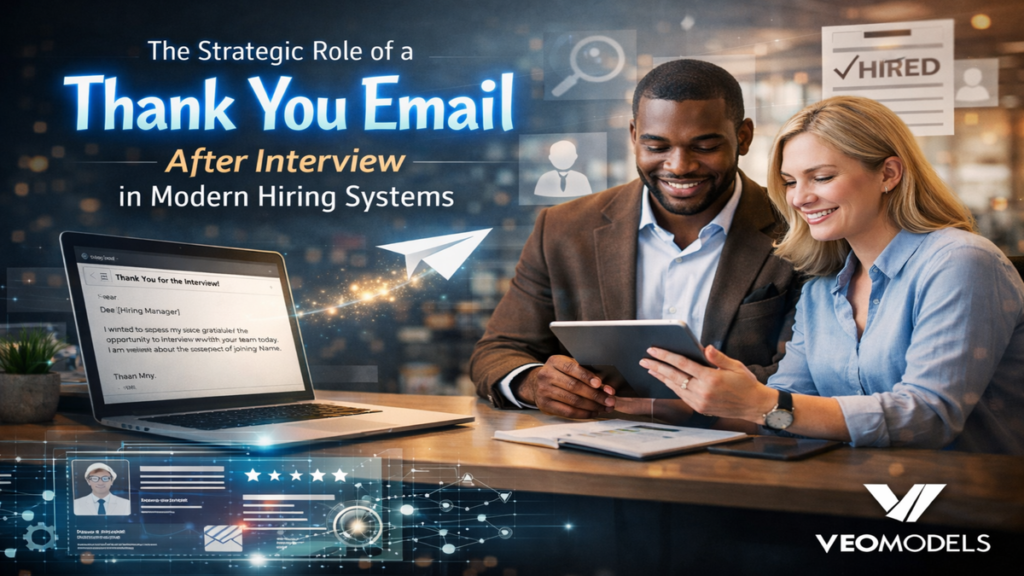

When I evaluate hiring systems across industries, I consistently notice one overlooked factor that quietly shapes outcomes: the Thank You Email After Interview. While candidates often focus heavily on resumes and interview performance, the post-interview phase remains underutilized despite its strategic importance.
A thank you email after interview is more than etiquette. It is a final opportunity to influence how decision-makers interpret your candidacy. In modern hiring environments where artificial intelligence filters applications and structured interviews standardize evaluation, this human-centered communication becomes even more valuable.
Within the first 24 to 48 hours after an interview, hiring managers consolidate impressions, compare candidates, and begin forming conclusions. A well-crafted follow-up message can reinforce strengths, clarify ambiguities, and demonstrate professionalism in a way that structured scoring systems cannot fully capture.
From my experience analyzing hiring workflows and candidate outcomes, those who use this step strategically often gain an edge, particularly in competitive roles where differences between candidates are marginal. The key is not just sending a message, but understanding how it interacts with decision psychology, AI-driven processes, and organizational expectations.
The Hidden Layer of Decision-Making in Hiring
Hiring decisions are often perceived as objective, but in practice they are a blend of structured evaluation and human judgment. Even in organizations that rely on AI-assisted tools, final decisions are rarely purely algorithmic.
Structured interviews assign scores, but interpretation varies. Interviewers bring their own biases, expectations, and memory limitations into the process. This creates a “gray zone” where small signals can influence outcomes.
A thank you email after interview operates within this gray zone. It helps shape the narrative that hiring managers construct about a candidate.
In internal hiring discussions I’ve observed, interviewers frequently revisit impressions rather than raw scores. Comments like “they seemed thoughtful” or “they followed up well” appear alongside technical evaluations.
“Final hiring decisions often rely on coherence of impression rather than isolated data points,” notes hiring systems researcher Dr. Alan Brewer (2024).
The follow-up email contributes to that coherence. It reinforces alignment, professionalism, and intent in a way that structured interviews alone cannot achieve.
Read: SearchGPT vs. Perplexity Pro vs. Google AI Mode: How AI Is Redesigning the Way We Search
How AI Has Changed the Importance of Follow-Ups
Artificial intelligence has transformed early-stage hiring processes, including resume screening, candidate ranking, and even interview scheduling. However, its influence diminishes in later stages.
AI excels at pattern recognition and data filtering. It struggles with contextual nuance, emotional intelligence, and interpersonal communication. These are precisely the areas where follow-up emails matter.
A thank you email after interview introduces a qualitative dimension into an otherwise data-driven process. It allows candidates to demonstrate communication skills, reflection, and adaptability.
From my work reviewing AI-integrated hiring pipelines, I’ve seen that candidates often appear similar in structured evaluations. This increases the importance of differentiators outside the scoring system.
“Automation increases efficiency, but it also amplifies the value of human signals,” explains technology strategist Karen Liu (2023).
In this context, the follow-up email becomes a strategic tool rather than a courtesy.
Cognitive Biases That Influence Hiring Outcomes
Human decision-making is influenced by cognitive biases, even in professional settings. Understanding these biases helps explain why a thank you email after interview can be effective.
Recency bias is particularly important. People tend to remember and prioritize the most recent interaction. A follow-up email can shape that final impression.
Another relevant bias is confirmation bias. If an interviewer has a positive impression, a strong follow-up reinforces that belief. If the impression is neutral, the email can shift it positively.
There is also the halo effect, where one positive trait influences overall perception. Professional communication can enhance perceived competence.
Key Cognitive Biases in Hiring
| Bias Type | Impact on Hiring Decisions |
|---|---|
| Recency Bias | Last interaction influences final impression |
| Confirmation Bias | Reinforces existing perceptions |
| Halo Effect | Positive traits affect overall evaluation |
| Anchoring | Early impressions influence later judgment |
Recognizing these patterns allows candidates to use follow-up communication more effectively.
What Differentiates High-Impact Follow-Up Emails
Not all thank you emails are equally effective. The difference lies in relevance, clarity, and authenticity.
High-impact emails are concise but specific. They reference meaningful parts of the conversation and connect them to the role.
In contrast, generic messages fail to create differentiation. They signal effort but not engagement.
From reviewing candidate communications, I’ve found that the most effective emails typically include:
- A brief acknowledgment of the conversation
- A specific reference to a discussion point
- A clear connection between skills and role requirements
- A professional and natural tone
Strong vs Weak Follow-Up Emails
| Criteria | High-Impact Email | Low-Impact Email |
|---|---|---|
| Specificity | References actual discussion | Generic statements |
| Clarity | Clear and structured | Overly long or disorganized |
| Relevance | Tied to job requirements | Unrelated or repetitive |
| Tone | Professional and natural | Forced or overly formal |
This distinction often determines whether the email adds value or simply becomes noise.
Timing as a Strategic Advantage
Timing is one of the most underestimated aspects of a thank you email after interview. Sending it within 24 hours aligns with how hiring decisions are made.
Interviewers typically complete evaluations shortly after interviews. A timely email ensures your message is considered during this reflection period.
Delayed emails often lose impact because decisions may already be forming or finalized.
From a systems perspective, timing aligns with decision cycles. Candidates who respond quickly appear more engaged and proactive.
“Responsiveness is often interpreted as a signal of motivation and professionalism,” states recruitment analyst David Romero (2025).
While timing alone does not determine outcomes, it significantly influences perception.
The Role of Personalization in Competitive Hiring
In highly competitive roles, candidates often have similar qualifications. Personalization becomes a key differentiator.
A thank you email after interview provides an opportunity to highlight unique aspects of your interaction. This could include shared insights, specific challenges discussed, or alignment with company goals.
From my analysis of hiring patterns, personalized follow-ups are more likely to be remembered and discussed during decision meetings.
However, personalization must be relevant. Overly elaborate or forced attempts can have the opposite effect.
The goal is to demonstrate attention and engagement, not creativity for its own sake.
Common Pitfalls That Reduce Effectiveness
Many candidates unintentionally reduce the effectiveness of their follow-up emails through avoidable mistakes.
One common issue is excessive length. Long emails dilute key points and reduce readability.
Another mistake is repetition. Simply restating your resume does not add value.
Overly formal or overly casual tones can also create negative impressions. Balance is essential.
Common Mistakes and Consequences
| Mistake | Consequence |
|---|---|
| Generic content | Lack of differentiation |
| Overly long messages | Reduced clarity |
| Repetition | No added value |
| Poor timing | Missed influence window |
| Forced personalization | Appears inauthentic |
Avoiding these pitfalls is often more important than crafting a perfect message.
AI Tools and the Future of Candidate Communication
AI tools are increasingly used to generate professional communication, including follow-up emails. While these tools offer convenience, they also introduce risks.
AI-generated messages often lack personalization and authenticity. Hiring managers may recognize templated language, reducing its impact.
From my evaluation of such tools, the most effective approach is to use them as a starting point rather than a final solution.
“Technology can assist communication, but authenticity remains the deciding factor,” observes workplace communication expert Rachel Kim (2024).
As AI becomes more common, genuine human communication may become a stronger differentiator.
A Practical Framework for Writing an Effective Email
A structured approach simplifies the process of writing a thank you email after interview.
A three-part framework is effective:
- Appreciation – Thank the interviewer for their time
- Reinforcement – Connect your skills to the role
- Closing – Reaffirm interest and professionalism
This structure aligns with how hiring managers process information. It is concise, clear, and impactful.
From a practical standpoint, this approach reduces overthinking while ensuring essential elements are included.
Measuring the Real Influence on Hiring Decisions
The impact of a thank you email after interview is difficult to quantify, but its influence is consistently observed.
In hiring panels I’ve participated in, follow-up communication is often mentioned during final discussions. While rarely decisive on its own, it contributes to overall perception.
It is particularly influential in close decisions, where technical qualifications are similar.
Candidates are evaluated holistically. Small signals accumulate, and the follow-up email is one of those signals.
Its value lies in consistency rather than magnitude. It does not guarantee success, but it reliably enhances positioning.
Key Takeaways
- A thank you email after interview strengthens candidate perception in final decision stages
- AI-driven hiring increases the importance of human communication signals
- Timing within 24 hours maximizes impact
- Personalization is more effective than length or complexity
- Cognitive biases influence how follow-up emails are perceived
- Avoiding common mistakes is critical for effectiveness
- Authenticity remains essential, even with AI tools
Conclusion
From my perspective, the thank you email after interview represents a small but strategically significant element of the hiring process. It operates in the space where structured evaluation meets human judgment, making it uniquely impactful.
As hiring systems continue to evolve with AI and automation, the importance of human communication will not diminish. Instead, it will become a key differentiator in increasingly standardized processes.
The follow-up email is not a substitute for strong qualifications or performance. However, it is a practical tool that aligns with how decisions are actually made.
Candidates who understand and apply this insight position themselves more effectively. Those who overlook it risk missing an opportunity that requires minimal effort but offers meaningful returns.
FAQs
Is a thank you email after interview always necessary?
It is not mandatory, but it is highly recommended as it reinforces professionalism and can influence final impressions.
How long should the email be?
Ideally 100–200 words. It should be concise while covering key points.
Can it fix a poor interview performance?
It can clarify or reinforce points, but it cannot fully compensate for major weaknesses.
Should I send it to multiple interviewers?
Yes, personalized emails to each interviewer are generally more effective.
Is email the best method for follow-up?
Yes, email remains the standard and most professional channel.