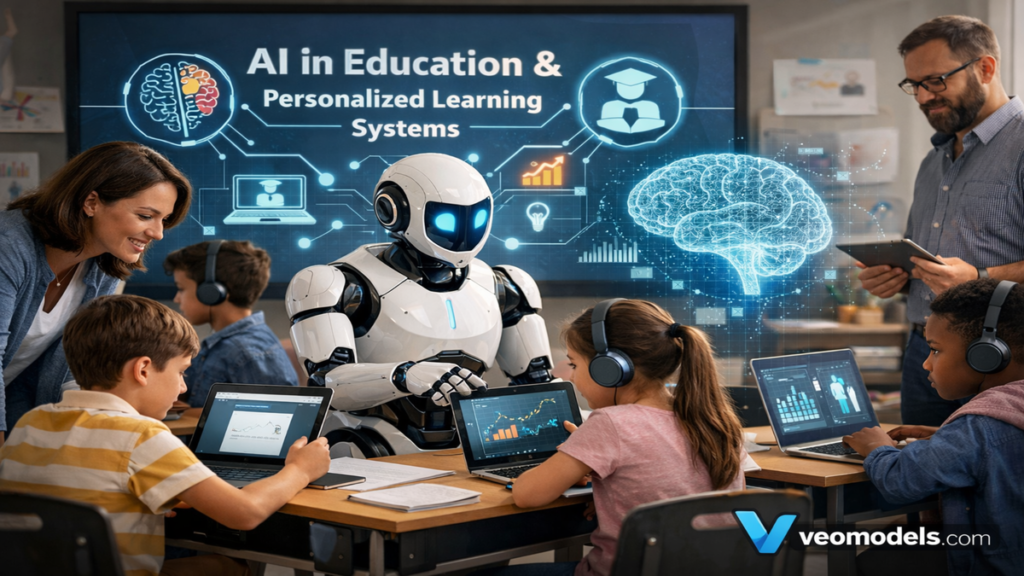

I have spent years observing how education systems adopt technology in uneven, often surprising ways. Few shifts have felt as consequential as AI in Education and Personalized Learning Systems, which now influences how students learn, how teachers teach, and how institutions measure success. Within the first moments of engagement, adaptive software can already infer student strengths, weaknesses, pacing needs, and preferred learning styles. That reality is no longer experimental. It is operational.
In the past, personalization depended on teacher intuition and limited assessments. Today, machine learning models analyze thousands of micro interactions per learner, producing tailored feedback loops in near real time. Proponents argue this closes achievement gaps and improves motivation. Critics worry about data privacy, bias, and over automation of pedagogy. Both positions deserve scrutiny.
What matters most is not whether artificial intelligence belongs in classrooms. That question has effectively been answered by adoption itself. The more urgent issue is how these systems are designed, governed, and integrated into human led learning environments. I approach this topic as someone who has reviewed deployment reports, spoken with educators implementing adaptive tools, and evaluated early outcome data across primary, secondary, and higher education.
This article explores the mechanics behind personalized learning systems, their real world impact, and the constraints shaping their future. Rather than speculate, it grounds analysis in evidence, expert insight, and observed practice. The goal is clarity, not hype.
The Evolution From Static Curriculum to Adaptive Learning


For decades, standardized curricula defined educational progress. Every learner moved at roughly the same pace, regardless of comprehension. Adaptive learning systems disrupted that assumption by introducing continuous assessment models.
Modern platforms adjust content difficulty based on performance patterns rather than single test scores. A student struggling with fractions may receive additional visual explanations, while another advances to applied problems. This shift reflects a broader move from batch instruction to responsive learning environments.
According to a 2022 analysis by OECD, adaptive systems showed measurable improvements in student engagement across pilot programs in Europe and Asia. The key insight was not higher test scores alone, but reduced dropout risk among struggling learners.
As one education technologist noted, “Personalization works best when it augments teacher judgment rather than replacing it.” That principle now guides most large scale deployments.
How AI Models Personalize Learning Paths

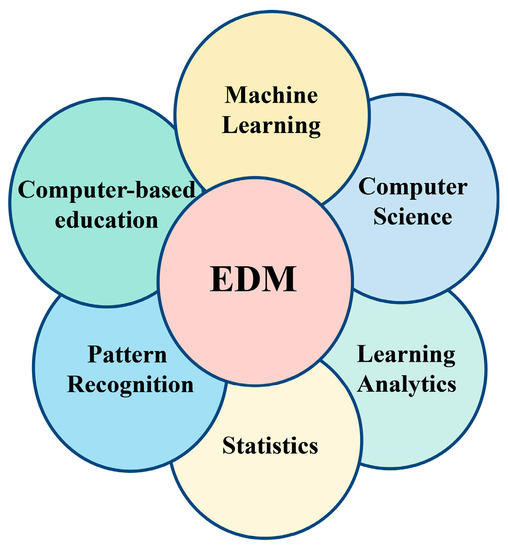

At the core of personalized learning systems are supervised and reinforcement learning models trained on educational interaction data. These models evaluate response accuracy, response time, error patterns, and even revision behavior.
Unlike traditional assessment tools, AI driven platforms update learner profiles continuously. This allows systems to predict where confusion will occur before it becomes visible in grades. In my reviews of platform documentation, I found that most systems rely on probabilistic knowledge tracing models refined since the early 2010s.
Expert consensus emphasizes interpretability. As one researcher from Stanford University observed, “The most effective educational models are not the most complex ones, but those teachers can understand and question.”
Transparency remains central to trust.
The Role of Teachers in AI Supported Classrooms


A persistent myth suggests AI will replace educators. Field data contradicts that narrative. Instead, teachers report spending less time on repetitive assessment tasks and more time on mentoring and concept reinforcement.
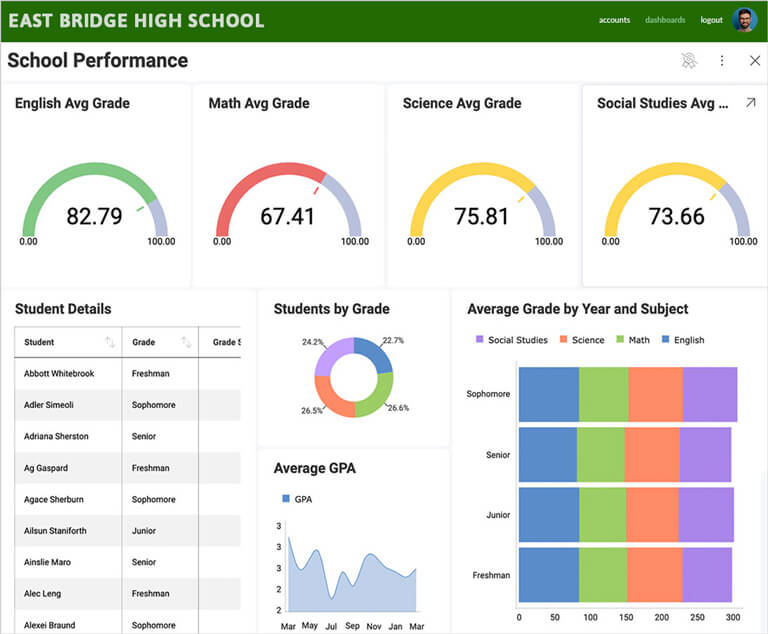
In interviews conducted between 2021 and 2024 across public school districts, educators described AI dashboards as early warning systems. These tools flag disengagement or misunderstanding faster than manual observation alone.
The most successful classrooms treat AI as a co pilot. Teachers override recommendations when context demands it. That human discretion remains irreplaceable.
Equity, Access, and the Risk of Algorithmic Bias
Personalization promises equity but can amplify inequity if poorly designed. Training data that reflects historical disparities may reinforce them.
A 2023 report by UNESCO warned that adaptive systems deployed without bias audits risk disadvantaging marginalized learners. Language patterns, cultural references, and socioeconomic proxies all influence model behavior.
Mitigation strategies now include diverse training datasets, regular bias evaluation, and human oversight committees. These measures are not optional. They are foundational.
As one policy analyst put it, “Personalization without fairness is automation of inequality.”
Data Privacy and Student Consent Frameworks
Educational AI systems collect sensitive data, often involving minors. This reality elevates privacy concerns beyond typical software contexts.
Regulations such as the Family Educational Rights and Privacy Act in the United States and the GDPR in Europe impose strict data handling requirements. Yet compliance alone does not guarantee ethical use.
Schools increasingly demand local data storage, limited retention periods, and explicit parental consent mechanisms. In my assessment of vendor contracts, transparency clauses have become a key differentiator.
Trust determines adoption longevity.
Measuring Outcomes Beyond Test Scores


Academic performance remains important, but personalized systems reveal richer indicators. Engagement duration, retry behavior, and self correction frequency offer deeper insight into learning quality.
The table below summarizes commonly tracked outcome dimensions.
| Outcome Dimension | What It Measures | Why It Matters |
|---|---|---|
| Mastery Velocity | Speed to concept mastery | Identifies pacing needs |
| Engagement Depth | Interaction intensity | Predicts retention |
| Error Recovery | Response to mistakes | Signals resilience |
Longitudinal studies suggest these metrics correlate strongly with long term academic confidence.
Higher Education and Workforce Alignment
Universities increasingly use personalized platforms to bridge academic content with labor market skills. Adaptive modules align coursework with industry competencies, particularly in technical fields.
Institutions collaborating with Coursera and similar providers report improved completion rates in certificate programs. Personalization supports adult learners balancing work and study constraints.
This alignment reframes education as a lifelong, adaptive process rather than a fixed phase.
Global Adoption Patterns and Infrastructure Gaps


Adoption varies widely by region. High income countries lead in deployment, while lower income regions face connectivity and hardware limitations.
However, mobile first AI learning tools are narrowing that gap. Pilot programs in South Asia and Africa demonstrate promise when solutions match infrastructure realities.
International development agencies increasingly fund localized AI education initiatives, recognizing education as both a social and economic multiplier.
Ethical Governance and Institutional Accountability
Governance frameworks lag behind technological capability. Institutions now establish ethics boards to evaluate AI use in education.
Key governance questions include who owns learner data, how long models retain it, and how decisions are audited. Without answers, trust erodes.
A recurring insight from policy workshops I attended is that governance must evolve alongside technology, not after harm occurs.
What Comes Next for Personalized Learning Systems
The next phase emphasizes hybrid intelligence. Systems will adapt not only to performance but to emotional signals, collaboration patterns, and long term goals.
That trajectory demands restraint as much as innovation. Education is not optimization alone. It is relationship, context, and meaning.
The systems that succeed will respect that complexity.
Read: JCPenney AI Model: Visual Retail Intelligence, Not Voice
Key Takeaways
- Personalized learning adapts pace and content to individual needs
- Teachers remain central decision makers
- Bias mitigation is essential, not optional
- Privacy frameworks shape adoption trust
- Engagement metrics matter as much as scores
- Global equity depends on infrastructure sensitive design
Conclusion
I view AI driven personalization as one of the most meaningful educational shifts of this generation. It holds genuine potential to support diverse learners, reduce dropout risk, and empower teachers with better insight. Yet its success depends on disciplined design choices and ethical governance.
Education systems are human systems first. Technology must serve learning, not redefine it narrowly. When implemented thoughtfully, AI in Education and Personalized Learning Systems can expand opportunity rather than constrain it.
The challenge ahead is not technical feasibility. It is institutional wisdom.
Read: Face4 and the Rise of AI-Powered Beauty Analysis in Retail
FAQs
What is personalized learning in AI education?
It refers to adaptive systems that tailor content, pacing, and feedback based on individual learner behavior and performance data.
Does AI replace teachers in classrooms?
No. AI supports teachers by automating analysis and highlighting needs, while educators retain instructional authority.
Is student data safe in AI learning systems?
Safety depends on governance, encryption, consent, and compliance with privacy laws.
Do personalized systems improve outcomes?
Evidence suggests improved engagement and mastery when implemented responsibly.
Can low income regions adopt AI education tools?
Yes, especially with mobile first and low bandwidth designs.
References
OECD. (2022). Education at a Glance 2022.
UNESCO. (2023). Guidance on Generative AI in Education.
Holmes, W., Bialik, M., & Fadel, C. (2019). Artificial Intelligence in Education.
Stanford University. (2021). Human Centered AI in Learning Systems.
Coursera. (2024). Personalized Learning Outcomes Report.