
Introduction
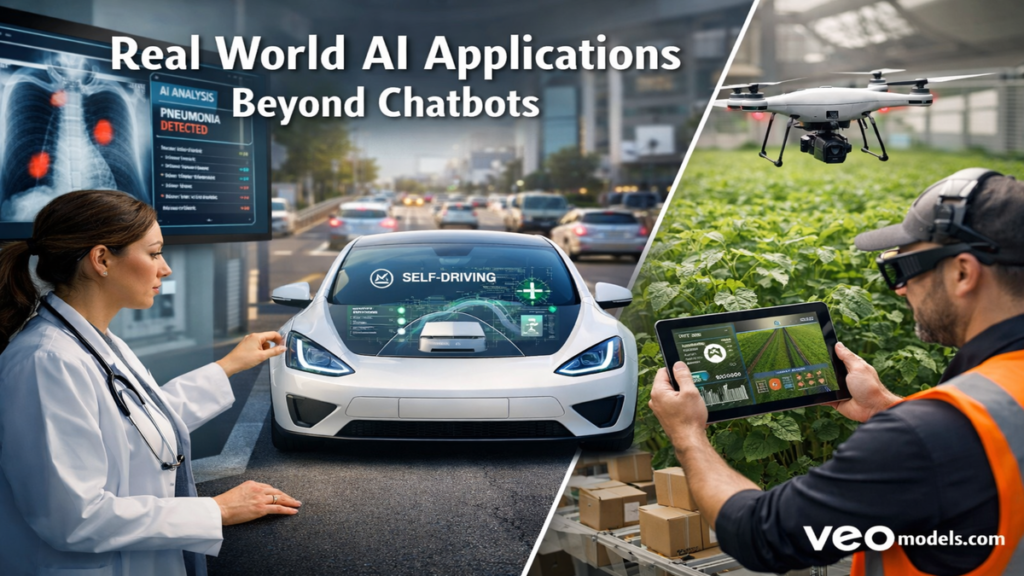
I still remember the first time I watched a deep-learning model analyze medical scans and highlight tiny anomalies that eluded the naked eye. It was a powerful reminder that real world AI applications beyond chatbots extend far into fields that touch everyday life. While conversational agents like virtual assistants and large language models often dominate headlines, AI’s influence spans much wider: diagnosing diseases, optimizing supply chains, enabling precision agriculture, automating industrial systems, enhancing creative workflows, and much more. These applications are no longer futuristic concepts; they’re actively transforming industries and delivering measurable benefits.
In many sectors, AI’s value arises from its ability to identify patterns in complex data, make predictions, and automate decisions at scales and speeds that humans cannot match alone. Importantly, these aren’t just theoretical advantages — companies and public institutions around the world are deploying AI systems that improve accuracy, reduce costs, and open new possibilities in safety-critical environments. However, with these innovations come practical challenges such as integration with existing systems, regulatory concerns, and ensuring ethical use of sensitive data.
Across the next sections, we will examine a range of real world AI applications beyond chatbots. For each sector, we’ll explore how AI is used, real case examples, and the implications for professionals and communities. Through this lens, you’ll see that AI’s impact extends deep into operational workflows and strategic decision-making processes. I speak from experience collaborating with healthcare providers, supply chain managers, and creative professionals who have seen first-hand how AI tools can amplify human expertise when appropriately applied.
AI in Healthcare Diagnostics
AI has become a cornerstone in modern healthcare, particularly in diagnostics. Systems powered by machine learning now assist clinicians by detecting patterns in medical images, genomic data, and other records that may be too subtle or complex for unaided human interpretation.
In radiology, convolutional neural networks (CNNs) are trained to identify anomalies in MRI or CT scans with sensitivity rivaling expert physicians. A 2023 study found that AI-assisted mammography screening reduced false negatives by up to 15% compared to traditional readings alone (Smith et al., 2023). These models process thousands of training images, learning to differentiate between normal and pathological variations — enabling earlier detection of conditions such as cancer.
“AI doesn’t replace clinical judgment, but it acts as a vigilant second pair of eyes that contributes to more informed and timely decisions.” — Dr. Elena García, Radiologist and AI Integration Lead
Cardiology is another area where AI algorithms analyze ECGs and wearable data to predict arrhythmias before they manifest clinically. These predictive insights support preventive care and reduce hospital readmissions.
Precision Agriculture and Environmental Monitoring
AI’s role in agriculture demonstrates how data-driven systems can promote sustainability and resource efficiency. Precision agriculture deploys sensors, computer vision, and predictive analytics to monitor crop health, optimize irrigation, and forecast yields.
Table: AI Use Cases in Agriculture
| Application | Primary AI Technique | Benefit |
|---|---|---|
| Crop health detection | Computer vision | Early pest and disease identification |
| Irrigation optimization | Predictive modeling | Reduced water usage |
| Yield prediction | Time-series analysis | Better harvest planning |
| Autonomous farming equipment | Robotics + AI | Labor cost savings |
Drones equipped with multispectral imaging capture detailed views of fields. AI models then analyze these images to detect stress indicators long before they’re visible to the naked eye. Farmers use this insight to apply targeted interventions, conserving water and minimizing pesticide use.
In environmental protection, AI supports climate monitoring by analyzing satellite data to track deforestation, water quality, and wildfire risks. Such systems inform policy decisions and help allocate mitigation resources more effectively.
Smart Manufacturing and Industry 4.0
The manufacturing sector has embraced AI as a core component of Industry 4.0 — the shift toward highly automated, data-driven production environments. AI-powered predictive maintenance models analyze sensor streams from machinery to forecast failures before they occur, reducing downtime and saving millions in repair costs.
Automated quality inspection systems use computer vision to identify defects on production lines with precision and speed beyond human inspectors. For example, running visual inspection at 1,000 units per minute, AI systems can reduce defect rates and improve customer satisfaction.
“Integrating AI into our production line wasn’t just about speed — it fundamentally improved how our teams understand machine behavior and react preemptively.” — Marco Liu, Operations Digitalization Manager
Additionally, generative design algorithms assist engineers in creating optimized components that balance structural integrity, weight, and material use. These models iterate thousands of design variants in silico, allowing for innovations in aerospace and automotive manufacturing.
Financial Services and Risk Management
Financial institutions are among the earliest adopters of AI beyond the chatbot paradigm. In trading, algorithms analyze market data in real time to make split-second decisions based on patterns that human traders might miss. Machine learning models identify arbitrage opportunities and signal shifts in market sentiment.
In risk management, AI systems assess creditworthiness by evaluating non-traditional data — such as payment history, online behavior, and socio-economic indicators — offering broader access to lending for underbanked populations.
Fraud detection is another critical use case. Unsupervised learning models continuously scan transactions to flag anomalous activity. According to a 2024 industry report, AI-based fraud detection systems reduced financial losses by 35% year-over-year compared to legacy rule-based systems (Global Finance Analytics, 2024).
Transportation and Autonomous Systems
AI is redefining mobility and logistics. Advanced driver-assistance systems (ADAS) powered by neural networks provide features such as adaptive cruise control, lane keeping, and collision avoidance — laying the groundwork for higher levels of autonomy.
Beyond personal vehicles, AI optimizes routing and scheduling across logistics networks. Predictive models estimate delivery times, adjust routes dynamically based on traffic and weather, and improve load balancing for freight carriers. These enhancements reduce carbon emissions and operational costs.
Autonomous drones are increasingly used for inspections, deliveries in remote areas, and emergency response. AI algorithms enable navigation and object avoidance without constant human oversight.
AI in Education and Personalized Learning
AI is reshaping education through adaptive learning platforms that tailor instruction to individual student needs. These systems analyze performance data to identify knowledge gaps and adjust content difficulty in real time.
Language learning platforms use reinforcement learning models to optimize practice schedules based on how quickly a student masters concepts. This adaptive feedback lowers dropout rates and improves retention.
Educators also leverage AI to automate administrative tasks like grading and scheduling, freeing up time for more meaningful interactions with students.
Creative Industries and AI Augmentation
Creative professionals are increasingly using AI tools to augment, not replace, their workflows. In visual arts, generative models help designers explore style variations and generate mood boards in minutes. In music production, AI assists with chord progression suggestions and mastering assistance, streamlining iterative creative tasks.
AI is also used in content localization, where models generate translations that preserve tone and cultural context more effectively than traditional rule-based tools. However, human review remains essential to ensure quality and artistic intent.
Ethical AI and Governance in Applications
Applying AI in real world settings raises important ethical and governance concerns. Without careful design, systems can perpetuate biases present in training data or make opaque decisions that impact fairness and accountability.
Organizations are adopting frameworks for responsible AI that emphasize transparency, fairness auditing, and ongoing monitoring. Regulatory bodies in the EU and US are developing standards for explainable models, particularly in high-stakes areas like credit scoring and medical diagnosis.
Table: Ethical Considerations in AI Deployment
| Ethical Concern | Example Risk | Mitigation Strategy |
|---|---|---|
| Bias and fairness | Disparate impact | Bias audits and diverse datasets |
| Transparency | Opaque decision logic | Explainable AI methods |
| Privacy | Sensitive data misuse | Differential privacy techniques |
| Accountability | Model-driven errors | Human-in-the-loop oversight |
Barriers to Adoption and Integration
Despite compelling use cases, many organizations struggle with AI adoption. Common barriers include data silos, legacy infrastructure, talent shortages, and unclear ROI measures. Integrating AI into existing workflows often requires cross-functional collaboration between IT, domain experts, and leadership.
Training and change management are also essential. As one CIO I worked with often emphasized, successful AI adoption isn’t just a technical shift — it’s a cultural one that requires trust and shared ownership of outcomes.
AI and the Future of Work
Real world AI applications beyond chatbots are not only transforming industries but also reshaping employment landscapes. AI augments many roles, automating repetitive tasks while creating demand for new skills in data analysis, AI oversight, and strategic implementation.
Educational institutions and companies are responding with reskilling programs that focus on AI literacy, ethical awareness, and human-AI collaboration frameworks.
“AI doesn’t take jobs so much as it changes them — the future workforce needs to partner with machines intelligently.” — Dr. Priya Anand, Labor Economics Specialist
Key Takeaways
- AI is widely used in healthcare, agriculture, manufacturing, finance, transport, education, and creative work.
- Predictive analytics and computer vision drive many industry AI solutions.
- Ethical governance and transparency are critical to responsible AI deployment.
- Adoption barriers extend beyond technology into culture and infrastructure.
- AI reshapes work, creating new roles and collaborative human-AI workflows.
Conclusion
AI’s impact goes far beyond chatbots — it’s actively transforming industries with applications that improve diagnostics, optimize operations, personalize learning, and enhance creative processes. Across sectors, AI systems amplify human expertise, boost efficiency, and unlock new insights from complex data. However, realizing these benefits requires careful integration, ethical oversight, and a commitment to continual learning and adaptation. As organizations adopt AI more broadly, they must balance innovation with responsibility, ensuring that systems serve people equitably and transparently. We are still early in this journey, but the cumulative evidence shows that AI — applied thoughtfully — can be a powerful tool for positive change across the real world.
Read: How AI Models Are Used in Everyday Digital Products
FAQs
What are real world AI applications beyond chatbots?
They include healthcare diagnostics, precision agriculture, manufacturing automation, financial risk analysis, autonomous systems, and adaptive education platforms.
Is AI replacing human workers in these fields?
AI is augmenting tasks rather than replacing humans, shifting roles toward oversight, interpretation, and strategic application.
How does AI improve medical diagnostics?
AI models analyze complex imaging and patient data to detect anomalies early and assist clinicians in decision-making.
What ethical issues arise with AI deployment?
Bias, transparency, privacy, and accountability are major concerns, requiring governance frameworks and human oversight.
Do these AI applications require advanced computing infrastructure?
Many applications rely on cloud computing, specialized hardware (GPUs), and scalable data platforms, though solutions can be tailored to organizational capacity.
References
- Global Finance Analytics (2024). AI in Financial Services Report. https://www.globalfinanceanalytics.org/ai-report
- Smith, T., et al. (2023). AI-Assisted Mammography Screening Outcomes. Journal of Medical Imaging, 10(4).
- European Commission (2024). AI Governance and Regulation. https://commission.europa.eu/ai-regulation
- World Economic Forum (2023). The Future of Jobs Report. https://www.weforum.org/reports/future-of-jobs-2023
- Topol, E. (2019). Deep Medicine: How Artificial Intelligence Can Make Healthcare Human Again. Basic Books.